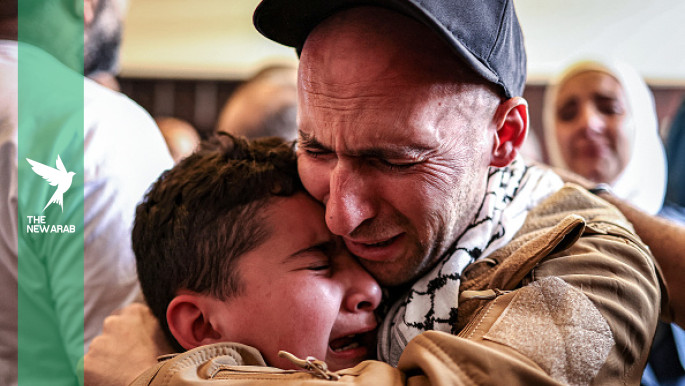
According to the latest figures issued by rights organisations cited in the statement, more than 9,600 Palestinians are held in Israeli prisons, including 86 women and about 350 children. [Getty]
The Red Ribbons campaign has called for broad public participation worldwide to mark Palestinian Prisoners Day, which falls on 17 April each year.
It urged activation of the extended weekend between 17 and 19 April through events in streets, public squares and city centres across the world. The aim, it said, is to expand the popular and rights-based visibility of the Palestinian prisoners’ issue and increase international pressure.
The call comes as thousands of Palestinian prisoners and hostages continue to be held in Israeli prisons, amid what the campaign describes as severe violations. These include torture, medical neglect and administrative detention, alongside escalatory policies and laws which it says form part of an ongoing apartheid system.
According to the latest figures issued by rights organisations cited in the statement, more than 9,600 Palestinians are held in Israeli prisons, including 86 women and about 350 children.
The figures also include 3,532 administrative detainees and 1,251 people classified as so-called “unlawful combatants”, as well as 326 prisoners who have died in custody, according to the same data.
The campaign said that 144 events have been documented so far in 19 countries across multiple continents. It said the level of mobilisation reflects growing international solidarity with Palestinian prisoners, but added that it remains insufficient and called for wider participation and more events.
Adnan Hamidan, coordinator of the Red Ribbons campaign, said symbolism plays an important role in conveying messages.
He said there is an urgent need to promote the red ribbon as a visible public symbol, worn and displayed in public spaces, to highlight Palestinian suffering and calls for freedom, as well as the situation of thousands of prisoners held in what he described as extremely harsh conditions.
In a separate interview with The New Arab, Hamidan said the current mobilisation cannot be reduced to passing sympathy. He said it reflects a broader global movement driven by Israeli policies.
“Israeli arrogance and racist laws that threaten execution and seek to turn prisons into closed and isolated spaces by preventing access for the Red Cross have all contributed to growing global awareness of the issue,” he said.
Hamidan added that the current momentum is the result of both the perceived legitimacy of the cause and coordinated campaigning that has moved the issue from streets to parliaments and rights platforms.
He said the movement is no longer limited to symbolic appeals, but is now shaping a wider political and legal narrative that goes beyond victimhood and focuses on enforceable rights.
He said the core issue is breaking the isolation imposed on prisoners, adding that key demands include stopping the execution law and allowing the Red Cross access to prisons. He said meeting these demands would turn demonstrations into a form of political pressure.
Hamidan also said pressure in major capitals should not remain at the level of appeals. He said governments must be held accountable for what he described as moral and political complicity, particularly regarding the absence of Red Cross access.
He further noted that images of detained doctors and isolated children place Western governments under scrutiny, challenging their claims to uphold human rights and democratic values.
“Moving out of the circle of symbolism requires cumulative action until every street is filled with slogans, every international institution is confronted with facts, and every lawmaker is pressed with questions,” he said.
“Sustained movements combining street protest with legal and institutional work are best placed to turn Palestinian Prisoners Day into a long-term campaign capable of forcing political change,” he added.
The secretary-general of the Palestinian National Initiative, Mustafa Barghouti, noted that describing Palestinian prisoners as “hostages” is the most accurate term. He said they are held without consent and subjected to military trials that lack basic standards of justice, as well as repeated administrative detention without charge or trial.
He said this amounts to a clear violation of international law by what he described as an occupation authority acting without legitimacy.
The Red Ribbons campaign said its call is not limited to moral solidarity but also seeks to create a visible public presence through red ribbons as a symbol of support.
It urged participants to carry images of prisoners and hostages and to share and document events using the hashtags #FreePalHostages and #FreedomforPrisoners.
The campaign also stressed the importance of continuing public awareness of figures and information related to the issue, based on data from relevant rights organisations.
It concluded that “freedom is a right for every prisoner and justice is a right for every family”, renewing its call for an end to occupation and what it described as an apartheid system.
Article translated from Arabic by Afrah Almatwari. To read the original, click here.