
The Independent National Electoral Commission (INEC) has said that failure by the Bimodal Voter Accreditation System (BVAS) machines to transmit results from some polling units will not halt the collation of election results in 2027.
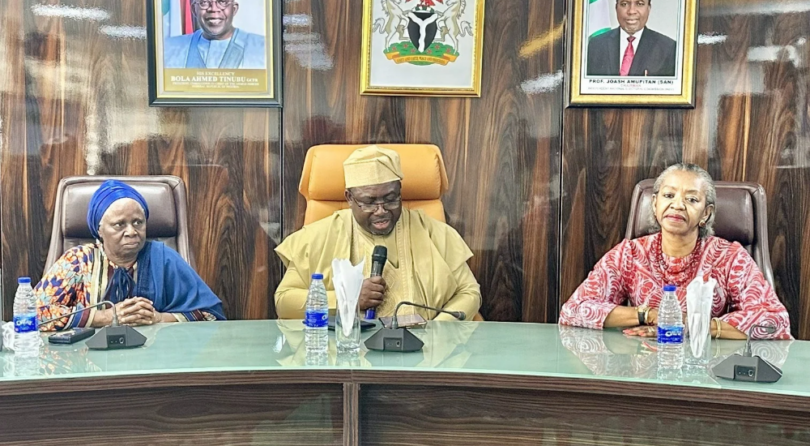
INEC Chairman, Prof. Joash Amupitan, disclosed this on Tuesday during a question-and-answer session at the commission’s world press conference and stakeholders meeting, monitored by THE WHISTLER.
Amupitan was responding to concerns over the possible recurrence of the technical problems that affected the transmission of polling-unit results to the INEC Result Viewing Portal (IReV) during the 2023 general elections.
He said the commission was upgrading both BVAS and IReV to ensure optimal performance ahead of the 2027 elections, adding that it had acquired 57,000 additional BVAS devices.
“When we’re talking about technology upgrades, I told you that we are doing some work with regard to our BVAS and also our IReV to ensure optimal performance. It is not possible for BVAS to fail everywhere. We are doing everything possible; that is why we have even acquired an additional 57,000 BVAS, as well as inbuilt batteries,” said Amupitan.
The INEC chairman said the commission was also replacing many of the existing inbuilt batteries to address problems that could affect result transmission.
“We are changing most of the inbuilt batteries to ensure that we don’t have any issues relating to the transmission of the results,” he said.
According to Amupitan, a transmission failure affecting a particular polling unit or group of polling units would not stop voting and other electoral activities from continuing elsewhere.
“But if for any reason there is an inability to transmit from a particular polling unit or from a group of polling units, that will not stop the election from continuing in other places. But it is at the end of it all that you now determine the number of those that are involved,” he said.
He said that where the affected polling units did not alter the outcome of an election, transmission failures would not prevent collation from proceeding.
“And if they do not affect the result of the election, that will not stop the collation. However, efforts will be made,” he added.
Amupitan stressed that the Electoral Act provides for an election to be postponed in an affected polling unit where BVAS fails and the problem cannot be resolved.
“Even under the Electoral Act, if the BVAS doesn’t work, the election will be postponed in that particular polling unit until the following day,” he stated.
According to Amupitan, INEC had also strengthened its technical support structure through its Registration Area Technical Support (RATECH) teams, which would intervene when problems occur at polling units.
“And we have protocols and procedures through our RATECH (Registration Area Technical Support) to immediately intervene. So we have a lot of supporting BVAS with the RACTECH that will be able to intervene whenever there is any problem. And a very strong communication channel is maintained between the RACTECH and the polling units.
“So that problem will be solved. But if for any reason it cannot be solved, the election can be shifted to the following day,” he said.
The assurance comes against the backdrop of the controversy surrounding the failure of IReV to upload presidential polling-unit results in real time during the February 25, 2023 presidential election.
INEC’s post-election report acknowledged that the failure to upload the presidential results in real time became a major challenge and attracted widespread criticism.
The commission attributed the problem to technical issues, including a configuration and mapping error that affected the upload of presidential results, a surge in queued uploads and BVAS devices that were switched off or disconnected after presiding officers left polling units.
The failure fuelled allegations of manipulation by opposition parties and intensified public concerns over the credibility of the results transmission process.
The EU Election Observation Mission and other observers also identified the failure of real-time transmission as a key weakness that increased the risk of manipulation and damaged confidence in the electoral process.
The issue also featured in the legal challenges to the 2023 presidential election but at the tribunal and Supreme Court.
The Presidential Election Petition Tribunal and the Supreme Court held that IReV was a public viewing platform and not part of the statutory collation process. The courts also held that petitioners had to establish that non-compliance substantially affected the election outcome.
Meanwhile, INEC, on Tuesday, announced that it had acquired 57,000 new BVAS devices as part of preparations for the 2027 general elections.
Speaking at a workshop organised by the Nigerian Guild of Editors in collaboration with INEC in Abuja on Monday, the chairman said the new devices are part of hardware and software upgrades intended to improve electoral technology.
“We have undergone extensive software hardening, battery optimisation and biometric calibration to prevent accreditation bypass and eliminate manual manipulation.
“We are acquiring 57,000 new BVAS for optimal performance, some of which have already arrived,” he said.
Amupitan also said INEC had improved its result management system through the eEC8A system, which he said would ensure polling-unit result sheets are digitised, authenticated and uploaded directly to IReV.
“Building on successful deployments in recent off-cycle elections, our enhanced eEC8A system ensures that polling unit result sheets are digitised, cryptographically authenticated and uploaded directly to the INEC Result Viewing Portal (IReV),” he said.
He said verification would take place at the polling unit before results are uploaded.
“What we have done through this eEC8A system is that verification must take place at the polling unit so that if you cannot reconcile, the result will not even go to IReV.
“We want to ensure whatever goes to IReV, which is a public trust, will have been verified by the presiding officer and all party agents present.”
The commission also plans to deploy AI-driven anomaly detection tools to monitor database traffic and protect its public portals against cyber intrusions and unauthorised alterations, according to Amupitan.