The forum resolved to take the message of the adoption of President Tinubu to all 36 states of the federation and the FCT.
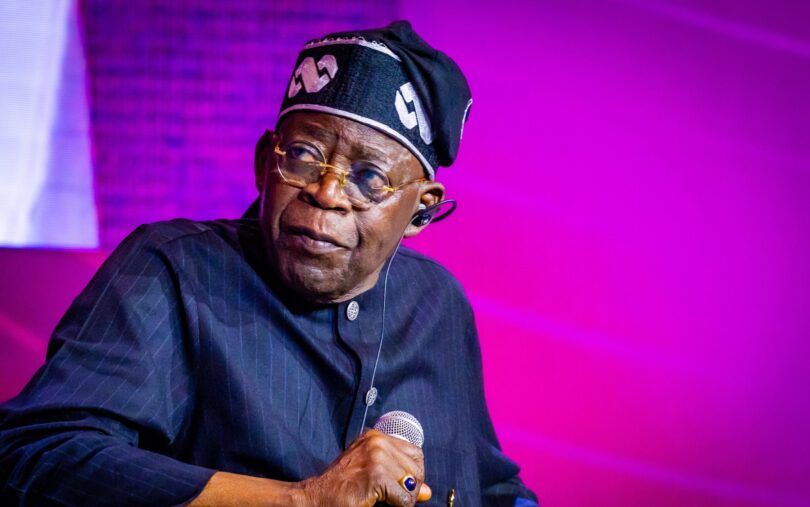
Former Presiding Officers of State Houses of Assembly in Nigeria (FOPSHAN) have reiterated their support for the re-election of President Bola Tinubu in 2027
Members of the forum, however, resolved that their removal of the subsidy was a bold step aimed at driving sustainable development and long-term growth.
They vowed to mobilise over 11 million votes for Tinubu in the 2027 presidential election.
They also reaffirmed their alignment with key national adjustments, including the establishment of state police, regional development commissions, and local government autonomy.
In a motion read by FOPSHAN National Secretary Matog Dogara, all members adopted a motion urging President Tinubu to be allowed to continue leading the country for a second term.
”The forum of All Progressive Conference (APC), former presiding officers of state councils of assembly in Nigeria, the summit resolved as follows: one, endorsement of Renewed Hope Agenda, a motion that fully endorses the bold economic reforms of President Tinubu’s administration, particularly the removal of oil subsidiaries.
”The forum resolved to take the message of the summit to all the 36 states of the Federation, including the Federal Capital Territory (FCT),” he said.
The forum also endorsed the First Lady, Oluremi Tinubu, as the FOPSHAN grand patron.
Earlier, a former Senate President, Pius Anyim, in his remarks as chairman of the occasion, declared that President Bola Ahmed Tinubu is “not a politician of today” but a statesman taking difficult decisions to secure Nigeria’s future.
He said President Tinubu is thinking beyond the next election and “planting” reforms for the next generation.
He defended the administration’s reform agenda, including the removal of petrol subsidies, student loans, and the proposed state police initiative.
According to the former Senate president, reforms are rarely popular when they are introduced because their benefits are often realised long after the immediate pain of implementation.
“I rarely talk about iconic leaders. I would rather observe them because most of the time they are not defined by the projects they do. They are rather defined by their vision and reforms to implement.”
He argued that reforms become necessary when societies reach a critical point that requires fundamental political, social, and economic changes, adding that only courageous leaders are willing to make decisions whose benefits may not be immediately apparent.
“Reforms at every time have never always been very popular, but only courageous leaders who are not thinking about today but tomorrow actually embark on reforms.”
Mr Anyim said his assessment of President Tinubu’s political trajectory had convinced him that the President was looking beyond immediate political considerations.
Former Plateau State Governor and former Speaker of the Plateau State House of Assembly, Simon Lalong, in his presentation, acknowledged the economic difficulties generated by the reform programme but said Nigeria needed to move from macroeconomic stabilisation to shared prosperity.
Mr Lalong, a serving Senator, examined the removal of the petrol subsidy, foreign-exchange reforms, fiscal consolidation, debt management, revenue generation, and tax reforms as key components of the administration’s economic programme.
He noted that the removal of subsidies had increased transportation and living costs, placing considerable pressure on households and businesses. Still, he argued that addressing the issue had been postponed for years by previous governments.
The former governor said assessments by the World Bank indicated progress towards macroeconomic stability, while poverty remained high and household incomes had yet to recover fully.
He therefore stressed that macroeconomic gains would need to translate into tangible improvements in Nigerians’ lives.
Mr Lalong identified infrastructure, agriculture, human capital development, security, social protection and youth opportunities as critical to achieving that transition.
He called for sustained investment in roads and bridges, while insisting that infrastructure projects must be delivered to a high standard and represent good value for money.
A former Speaker of the Bayelsa State House of Assembly and current Minister of State for Petroleum, Heineken Lokpobiri, commended President Tinubu for taking the bold step of removing the subsidy, adding that it was a huge advantage to the nation’s economy.
”It will be important that you take this message home that before Mr President came into office in 2023, there was no investment in Nigeria in the petroleum sector; it was zero investment for over a decade.
”Some people may attribute it to the delay in the passage of the Petroleum Industry Act, but that is not the only reason; some of the reasons were that people were not sure whether Nigeria was a very stable and predictable destination for investments to come,” he said.
The National Chairman of the forum, Wasiu Eshilokun, said the gathering was intended to provide an avenue for experienced legislators to examine the consequences of major policy decisions and contribute to national development.
He said the removal of fuel subsidy, changes in federal allocation and efforts to strengthen local government financial autonomy had generated significant national debate.
“These are consequential decisions which immediately affect citizens and institutions, and they therefore deserve thoughtful, honest and constructive engagement.”
Mr Eshilokun said the success of reforms would ultimately depend on the quality of implementation, the strength of institutions and the extent to which Nigerians experienced their impact.
He urged participants to identify unintended consequences and areas requiring improvement rather than merely reflecting on government policies.
He also called for stronger collaboration among the three tiers of government, saying increased public revenue should be reflected in responsible governance and improved public services.
Ebonyi State Governor and Chairman of the Board of Trustees of the Forum, Francis Nwifuru, in his address, stressed the importance of cooperation between the executive and legislature, drawing on his experience as a former speaker.
“Those years taught me an enduring lesson. Governance is not the responsibility of the executive alone; it is a partnership between institutions,” Mr Nwifuru, a former Speaker of the Ebonyi State House of Assembly, said.
Speaking at the occasion, the First Lady, Mrs Tinubu, who was the guest of honour, said Nigeria still needs the wisdom, experience, and networks of the former presiding officers.