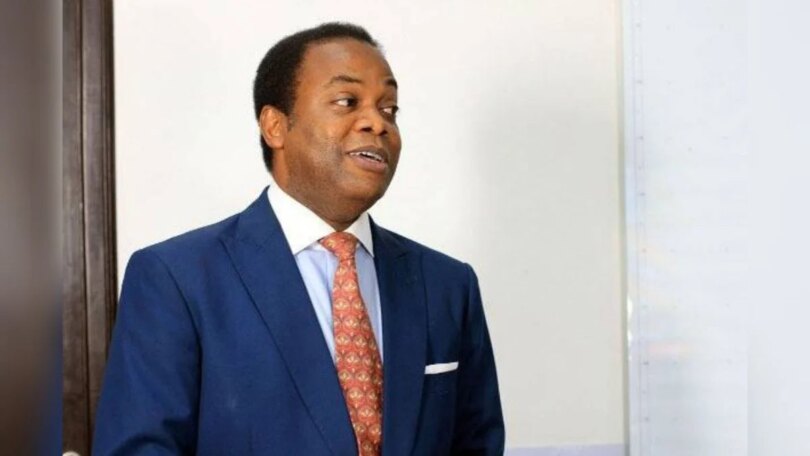
The presidential candidate of the Peoples Redemption Party (PRP), Donald Duke, has pledged to support whichever candidate emerges from the ongoing opposition coalition talks ahead of the 2027 general elections.
Duke, a former governor of Cross River state, made the commitment on Monday at the G100 Summit of Nigeria’s Opposition Political Parties held at the Shehu Musa Yar’Adua Centre in Abuja.
He said his commitment to the opposition unity process was not dependent on whether the eventual outcome favoured his political ambition, stressing that the broader interest of Nigerians should take precedence.
“We will support any political party that emerges in 2027. Whatever decision is arrived at today, I will not walk away but will strive all along because that’s what the people want to see,” Duke said.
The summit, organised by the G100 in partnership with the Minority Caucus of the House of Representatives, brought together representatives of six opposition parties — the African Democratic Congress (ADC), Allied Peoples Movement (APM), Nigeria Democratic Congress (NDC), Peoples Democratic Party (PDP), Peoples Redemption Party (PRP) and Social Democratic Party (SDP).
In his opening remarks on behalf of the G100, Salihu Lukman said opposition parties collectively obtained about 13 million votes in 2023 but lost the election because those votes were spread among different candidates.
“Nobody stole thirteen million votes. We divided them ourselves, in public, and we did it knowing exactly what the consequence would be,” Lukman said.
He urged opposition leaders to draw lessons from the alliance that preceded the 2015 presidential election, when opposition parties negotiated a framework for cooperation before deciding who would emerge as their candidate.
According to Lukman, the critical lesson from the 2015 experience was the need to establish rules for cooperation before individual interests and positions were negotiated.
“What they had was not affection. What they had was sequence. They agreed on the rules before they knew the outcome,” he said.
Lukman said consultations with the six opposition parties had shown that their leaders recognised the danger of division but had yet to create a structure through which their competing interests could be negotiated.
“What has been missing is not analysis. It is a table,” he said.
He stressed that the summit was not demanding the dissolution of political parties or the immediate withdrawal of presidential candidates.
“It is not asking any party to dissolve. It is not asking any party to disappear into another party. It is not asking any candidate to stand down this morning,” Lukman said.
Rather, he said the initiative sought approval for a structured process through which the parties could negotiate their interests and develop a common political framework.
The proposed arrangement includes a Central Leadership Committee, Publicity and Communication Committee, and Legal Committee, alongside five working groups mandated to prepare documents on democratic renewal, a proposed four-year transition, national reforms, opposition unity and the emergence of a common presidential candidate.
Lukman said the working groups were expected to complete their assignments within four weeks ahead of another summit where the proposals would be considered.
He said the proposed coalition would pursue a “Government of National Competence” and a four-year National Reset Programme supported by an enforceable Transition Charter.
The G100 facilitator, however, warned that the coalition would only succeed if opposition politicians were prepared to sacrifice personal ambitions and accept outcomes that might not favour them.
“There is no version of this that costs nobody anything. Someone in this hall will have to accept an outcome he/she did not want. That is what unity is. It is not a communiqué. It is somebody’s disappointment, borne well,” he said.
Lukman said the ultimate objective was to give Nigerians a credible alternative to the ruling party in 2027, arguing that democracy requires more than periodic elections.
“Our only interest is the one stated in the Doctrine we published on August 2: that a democracy is sustained not merely by holding elections, but by the credible possibility of an alternative government,” he said.
“Today, that possibility is in this room. It is in nobody else’s hands.”
Also speaking, minority Leader of the House of Representatives, Fredrick Agbedi, called on opposition leaders to subordinate personal ambitions to the national interest and work towards a common platform capable of defeating the All Progressives Congress (APC) in 2027.
Agbedi said the House Minority Caucus partnered with the G100 because of the need to consolidate the opposition and prevent another election in which opposition votes would be split among multiple candidates.
“On behalf of the Minority Caucus of the House of Representatives, we decided that we partner with the G100 to see how the opposition parties can come together, streamline our ambitions, and ensure that we take this government out,” he said.
He added that the objective was not merely to remove the APC from power but to “salvage Nigeria”, which he said was facing severe challenges.
The lawmaker maintained that the Minority Caucus had no preferred candidate and was not backing any particular opposition politician.
“For us, like the G100 has said, there is no issue of preferred candidates, there is no issue of one we love more than the other, but that there is strength in unity,” Agbedi said.
He urged the opposition to reproduce the cooperation that enabled the then opposition parties to defeat the PDP in the 2015 presidential election.
“And if we are united, what the APC did in 2015, we can repeat it, we can do it. Some will say it’s late, but we feel it’s better late than never,” he said.
Agbedi cautioned opposition politicians against assuming that victory must follow every electoral contest, arguing that genuine commitment to the country would require some aspirants and their supporters to accept political sacrifices.
He also urged party members and political followers to pressure their leaders to participate personally in the coalition process.
The Minority Leader warned that opposition parties could once again squander their collective electoral strength by entering the 2027 contest with multiple candidates and subsequently returning to calculate the votes that could have secured victory if pooled together.
“So what will it benefit us when we are divided and scattered and we go into elections and we come back to collate the millions of votes we have divided amongst ourselves and could not give us victory?” he asked.
“It will be like an exercise in futility. And we pray that we shouldn’t, in 2027, go back to that.”
Agbedi further said opposition disunity had affected the effectiveness of the minority caucus in the National Assembly, urging political leaders to close ranks to strengthen their lawmakers.
He called on representatives attending the summit on behalf of their principals to communicate the urgency of the coalition effort and persuade their leaders to participate directly in subsequent meetings.
“We urge those who are here representing their Principals in House to speak to their Principals. Their faces are required in gatherings like this,” he said.
“We need to take this journey collectively so that at the end of the day, victory shall be our own,” he added.