
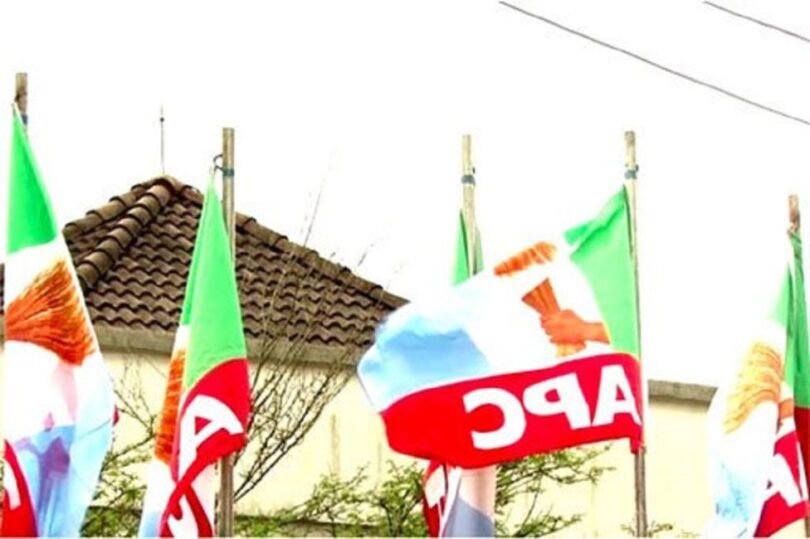
Ahead of the 2027 general elections, the Lagos State chapter of the All Progressives Congress (APC) has developed a strategy to secure five million votes out of an expected seven million votes in the state.
The strategy, tagged ‘Operation Man Your Polling Booth’, is also aimed at ensuring that influential presidential candidates, including former Vice President Atiku Abubakar of the African Democratic Congress (ADC) and former Anambra State governor Peter Obi of the Nigeria Democratic Congress (NDC), do not secure enough votes in Lagos.
According to figures from the Independent National Electoral Commission (INEC), Lagos has more than seven million registered voters, the highest in the country.
The APC plans to rely on coordinated grassroots mobilisation to achieve its target.
Speaking recently during the inauguration of the Tinubu-Hamzat campaign council at the party secretariat in Ikeja, the Lagos APC chairman, Cornelius Ojelabi, said the ruling party would adopt a decentralised grassroots strategy that would deploy APC leaders and members to senatorial districts, local government areas, wards and polling units.
He said the responsibility placed on APC members required clear lines of command, reporting and accountability throughout the campaign, adding that the strategy would be guided by the principle that all politics is local.
“Our emphasis this time will be more on ‘operation man your polling booth’. We are aware we have a total of 13,565 polling booths,” Ojelabi said.
“Our people need to get involved locally and mobilise to get voters to deliver.
“Our target is to get five million votes out of the projected seven million votes in Lagos state, and we will rely on coordinated grassroots mobilisation to achieve the objective.”
The Labour Party (LP) pulled off one of the biggest political upsets in Nigeria’s recent history in the 2023 presidential election when it defeated the APC in Lagos, the political stronghold of then APC presidential candidate Bola Tinubu.
Then LP candidate Obi polled 582,454 votes to defeat his closest challenger, Tinubu, who scored 572,606 votes. Atiku, who contested on the platform of the Peoples Democratic Party (PDP), came third with 75,750 votes.
A total of 1,347,152 voters were accredited for the election in Lagos, where Tinubu had exercised considerable political control and influence, having served as governor of the state from 1999 to 2007.
Although the APC won in 11 of the state’s 20 local government areas, Obi secured more votes overall and won the remaining nine local government areas.
The result was described by some political analysts as a significant setback for Tinubu in a state where he had exercised longstanding political influence. Tinubu, however, went on to win the presidential election nationally and was sworn in as president in May 2023.
With Atiku’s political profile and Obi’s continued influence, the Lagos APC appears unwilling to leave anything to chance ahead of 2027.
The party’s campaign council has been instructed to focus on facts, data, measurable achievements and direct engagement with voters.
Speaking with THE WHISTLER, a chieftain of the Lagos APC and spokesperson, Oluseye Oladejo, acknowledged the political weight of both Atiku and Obi, stressing that the APC could not approach 2027 with complacency.
He pointed to Obi’s victory in the presidential election in the state but noted that the APC now had a predetermined template for 2027 unlike in 2023.
“But it is equally important not to confuse the 2023 result with a predetermined template for 2027. Lagos has a large and politically sophisticated electorate, and voting patterns can change from one election to another. In 2023, for example, Obi won the presidential popular vote in Lagos, while Tinubu won more local government areas,” Oladejo said.
“The real question, therefore, is not whether five million votes can simply be declared into existence. The question is whether the APC can build the organisation, turnout and voter engagement necessary to approach that figure.
“That is where the current strategy becomes significant. The party is talking about polling-unit-level mobilisation, accountability and direct engagement rather than relying simply on the popularity of individual political leaders. The campaign has also been told to sell the records of the Tinubu and Sanwo-Olu administrations and to explain their policies and projects to voters with facts and measurable evidence.”
Oladejo said he would not underestimate either Atiku or Obi, adding that the APC’s five-million-vote target in Lagos was an ambitious but deliberately set mobilisation target, rather than an exercise in wishful thinking.
“As for Atiku and Obi, I would not underestimate either of them. Any serious political organisation must respect its opponents and understand their areas of influence. But influence is not the same thing as votes, and past performance is not an entitlement to future votes,” Oladejo told THE WHISTLER.
“Ultimately, Lagos voters will make their own decisions in 2027. The APC’s responsibility is to present its record, articulate what it intends to do next, organise effectively at the grassroots and persuade as many Lagosians as possible to support its candidates.
“So, five million is an ambitious target, but the credibility of that target will be determined by the work the APC does between now and election day-not by political rhetoric. The party has set the benchmark; the campaign organisation now has to do the hard work of converting mobilisation into actual voter turnout.
“And that is precisely why the Lagos APC is already telling its candidates and campaign structures that the 2027 election should be approached as a serious, full-time assignment rather than business as usual.”
As the general elections draw closer, Lagos remains a key battleground for the political gladiators. If the APC can help Tinubu secure even three million votes in Lagos and he wins at least 25 per cent of the votes cast in 23 additional states, it would significantly strengthen his chances of securing re-election.