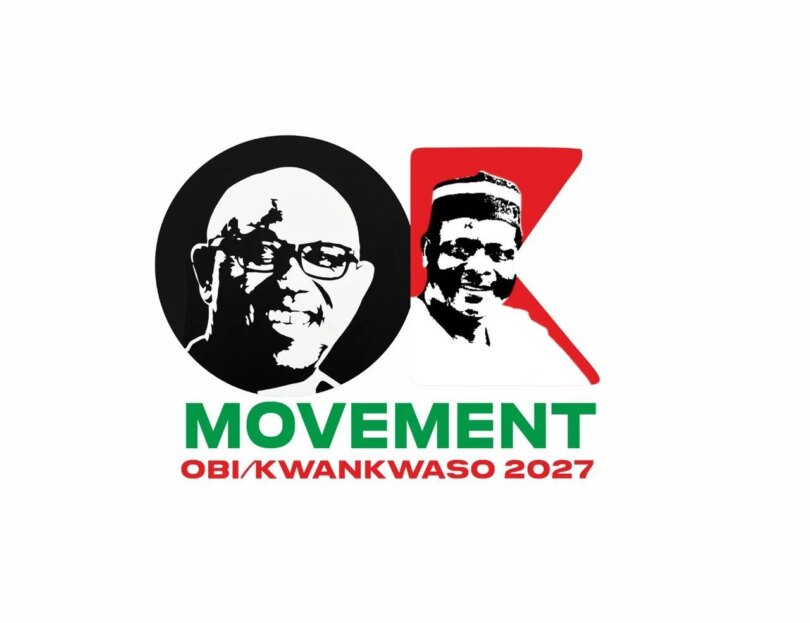
The Obi-Kwankwaso Movement, popularly known as the OK Movement, has rejected any attempt by the Nigeria Democratic Congress (NDC) to take control of its structures ahead of the 2027 general elections.
The movement said it would maintain its independent identity and would not allow its national, state, local government or ward structures to be absorbed into the NDC.
Its Director-General, John Ughulu, made the position known while responding to comments by the NDC National Leader, Senator Seriake Dickson, on the role of political support groups in the party’s preparations for the 2027 elections.
Dickson had criticised the decision of the OK Movement to establish a 59-member Presidential Campaign Council, arguing that support groups should assist political parties rather than create structures that compete with the official machinery of the party.
Speaking on Tuesday while receiving former Secretary to the Government of the Federation, Babachir Lawal, into the NDC, Dickson said support groups should concentrate on mobilisation and support for candidates.
“You have several support groups. Support groups don’t compete with the political party that is sponsoring candidates. Support groups don’t compete for supremacy, for space.
“Support groups are what they are, support groups. They don’t play the role of a political party. They don’t sponsor candidates. They provide grassroots support, mobilisation support,” he said.
The former Bayelsa State governor also questioned the decision by the OK Movement to establish its own presidential campaign council.
“None of them will dare say they are setting up a presidential campaign council. It’s unheard of. Nonsensical. And those who have a duty to educate and call people to order should do so,” Dickson said.
But Ughulu disagreed with the description of the OK Movement as an ordinary support group.
He maintained that the organisation was independently established and operated its own leadership and mobilisation structures.
According to him, the movement brings together people from different political backgrounds who are united by their support for Peter Obi and Rabiu Kwankwaso, the NDC presidential candidate and running mate ahead of the 2027 election.
“I strongly agree with the position expressed by Senator Seriake Dickson. However, there appears to be a missing link in the argument currently being advanced.
“If the Obidient Movement is regarded as a support movement, and if the Obidients and Kwankwasiyya have equally been described by Idris Zekeri, while claiming to speak on behalf of Peter Obi, as a support movement, then it becomes necessary to properly define the identity and status of the Obi-Kwankwaso Movement, popularly known as the OK Movement.”
“For the avoidance of doubt, the OK Movement is not a support group created as an appendage of any political party or another movement. It is independently organised, managed and structured through its own established movement mechanisms.”
Ughulu also rejected Dickson’s description of the movement’s campaign council as “nonsensical”.
He argued that the movement was not attempting to take over the responsibilities of the NDC.
“So it is not nonsensical as claimed by Seriake Dickson; rather, the national leader of the NDC Party should come to realise that politics has long evolved from the conventional political system he is used to.
“The OK Movement comprises individuals and members from different political parties who share a common commitment to the ideals, values and political aspirations represented by the presidential candidate, Peter Obi and his running mate, Senator Rabiu Kwankwaso,” he stated.
Ughulu said the movement would continue to mobilise support for Obi and Kwankwaso while maintaining its own internal administration.
“The OK Movement remains an independent organisation. Its existence and internal administration are not subject to the internal management of the NDC.
“The OK Movement will not be collapsed, merged or subsumed into the NDC or any other organisation. Cooperation and political alignment do not extinguish the independent identity of the Movement,” he said.
He further insisted that the movement would retain control of the structures it had built across the country.
“Our organisational structure remains the property and responsibility of the OK Movement. We will not surrender our established national, state, local government and ward structures to any political party or external support group for management,” he said.
The disagreement between the two sides follows a series of exchanges over the 59-member Presidential Campaign Council unveiled by the OK Movement on September 17.
The council was presented as part of the movement’s mobilisation efforts for Obi and Kwankwaso ahead of the 2027 election.
However, the NDC quickly distanced itself from the announcement.
National Chairman of the party, Senator Moses Cleopas, said the structure did not originate from the party and was not authorised by its National Working Committee.
The NDC warned that no individual, candidate or support group could establish a campaign structure in the name of the party without the approval of its leadership.
Cleopas also referred Ughulu to the appropriate disciplinary organ of the party over what the NDC described as his conduct during the Lagos State primary and his alleged disregard for party authority.
The move prompted another response from the OK Movement.
Its National Secretary, Saadatu Sani, demanded an apology from the NDC chairman and insisted that the movement was not an appendage of the party.
Sani said the movement would support NDC candidates but would continue to retain its independent structure and decision-making process.
She also said the movement had built a nationwide grassroots network, claiming that its internal database contained about 2.5 million registered members and coordinators.