
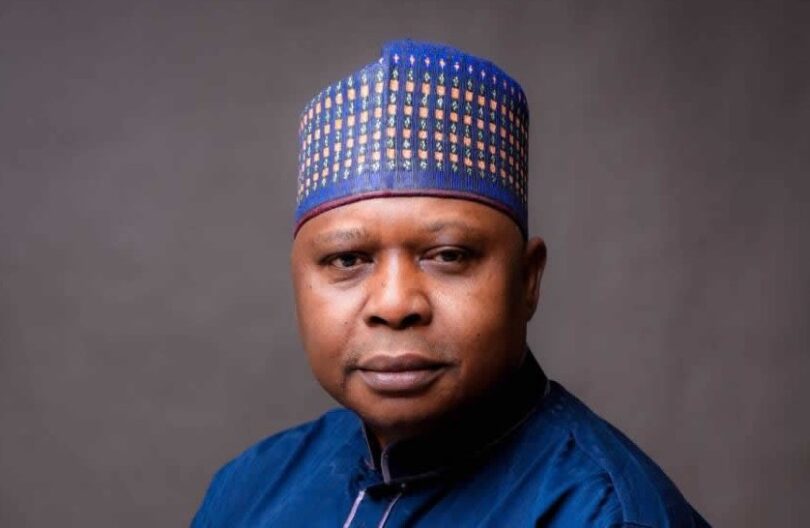
The faction urged Nigerians to reject attempts by politicians to influence their votes with food items or cash.
A faction of the Peoples Democratic Party (PDP), led by former Minister of Special Duties and Inter-Governmental Affairs, Kabiru Turaki, has cautioned Nigerians against exchanging their votes for money, rice, spaghetti, and other material inducements during elections.
He advised caution at the second Bala Mohammed Colloquium in Bauchi, marking the 68th birthday of Bauchi State Governor, Bala Mohammed.
The factional chairman said the quality of leaders produced by elections largely depends on voters’ choices, warning that accepting inducements or refusing to vote could contribute to poor leadership.
“It is often said that a country has the leaders it deserves. That is true because they don’t become leaders except when we choose them or acquiesce to their emergence. Some actively vote for bad leaders, while others refuse to vote at all, thereby still allowing bad leadership to emerge.
“We must not vote in exchange for spaghetti, rice, money or any other inducements. We must vote according to the capacity of the candidates to offer quality representation and contribute to national development,” he said.
He said Nigeria had in the past produced legislators who provided effective and responsible representation, contrasting that with what he described as the current “rubber stamp legislature.”
Mr Turaki said a weak legislature harms democracy because it cannot effectively check the executive.
“In the past we had leaders, especially legislators, who offered effective and responsible representation of their people, which contrasts with the rubber stamp legislature that we now have.
“A weak legislature is not good for our country, as there will be no effective checks and balances. I commend the organisers of this event for providing an opportunity for the meeting of minds to x-ray the past and plan the future.”
He also called for young people’s participation in politics and governance, arguing that youths should be involved in decision-making rather than treated merely as campaign statistics or election-day voters.
“Young people must be consciously engaged in the process of politics and governance, as integral parts of the process, and not just as a decoration, or a statistic to look good. We must stop saying that youths are the leaders of tomorrow; when will that tomorrow come? Young people are the greatest stakeholders of the future, and that future cannot be discussed or planned in their absence.”
He commended Governor Mohammed for his commitment to youth inclusion in his administration.
“I thank Governor Bala Mohammed for making youth inclusion a priority of his administration, which is even obvious in the choice of his preferred successor. We cannot keep leaving the owners of the future out of the room when we are planning the future.”
The warning comes against the backdrop of vote buying in Nigeria, where politicians offer cash, food items, and other material inducements to voters before and during elections.
Rice, cooking oil, spaghetti, and other food items have frequently been distributed during election campaigns and at polling units, particularly in communities facing economic hardship. Cash payments have also been used to persuade voters to support particular candidates or parties.
The practice has raised concerns among electoral observers and civil society organisations because it can undermine voters’ ability to make independent choices and distort the electoral process.
Nigeria’s electoral laws prohibit voter inducement; the Electoral Act criminalises giving or receiving money or other valuable consideration to influence a person’s vote. Despite these provisions, vote buying has remained a recurring feature of elections, with observers reporting cash and material inducements during recent electoral cycles.
The persistence of the practice has also been linked to poverty and economic hardship, which can make voters more vulnerable to immediate financial or material incentives offered by politicians.