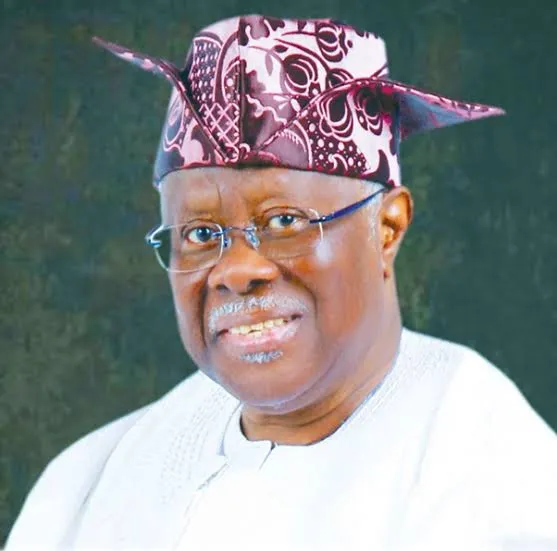
Former Deputy National Chairman of the Peoples Democratic Party, PDP, Chief Olabode George, says the party will decide its direction for 2027 after the Supreme Court delivers judgment on its leadership dispute.
Mr George, a former Military Administrator of Ondo State and member of the PDP Board of Trustees, BoT, said this in an interview with the News Agency of Nigeria on Sunday in Lagos.
The elder statesman, who turned 81 on Nov. 21, said he remained hopeful that the Supreme Court would correct what he described as an imbalance in the party’s leadership dispute.
Mr George, who supports the Dr Kabiru Turaki-led interim PDP National Working Committee, NWC, said the party was seeking an opportunity to present its own candidate and participate in the 2027 presidential election.
“I am asking the Supreme Court to give us a hearing. After that, we will decide our next line of action.
“If the Supreme Court eventually delivers a judgment against our party, we may be forced to conclude that the entire judiciary requires medical attention.
“What exactly is our offence? What have we done wrong? We are waiting for justice because I have experienced a similar situation before,” he said.
Mr George said the party would not resort to violence or encourage its supporters to engage in confrontation, irrespective of the Supreme Court’s eventual decision.
“What I want to tell our supporters is that there should be no fighting. I plead with them to remain calm and peaceful.
“If we are denied the opportunity to present a candidate and participate in the contest, that will not be the end of the world. Life will go on.
“However, this will be recorded in the pages of history because it will be the first time that the largest political party, with structures and presence across the country, will allegedly be prevented from participating in an election,” he said.
The former PDP chieftain urged political stakeholders to embrace competition, saying democracy required allowing all parties and candidates to test their popularity before the electorate.
“What will happen in the future, I cannot say. But everyone should be allowed to compete. Even the U.S President Donald Trump went around campaigning and seeking votes in the last midterm elections.
“He (Trump) believed in himself and presented himself to the electorate, but the people ultimately had their say.
“That is democracy and good governance. You cannot win all the time. If God says we will continue, we will continue.
“If they tell us to go home, we will return to our offices, not abandon our political activities. That is the position we are communicating to ourselves and our Board of Trustees,” he said.
George recalled his previous legal experience, saying an unfavourable judgment by lower courts did not necessarily mean that justice would not eventually prevail at the Supreme Court.
“You will recall when I had a case at the NPA. The first judge found me guilty. I proceeded to the Court of Appeal, which also found me guilty. But when the matter got to the Supreme Court, the entire judgment was torn to shreds.
“You see, every judgment of the Supreme Court becomes a precedent. People will continue to quote and refer to the names of the judges who delivered such judgments. That is why the decision is very important.
“We therefore hope that the Supreme Court will correct the imbalance,” he said.