
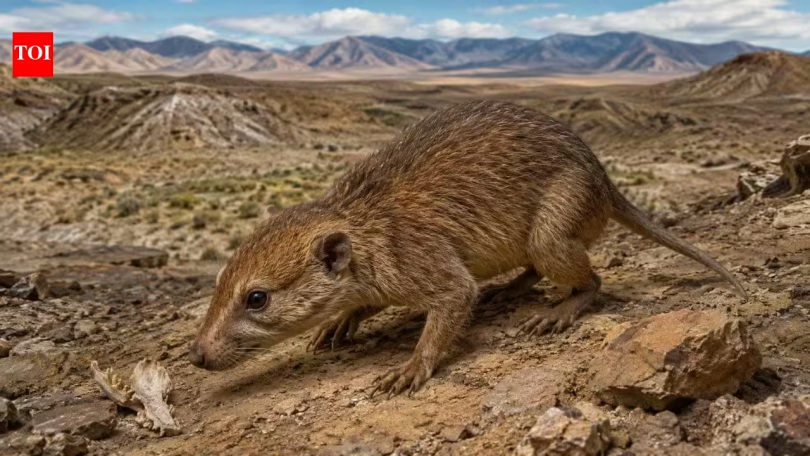
The fossil record has a habit of reshaping ideas that once seemed settled. In the Late Cretaceous, long before the extinction of the dinosaurs, small mammals occupied a world dominated by much larger reptiles. Most left behind little more than isolated teeth and fragments of bone, making it difficult to understand how they were related to one another. A newly described specimen from Mongolia’s Gobi Desert has changed that picture. About 6 inches (roughly 15 centimetres) long, the animal looked broadly rabbit-like in its proportions, yet its ancestry tells a different story. According to a new study published in Nature, titled “Cretaceous zhelestid mammals are zalambdalestoids”, the remarkably complete fossil suggests that this tiny mammal belonged to a separate branch of early mammalian evolution rather than being closely linked to the ancestors of modern placental mammals.
70-million-year-old Tamirkhan balcarceli fossil solves the mystery of zhelestid mammals
The new species, Tamirkhan balcarceli, is unusual because its skull, teeth and parts of its hind limbs all belong to the same individual. According to the study, that combination has never before been available for a member of the group known as zhelestids, whose classification has puzzled palaeontologists for nearly four decades. Earlier discoveries largely consisted of isolated teeth, leaving scientists to infer the rest of the animal’s anatomy.Those teeth created much of the confusion. Their rounded shape resembled the grinding molars seen in later plant-eating placental mammals, leading many researchers to suggest that zhelestids represented an early radiation close to the lineage that eventually gave rise to familiar mammals such as hoofed species. The newly discovered skeleton allowed those assumptions to be tested directly instead of relying on dental evidence alone.
New fossil shows zhelestids were not early placental mammals
Once the complete anatomy was examined, a different pattern emerged. While the molars matched those traditionally associated with Zhelestids, the rest of the animal displayed features characteristic of Zalambdalestoidea, an extinct group of small Cretaceous mammals. These included distinctive lower incisors, specialised openings in the skull known as translacrimal canals, and elongated fused bones in the hind feet that point to an animal adapted for fast running.Rather than representing a primitive placental mammal with unusually advanced teeth, the fossil indicates that zhelestids were actually members of the zalambdalestoid branch that independently evolved similar molars. In evolutionary biology, this kind of resemblance is known as convergent evolution, where unrelated groups develop comparable features because they adapt to similar ecological pressures instead of sharing a recent common ancestor.
Tamirkhan balcarceli was a tiny, fast-running mammal that lived with dinosaurs
Although it lived alongside dinosaurs around 70 million years ago, Tamirkhan balcarceli was a very small mammal. Measuring only about 15 centimetres from nose to tail base, it has often been described as rabbit-like because of its long hind limbs and lightly built body, though it was not an ancestor of rabbits. Its elongated feet and fused lower leg bones suggest a cursorial lifestyle, meaning it was adapted for rapid movement across the ground. That would have been useful in the Cretaceous landscapes of what is now Mongolia, where small mammals had to avoid predators while searching for food.Its teeth also hint that diet among these early mammals was becoming more varied than previously assumed. Rounded molars generally perform better at crushing and grinding than the sharp insect-eating teeth common in many earlier mammals, although the study focuses primarily on what those teeth reveal about evolutionary relationships rather than providing direct evidence of its exact diet.
New fossil rewrites the evolutionary history of zhelestid mammals
The significance of the fossil extends well beyond a single species. For years, zhelestids occupied an uncertain position on the mammalian family tree because scientists had only fragments to work with. The new specimen links their distinctive teeth with the rest of the skeleton for the first time, allowing researchers to place the group with greater confidence.The evidence indicates that zhelestids are not early placental mammals after all. Instead, they represent a specialised dental form within the zalambdalestoid lineage, a branch that disappeared before the rise of today’s placental mammals. That revised placement changes how palaeontologists interpret mammalian diversity during the Late Cretaceous and suggests that similar-looking teeth evolved independently in separate evolutionary groups rather than marking a direct path towards modern mammals.