
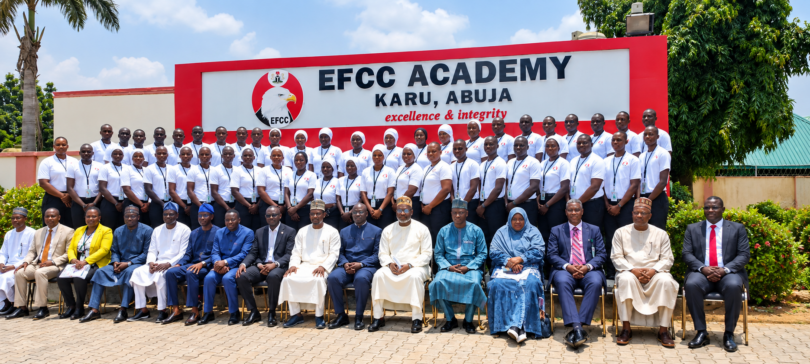
CCB chairperson asked the candidates to protect the confidentiality of declarations and files, reject gifts or favours that could compromise their duties, and conduct thorough investigations.
Ninety-four newly recruited officers of the Code of Conduct Bureau (CCB) have graudated from the Academy of the Economic and Financial Crimes Commission (EFCC) after receiving training in basic investigation and enforcement.
At the ceremony, CCB Chairman Abdullahi Bello announced the results of the assessment conducted during the training.
He said 94 officers completed the assessment. While 32 officers scored 80 per cent and above, 50 scored 70 per cent and above. “Three officers scored 90 per cent and above,” Mr Bello said. But he did not provide the range of the scores of the remaining nine out of the 94 candidates who completed the assessments.
Mr Bello, who also indicated that a total of 102 new CCB recruits undertook the training, was also silent on what became of the eight candidates who did not complete the assessments.
He described the four-week ‘Basic Investigation and Enforcement Training’ as historic because it marked the first time the CCB had sent a full set of newly recruited officers to the academy for training in investigation and enforcement.
He said the training was necessary because the bureau’s constitutional mandate required officers who could investigate, examine and enforce the Code of Conduct for Public Officers while maintaining personal integrity.
The chairperson reminded the graduates that the completion of the course marked the beginning of their “responsibilities rather than the end of their training.”
He added that Nigeria needed officers who would perform their duties without fear or favour.
He therefore warned the officers that some subjects of investigations could attempt to compromise them through intimidation, gifts or promises.
He instructed them to protect the confidentiality of declarations and files, reject gifts or favours that could compromise their duties, and conduct thorough investigations.
“Unauthorised disclosure is not carelessness; it is an offence,” he said.
He therefore charged the new officers to go and serve “with integrity. Serve with courage. Serve Nigeria.”
Also speaking at the closing ceremony, the EFCC chairperson, Ola Olukoyede, also listed some of the principles the officers should abide by as including professionalism.
“You don’t give what you don’t have,” he said, while encouraging them to pursue excellence and discipline in the way they performed their duties and presented themselves.
He said courage would be essential because the officers would have to take difficult decisions in the course of their work.
According to him, some decisions could put them under pressure, so they must be prepared to “stand by difficult decisions when necessary.”
He also told them that without integrity, they had nothing.
“You must learn to say no to corrupt practices,” he said, warning that officers who compromised themselves would eventually be exposed.
“And so be careful. Do your job diligently,” the EFCC chairman said.
Mr Olukoyede congratulated the officers and welcomed them to what he described as “the world of challenges” and “the world of battle.”
Similarly, Rotimi Oyedepo, a Senior Advocate of Nigeria (SAN) and Director of Public Prosecutions of the Federation (DPPF) who represented the Attorney-General of the Federation, Lateef Fagbemi, also urged the new officers not to compromise their integrity.
He said the officers were joining the public service at a time when concerns about the moral standards of public servants were growing.
He referred to a situation “where a public servant of Grade Level 8 can no longer explain the source of his income,” but noted that the main question was: “Will you compromise? Will you betray Nigeria? Nigeria is in need of you.”
He expressed hope that the lessons from the training would remain with the officers as they begin their careers.
Suleiman Haruna, who represented the Minister of Information and National Orientation, Mohammed Malagi, told the graduating officers that their newly acquired skills must translate into professional conduct and effective performance.
He stressed that the work of CCB officers could directly affect public confidence in government.
He described the fight against corruption as a shared responsibility involving government institutions, the media, civil society, professional bodies and citizens.
The representative said the CCB occupied an important position in Nigeria’s governance structure because of its constitutional responsibility to promote high standards of conduct in public office and enforce the Code of Conduct for public officers.
Mr Haruna therefore agreed that the training in investigation and enforcement, alongside the emphasis on discipline, integrity, professionalism, confidentiality and respect for the law, was important to “public confidence in government institutions.”