
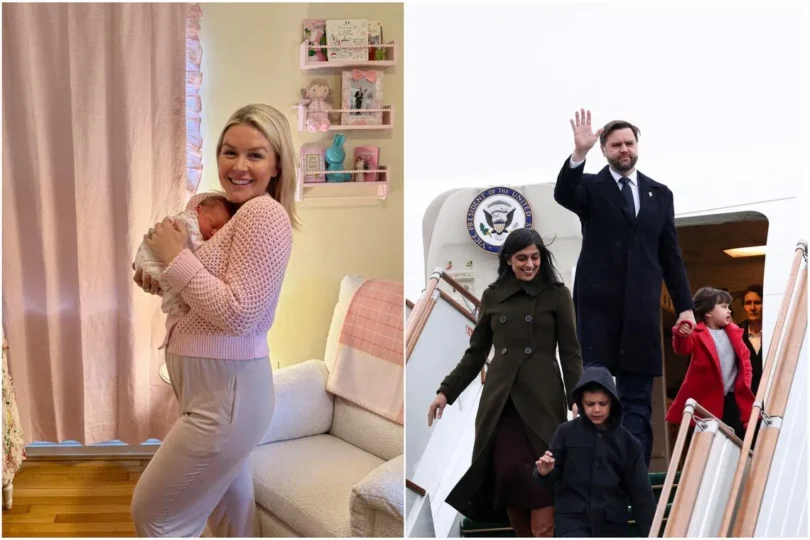
PHILADELPHIA – Baby Viviana was the first to arrive on May 1, a pleasant spring day in Washington, D.C. The birth of White House Press Secretary Karoline Leavitt’s daughter heralded a baby boom within the Trump administration.
The new arrival helped Ms Leavitt, already the mother of a toddler and essaying one of the country’s most public roles, make a bit of history. The 28-year-old became the first White House press secretary to give birth while in the job.
Next, it will be Mrs Usha Vance’s turn to make a splash in July when she becomes the first Second Lady to give birth while her husband is in office.
Vice-President J.D. Vance has presented the pregnancy as proof that he “practices what he preaches” when it comes to boosting birthrates; it will be their fourth child.
Also expanding his family is Mr Steven Miller, President Donald Trump’s deputy chief of staff who masterminded his controversial immigration policy. His wife, podcaster Katie Miller, has not revealed the due date but is soon expected to deliver their fourth child.
Other prominent Republicans are also doing their bit about the country’s falling birth rates, which have been below replacement level for the last 20 years.
Mr Vivek Ramaswamy had his third child, a girl, in February in the middle of his campaign to be Ohio’s next governor.
Secretary of State Marco Rubio has four children while Defence Secretary Pete Hegseth has seven.
Mr Trump has a corner on this too. The father of five children from three marriages and grandfather to 11, he has proclaimed himself, with his usual flourish, as America’s “fertilisation president” and called for a baby boom.
He is making an attempt, an uncertain and experimental one, at reversing the country’s demographic shift which has implications for its future if it succeeds.
In October 2025, Mr Trump unveiled policies that expanded access to in-vitro fertilisation (IVF) treatments, to lower the cost of a drug commonly prescribed to women going through the process and another to boost employer coverage of the expensive procedure.
Around two per cent of babies born in the US are conceived by IVF, but the new measures are seen as falling short by not comprehensively covering the expensive treatments that can cost up to US$20,000 (S$25,360) per cycle.
The White House has a number of other proposals to fight the demographic trend – it has announced a US$1,000 “bonus” for every new baby born during the Trump term. The money is invested in low‑cost US stock index funds and is meant to grow until the child turns 18.
The administration is also proposing to reshape Title X, a programme which provides contraceptive access to low-income women, to focus on fertility, reproductive health and family formation issues instead.
US President Donald Trump and First Lady Melania Trump stand with members of the Trump family as children participate in the annual Easter Egg Roll on the South Lawn of the White House on April 6.
PHOTO: AFP
Outside government, the conservative Heritage Foundation, a think-tank that drafted the agenda for Mr Trump’s second term, has offered a more controversial idea – it has proposed defunding higher education because years spent in study correlate inversely with family size.
But the trend to have fewer babies may be resistant to such cures.
The latest figures are not encouraging. There were groans when provisional birth data for 2025 was released in April 2026. The birth rate had dipped again, continuing a decline of over 25 per cent since 2007, when the Great Recession altered economic and societal patterns.
The long period of economic recovery that followed did not restore what was lost. Demographers say that birth rates have collapsed among women under 30 while rising for those over 30. But the increase does not make up for the cratering among younger women.
The number of births in 2025 was 3,606,400, a one-per cent decline from 2024, data from the Centers for Disease Control and Prevention showed.
The fertility rate dropped to 53.1 births per 1,000 women aged 15 to 44, down 23 per cent since 2007.
More tellingly, the total fertility rate – the average number of children a woman can be expected to have over her lifetime – has plummeted to a historic low of 1.6 children per woman, well below the 2.1 replacement level needed to maintain population without immigration.
The data, widely parsed in the media, shows what has changed. Teenage and single motherhood have declined. Births among college-educated women fell by 20 per cent between 2007 and 2024. The drop was even sharper for women with a high school diploma – 50 per cent.
For the first time, demographers say, almost half of the country’s 30-year-old women are childless.
The reasons have been extensively studied and are not easily fixed.
Americans are marrying later; the median age is 30 for men and 29 for women, about three years older for both sexes than in 2007, and many are choosing not to have children at all.
A 2024 Pew survey found that 57 per cent of adults under 50 who say they’re unlikely to ever have kids say it’s because they simply don’t want to have kids. Others say they have competing priorities, anxieties about the world, or just can’t afford to raise a child.
The costs are, indeed, unforgiving. Young Americans may earn more than their parents did in nominal terms, but the dollar stretches less. When housing, healthcare and education costs are factored in, their purchasing power is often lower. Thus, traditional milestones like homeownership and family formation are postponed or renounced.
Student debt adds its own drag. A woman with US$30,000 in student loan has a 36 per cent lower annual probability of having her first child compared to someone with no debt.
The real reasons young Americans are not having children remain largely unaddressed – surging home prices, high healthcare costs and a lack of paid parental leave.
The median age of first-time home buyers hit an all-time high of 40 in 2025, according to the National Association of Realtors. It was at 31 in 2007.
Childcare costs compound parents’ hesitation; it costs more that US$13,000 a year on average and far more in big cities.
Mr Trump has acknowledged the limits of government intervention. “We’re a big country. We have 50 states, and we have all these other people. We’re fighting wars,” Mr Trump said on April 16. “We can’t take care of daycare.”
But there is a political dimension to the data that he cannot ignore.
In the 2024 election, the counties that supported Mr Trump had significantly higher birth rates than those that supported his Democratic rival Kamala Harris. The higher the margin of his victory, the higher the birth rate tended to be, a study showed.
Another way of putting that would be that conservatives tend to have more babies, fertility rates are higher in red states. Studies have shown as much: young liberal women today are much less likely to have children than young conservative women, a gap of more than 30 percentage points.
This week, the pictures of one of them, a basking Ms Leavitt cradling little Viviana, were trending on news websites and social media. They will be followed by pictures of other high-profile births, bringing smiles to legions of onlookers.
But they will not fix America’s baby problem.