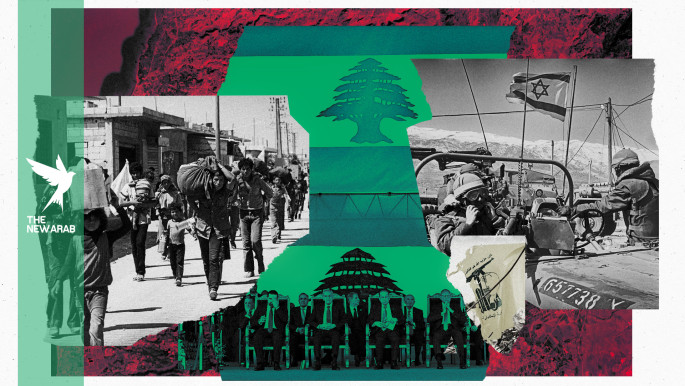
As Israel expands its war on Lebanon and openly discusses a new “northern border”, many are once again confronting a question that has overshadowed the republic since its independence: why has the south so often been left to bear the burden of conflict with so little protection from the state?
The immediate political debate often centres on Hezbollah, regional alignments, ceasefire terms or the latest round of indirect and direct contacts between Lebanese officials and Israel. Yet these arguments often obscure a deeper historical reality.
Long before Hezbollah became Lebanon’s most powerful armed actor, and long before the current war left Israel in control of some five percent of Lebanese territory, the state had never fully treated the south as an equal political priority, a region requiring sustained development, or a frontier deserving meaningful protection.
South Lebanon’s tragedy is not only that it has repeatedly been attacked by Israel, but that the Lebanese state, across decades and under very different governments, rarely built the conditions that would have allowed the region to live with security and genuine national belonging.
Since independence in 1943, Lebanon’s political system has been organised around sectarian compromise, elite bargaining, and the concentration of power in a predominantly Christian Beirut and Mount Lebanon. Peripheral regions such as the north, the Bekaa, and the south were frequently treated as secondary spaces, useful electorally but rarely central to state planning.
The south, however, carried a burden that other neglected regions did not, which was that it bordered Israel.
That meant south Lebanon was not only poorer and less developed than the political centre, but also structurally exposed to war, infiltration, bombardment and regional conflict. Yet the state never responded by building a serious frontier strategy based on development, deterrence, and equal citizenship.
Journalist and author Antoun Issa argues that this neglect was longstanding and predated the civil war entirely.
“The south was always the neglected part of Lebanon,” he told The New Arab, adding that while much of Lebanon’s periphery was marginalised, the south faced an added layer of danger because “it bordered Israel… this genocidal settler colony”.
The problem was not simply poverty, according to Issa, but government abandonment under the conditions of permanent threat.
While Beirut developed as a financial and commercial capital, many southern villages lacked adequate infrastructure, employment opportunities, investment, modern schools, and consistent public services. Large numbers of southerners migrated to Beirut, Africa, or the Gulf in search of livelihoods. In times of calm, the south was overlooked. In times of war, it was suddenly noticed.
The Shia south and the politics of exclusion
Any account of south Lebanon must also confront a central demographic and political fact: much of the south is predominantly Shia, particularly the Jabal Amel region and many of the border districts that have borne the brunt of Israeli attacks.
Historically, Lebanon’s Shia population was among the country’s most economically and politically marginalised communities. Long before Hezbollah’s rise, many Shia areas in the south and Bekaa suffered from weak state investment, poor infrastructure, and underrepresentation within the post-independence political order.
“The Shia were considered more of the underclass in those earlier decades post-independence,” Issa said, adding that many southern areas had “very little investment in services, schools, hospitals, job creation, industry”.
That history matters because it helps explain why resistance politics later gained such legitimacy in the south. For many families, the state had appeared distant, indifferent or absent long before Iran, Hezbollah or the post-1979 regional order entered the picture.
Beirut debated while the south absorbed the blows
After 1948, and especially after the Cairo Agreement of 1969, south Lebanon became increasingly entangled in the Arab-Israeli conflict. Palestinian armed factions operated from Lebanese territory, Israel retaliated repeatedly, and civilians in border villages often found themselves trapped between regional forces they did not control.
Yet successive Lebanese governments still failed to construct a serious national policy for the south. There was no sustained military doctrine to defend border communities, no transformative economic strategy, and no political consensus that the frontier deserved exceptional care.
Warnings were issued decades before Hezbollah’s emergence, with politicians and local leaders repeatedly arguing that the state had withdrawn from the south and left its people exposed. Those warnings proved prophetic in 1978 when Israel launched Operation Litani, invaded southern Lebanon, displaced huge numbers of civilians, and helped establish the forces that later evolved into the South Lebanon Army (SLA).
What followed was not merely an invasion but a replacement of state authority.
Occupation, proxy rule, and the rise of resistance
Israel’s 1982 invasion deepened the collapse as the south became a space of occupation, detention centres, proxy militias, checkpoints, and fragmented sovereignties. In many areas, the Lebanese state existed more as a legal fiction than a governing reality.
It was in this environment that Hezbollah emerged and expanded. However, it doesn’t mean Hezbollah can be understood only as a reaction.
It had ideology, organisation, regional backing, and strategic ambition – but none of those factors alone explains why it rooted itself so deeply in southern society. It gained legitimacy because it fought an occupation that the Lebanese state could not end.
“Hezbollah is a product of state failure rather than purely an ideological or external project,” Issa told TNA. Many critics, he argued, ignore the earlier Lebanese model of militias and weak sovereignty, saying Hezbollah “is just playing in the model that was already set up by earlier factions that preferred communal power over a strong national state”.
Liberation without reconstruction of the state
Israel’s withdrawal in 2000 was a watershed moment, ending more than two decades of occupation over most of the south and was celebrated across Lebanon and the wider Arab world.
But liberation did not produce a sovereign transformation of the Lebanese state.
The south still required roads, jobs, housing, hospitals, environmental recovery and long-term public investment. Lebanon instead remained trapped in sectarian patronage, corruption, debt politics and unresolved questions over defence authority.
The 2006 war reinforced the contradiction as the Lebanese army redeployed south of the Litani under Resolution 1701, but sovereignty remained layered and incomplete. The state returned symbolically, while Hezbollah retained deterrent capacity and military networks.
South Lebanon remained both Lebanese and exceptional, formally under the republic yet continually exposed to conflicts the republic could not manage.
The current war has exposed everything again
Israel currently occupies parts of southern Lebanon, amounting to around five percent of the country. It has flattened villages, demolished homes in large numbers, uprooted agricultural land, targeted infrastructure and rendered entire communities unlivable.
Last week, Environment Minister Tamara Elzein presented a national assessment titled ‘The Environmental Impact of Israeli Attacks on Lebanon from 2023 to 2025’, describing Israel’s military campaign in Lebanon as producing domicide, urbicide, and ecocide.
It reported that more than 220,000 housing units had been destroyed or damaged, while reaffirming Lebanon’s unquestionable right to pursue accountability and compensation.
The scale of destruction gives weight to those terms. Across many southern villages, entire neighbourhoods have been levelled, civilian infrastructure wiped out, places of worship and historical landmarks damaged or erased, and archaeological sites hit, amounting to a deliberate remaking of the built environment.
Beyond the towns themselves, forests have been burned, farmland devastated, soil contaminated, fisheries disrupted, water resources damaged and air quality degraded, leaving scars that will outlast the fighting itself.
The scale of devastation in the south extends far beyond battlefield damage, as communities have lost not only homes and roads, but also the land, infrastructure and economic foundations required for any meaningful return.
Villages have been emptied, farmland ruined, and public life dismantled, while Lebanon’s state institutions remain unable to alter the military realities imposed on the ground, leaving officials limited to negotiations and security contacts as border communities watch their territory transformed by force.
The symbolism of the army’s withdrawal
Nothing captured the crisis more starkly than the Lebanese army’s late March withdrawal from positions in several southern border villages, scenes many residents viewed as another moment in which the state retreated as danger advanced.
Given the military imbalance and weak state of the Lebanese army, such moves may be tactically understandable, but politically they were devastating. Many residents saw not a battlefield adjustment, but another historical confirmation that when danger comes, the state retreats.
“The army’s withdrawal had reinforced what many Lebanese see, which is that it’s a state, it’s an empty state. It’s a failed state. It’s a state that’s just absent from supporting the people,” Issa said.
He added that the images of troops leaving border villages were “the visual example of the state just being totally incapable and totally absent from protecting, servicing, and supporting the Lebanese citizenry”.
This does not mean resistance movements are beyond criticism, nor that Hezbollah’s trajectory is free of contradictions, particularly after choosing to align itself with Lebanon’s corrupt political order rather than help transform it during the 2019 uprising.
But if the question is why resistance repeatedly takes root in south Lebanon, the answer does not begin with ideology alone. It also begins with state failure – to understand that where the state does not defend, others claim defence, and where the state does not invest, other loyalties deepen and trust in the state erodes.
South Lebanon has long been expected to absorb war while the rest of the country debates sovereignty in the abstract.
Until the Lebanese state treats the south not as a buffer zone, bargaining chip or distant battlefield, but as an equal part of the republic deserving security, investment and political solidarity, the same cycle is likely to continue.
Sarah Khalil is a senior journalist at The New Arab
Follow her on Instagram: skhalil01
Edited by Charlie Hoyle