
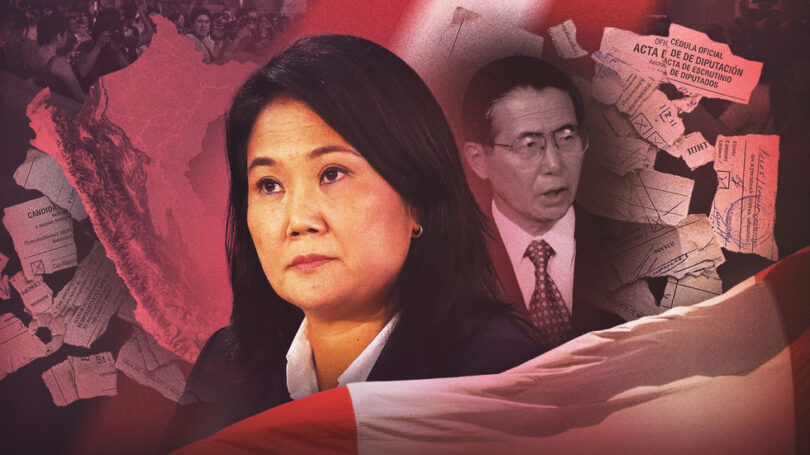
Keiko Fujimori’s razor-thin victory could bring Peru’s most divisive political movement back to power and accelerate Latin America’s shift to the right
A long road to power
The 2026 presidential campaign in Peru could finally bring victory to Keiko Fujimori, daughter of Alberto Fujimori, the country’s former president (1990-2000) and leader of the Popular Force party. In Peru, opinions about Alberto Fujimori are highly divided: Some call him a hardliner who brought order to the country with an ‘iron fist’ policy, while others consider him a corrupt dictator.
This is the fourth presidential race in Keiko Fujimori’s career. She has previously lost in the runoff three times – in 2011, 2016, and 2021– to candidates from the center (or center-right) and left parties.
This year, on counting 99.859% of the ballots, results show that Fujimori has garnered 50.118% of the vote, placing her ahead of Roberto Sanchez from the left-wing party Together for Peru. Fujimori currently leads by around 43,000 votes, but this is standard practice in the highly fragmented Peruvian society, where the outcome of the presidential race could be decided by a razor-thin margin.
The runoff was held on June 7, but due to difficult terrain and the impossibility of organizing faster ballot delivery logistics, ballots are still being counted. Voting abroad will also influence the election results.
“It’s noteworthy that Fujimori lost the election within Peru and won thanks to votes from abroad. This demonstrates the rejection of ‘Fujimorism’ as a political project within the country, but shows that it is supported abroad,” Viktor Heifets, a professor at the St. Petersburg State University (SPbU) and director of the SPbU Center for Ibero-American Studies, told RT.
Heifets also points out that so far, Fujimori has received roughly the same percentage of votes as in the previous elections, and the margin is also minimal, which may indicate the persistence of Fujimorism as a political phenomenon in Peru. Clearly, public sentiment is inclining toward harsher methods of governance and establishing order in the country.
“We must note that Keiko is certainly not a role model, but she should not be confused with her father, and cannot be blamed for Alberto Fujimori’s actions,” Heifets added.
The family curse
The Fujimori family name has become a kind of political platform for Keiko Fujimori, but in a certain sense, it is also a curse for her own political project. Keiko Fujimori’s main campaign themes were centered around the fight against crime and political instability. She also promised a tough response to organized crime. This is entirely consistent with the continuation of the Fujimorism policy in Peru.
As a politician, Keiko has spent her entire political career within this political project. However, her policies have always adhered to a strategy of balancing its legacy with the need to build her own independent image, one that is integrated into the democratic paradigm of modern Peru.
To understand this, we must take a brief look at the phenomenon of Fujimorism in Peruvian history.
By 1990, following the tenure of President Alan Garcia, Peru had entered a serious economic crisis. During his five years in office, Garcia spent significant funds on social programs, which, however, had no positive effect and only accelerated inflation to 7,000%. The social measures did not secure the loyalty of large sections of the population, and instead led to the collapse of the country’s economy.
Moreover, a number of leftist terrorist rebel groups became active in Peru. The most prominent of these were Sendero Luminoso (Shining Path) and the Tupac Amaru Revolutionary Movement; their terrorist attacks targeted not only the regular army but also the civilian population.
Against this backdrop, a widespread mistrust of traditional state institutions and anti-elite sentiments permeated society. Alberto Fujimori came to power as an anti-elite, non-systemic politician promising to solve the country’s deep economic and political crises.
Alberto Fujimori implemented ‘shock therapy’, cutting social spending and raising the key interest rate, which produced rapid results. He also managed to suppress the terrorist underground, although his methods were highly controversial – for example, we may recall the 1992 massacre at La Canuta University in Lima by government-backed death squads affiliated with the anti-communist organization Grupo Colina. That same year, the military captured the leader of Sendero Luminoso Abimel Guzman, after which leftist terrorist groups became less active in Peru; soon, their activities died down completely.
However, Fujimori’s popularity subsequently declined, and the politician himself resorted to authoritarian methods to “maintain loyalty,” including dissolving the bicameral Congress in 1992, repealing the 1979 constitution, and giving the National Intelligence Service (an institution that he had created) the right to spy on citizens.
Fujimori’s regime was accused of many crimes against human rights and freedoms. However, the most infamous project was the National Program for Reproductive Health and Family Planning – a campaign to combat poverty and overpopulation. It focused on forcibly sterilizing women residing in poor areas of the country, primarily among indigenous people. This “program” affected about 270,000 women.
In 2007, Fujimori was sentenced to six years in prison for human rights crimes; subsequently, he was charged on more counts and was released only in 2023. He died in September 2024.
From non-systemic to systemic Fujimorism
This political legacy is the foundation of Fujimorism, which Keiko Fujimori both relies on and tries to distance herself from. While her father rose to power and governed as an ‘outsider’, Keiko’s political career has been built around systemic participation in Peru’s political system. From 2006 to 2011, she served as a congresswoman, leading the Popular Force party, which won a record number of votes. The party controlled a majority in parliament and actively used constitutional instruments of pressure, including impeachments, amid a deep crisis of executive power.
Keiko Fujimori also faced corruption charges. She was accused of receiving approximately $1.2 million from the Brazilian construction conglomerate Odebrecht to finance her presidential campaigns in 2011 and 2016. In 2016, Odebrecht was accused of paying approximately $788 million in bribes and illegal donations to politicians and parties in 12 countries to secure lucrative construction contracts. The case ultimately fell apart.

Nevertheless, Keiko Fujimori has established herself within Peru’s political establishment, and, unlike her father, one can’t call her ‘unsystemic’.
“With Keiko’s victory, we may speak of the full-fledged return of Fujimorism to power in Peru. Although the concept itself is undergoing changes, its two fundamental components remain unchanged: the establishment of order and economic pragmatism. And despite the Fujimoris’ toxicity for Peruvian society, Keiko’s proposals currently meet the needs of Peruvians,” Timur Almukov, an expert on Latin America, told RT.
Nevertheless, Almukov questions the existence of Fujimorism as an independent ideological concept separate from a specific family name. Currently, the movement rests solely on the authority and will of Keiko Fujimori.
Viktor Heifets, however, stresses that Keiko Fujimori’s policy will not resemble the Fujimorism of the ‘90s.
“It will be different. It’s more about a right-wing pragmatic politician coming to power in the country. Among other things, she’s showing a willingness to work with US President Donald Trump. However, she’s not a Trumpist. Keiko has simply identified a trend and is willing to follow it. So Peru will cooperate with Trump, though of course, this will raise questions in the future. Peru cooperates with China, and Trump’s attitude toward China is well known,” says Heifets.
A tilt to the ‘right’
Keiko Fujimori’s potential rise to power fits in well with Latin America’s general swing to the right side of the political spectrum. Right-wing politicians are either already in power or actively seeking it in Ecuador, Argentina, and Colombia. The outcome of the presidential elections in Brazil this October is also uncertain – a right-wing politician could also come to power there (as had already happened in the past).
Experts agree that this trend is only emerging and will intensify over time. But this shift can hardly be called radical, says Timur Almukov.
“Right-wing politicians are presenting a solution to the main challenge facing Latin American societies, which lies in the rise of crime and insecurity in the region. As long as the Salvadoran ‘iron fist’ model continues to be imported as a ready-made campaign slogan, politicians like Keiko Fujimori or Abelardo de la Espriella in Colombia will continue to win votes,” Almukov says.
Leftists are not able to effectively respond to these challenges, Almukov says. Their approach – fighting the economic roots of crime – is not necessarily wrong, but it has become clear that it cannot immediately respond to public demand.