
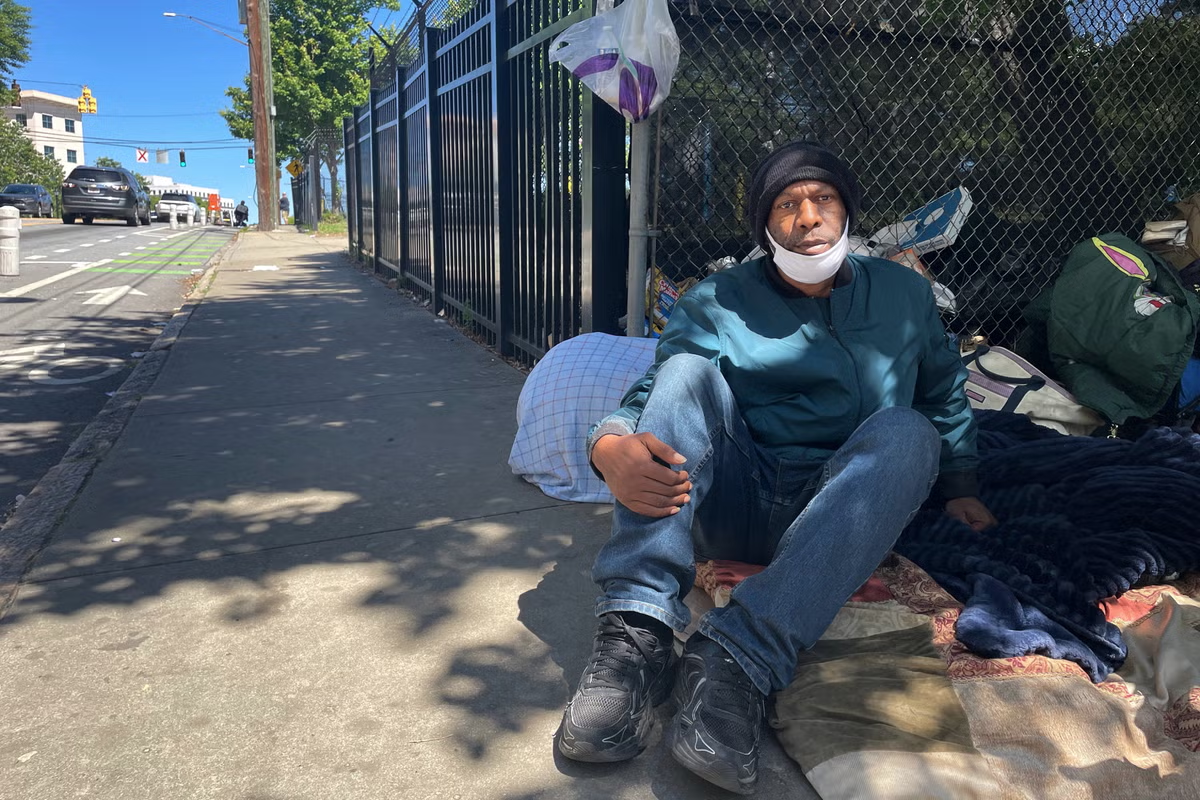
A stark contrast unfolds just a mile from Atlanta’s World Cup stadium, set to host thousands of football fans this month. Dozens of individuals were recently observed camped on a downtown pavement, awaiting the opening of a homeless shelter.
Some sought refuge in sleeping bags, face masks shielding them from the afternoon sun, while others ate cereal from boxes on the kerb. Shoes lay strewn amidst discarded mini-liquor bottles, as a boom box played a Jay-Z track: “This can’t be right, there’s gotta be more.”
Last summer, Atlanta unveiled an ambitious initiative, “Downtown Rising,” aiming to eradicate encampments and street sleeping ahead of the 39-day tournament, which kicks off on 11 June. The programme claims to have housed nearly 500 people, yet the scene outside the Pryor Street shelter serves as a potent reminder that the city’s efforts have not reached everyone.
Atlanta is among several host cities across the United States, Canada, and Mexico leveraging the global spotlight of the premier football tournament to tackle homelessness. Seattle has announced a housing drive, using the World Cup to assess its progress, while Dallas is expanding a successful scheme to house rough sleepers downtown.
However, an Associated Press survey revealed that most of the 16 venues, including New York, Boston, Philadelphia, Miami, Houston, Toronto, and Vancouver, British Columbia, are largely depending on existing programmes – predominantly without new World Cup-specific funding – to address the issue.
Growing tent encampments have bedeviled urban leaders for years. Federal data showed a double-digit percentage increase in homelessness nationwide from 2023 to 2024, when 770,000 people were counted as homeless — a number acknowledged as an undercount. That was followed by a slight decrease last year to 745,652.
In the past, many cities have treated the homeless as an eyesore to be removed ahead of big sporting and political events.
During last year’s Super Bowl, New Orleans spent millions of dollars clearing away tent encampments near the Superdome and moving the homeless into a temporary warehouse. Ahead of the 2024 Paris Olympics, migrants were bused out of the city until the Games ended. Chicago removed one of its biggest encampments ahead of the 2024 Democratic National Convention.
“These events provide a choice for communities,” said Ann Oliva, CEO of the National Alliance to End Homelessness. “They can do the easy thing and sweep people out of encampments and into jails or other neighborhoods, or they can do the harder work that will benefit everyone in the community — housed or unhoused.”
As host of the 1996 Olympics, Atlanta removed some 9,000 homeless people to a newly built detention center. It gave others one-way bus tickets out of town and launched “Operation Olympus,” detaining hundreds of people to reduce crime.
But this time around, the city was determined to do things differently.
It has raised $185 million in state and city funding, as well as corporate grants and other donations, toward a goal of $235 million, with the aim of housing 3,900 people citywide by next year. The latest city count last year showed there were some 2,900 homeless people citywide, about a third living in encampments or on the street.
“There will always be homeless people on our streets, more than likely, unfortunately,” said Cathryn Vassell, the CEO of Partners for HOME, the organization tasked with creating and executing Atlanta’s homelessness strategy. The goal is “to be able to identify them and quickly exit them into shelter, resources, services, and then ultimately housing.”
Downtown Rising has helped Michael Sutton turn his life around. In foster care since he was an infant, he bounced from family to family. For most of the past decade, the 31-year-old slept in train stations, parks, abandoned buildings and homeless shelters.
Since September, Sutton has had a one-bedroom apartment in an Atlanta suburb and a case worker.
“Everyone has rough days, and being able to go home or vent to yourself about it, relaxing in your own home … is priceless,” Sutton said.
But not everyone can be helped.
Some homeless people recoil at shelter rules, lack the documents to quickly move into permanent housing or have complicated drug and mental health challenges, or nomadic lifestyles that make them difficult to reach.
Tommy Elam said he’s been on numerous housing lists, but nothing has happened — though he’s hard to find. His phone was stolen countless times and he doesn’t currently have one.
“They don’t know where I’m at,” said Elam, who’s been homeless since early 2020 and spent the last three months sleeping on the sidewalk near the Pryor Street homeless shelter, his latest spot since a crackdown on the encampment where he lived near the Georgia State Capitol building.
Standing outside the downtown supportive housing center where he now lives, Willie Jackson, who spent years on the streets, said he knows people who’ve been helped by the Downtown Rising initiative. But he’s skeptical it will lead to lasting change after the World Cup — or that it’s made a significant impact on downtown’s homelessness problem.
“Just look around,” he said.
Two years ago, it was hard to miss the hundreds of tents around Dallas City Hall.
But ahead of the World Cup, there were no tent encampments downtown, where FIFA’s broadcast center is set up, or at the nearby fan zone. The matches will be played at Dallas’ stadium in suburban Arlington.
Sarah Kahn, president and CEO of Housing Forward, which leads the homelessness response for Dallas and nearby Collin counties, said a $30 million campaign since 2024 reduced the number of people sleeping on downtown streets by 87% and placed some 2,000 into permanent housing.
More details here…