Secrets Reporters
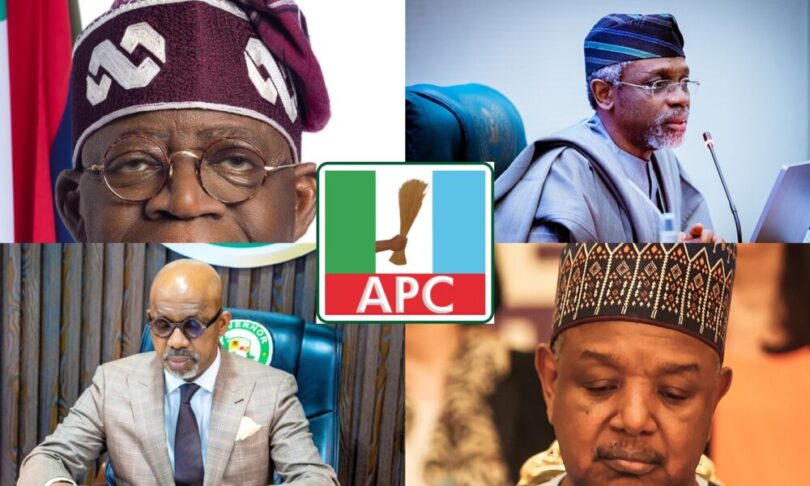
Four men sit at the summit of the All Progressives Congress (APC) and of the Federal Government of Nigeria. Four American files sit beneath them.
The President of the Federal Republic forfeited $460,000 to the United States in a Chicago case built on a heroin network. His Chief of Staff was suspended from the practice of law in Georgia after admitting he took a client’s $25,000 settlement and used it for himself. One of his governors carried seven charges in Miami, among them forgery and grand theft, under a name that was not the name he now bears in Government House. His Minister of Budget and Economic Planning stands named in the United States Department of Justice’s own complaint as a man instrumental in laundering the Abacha loot through America, and when America returned $311 million of that loot to Nigeria, it wrote into the agreement that not one cent of it may benefit him.
These are not allegations traded on campaign grounds. Every line of what follows stands in American court records, in the filings of the United States Department of Justice, and in the judgments of American courts, pulled and checked by SecretsReporters across the full roster of the APC in government, the President, the cabinet, the governors and both chambers of the National Assembly. Four files survived the records. They are the four that follow.
The President and the Chicago money
On 26 July 1993, the United States of America filed a verified complaint in the District Court for the Northern District of Illinois, No. 93 C 4483, against funds held in the name of Bola Tinubu at First Heritage Bank and at Citibank, and against accounts of Compass Finance and Investment Company. Behind the complaint stood the sworn affidavit of Kevin Moss, a Special Agent of the Internal Revenue Service, sworn on 20 July 1993.
The United States alleged that the money was the proceeds of narcotics trafficking, or money moved in violation of America’s money laundering laws, and forfeitable under American law. The Moss affidavit tied the accounts to a white heroin network running between Chicago and Hammond, Indiana, a network the affidavit said was led by Adegboyega Mueez Akande and Abiodun Agbele between 1988 and 1991. More than $1.4 million in the accounts had been frozen in January 1992.
Tinubu fought the forfeiture. He told the American court the money belonged to himself, to members of his family including K. O. Tinubu, to his wife Oluremi Tinubu, and to his foster mother, Alhaja Abibatu Mogaji. The fight ended in a compromise. By a settlement dated 15 September 1993, the case was dismissed with prejudice on 21 September 1993, and by the decree of Judge John A. Nordberg on 4 October 1993, the United States kept $460,000 from the First Heritage account. The rest of the money was released.
The settlement did not decide that Bola Tinubu trafficked drugs. He was never charged with a crime in the case, never pleaded, and was never convicted, and Nigeria’s Presidential Election Petition Court held in September 2023 that the forfeiture was a civil proceeding and no disqualification. What the record holds is narrower and, for a sitting president, heavy enough: the United States seized his bank accounts as heroin money, and he settled the case by surrendering $460,000 of it.
The American file did not close in 1993. In the District Court for the District of Columbia, in Greenspan v. Executive Office for United States Attorneys, No. 1:23-cv-01816-BAH, Judge Beryl A. Howell ruled on 8 April 2025 that the FBI and the Drug Enforcement Administration could no longer refuse to confirm or deny, and ordered both agencies to search for and process their Tinubu records. The ruling established on the American record that the FBI and the DEA criminally investigated Bola Tinubu. In a sworn declaration filed on 28 August 2026, the FBI stated that the records at issue were compiled in furtherance of the FBI’s investigation of multiple individuals for drug trafficking crimes, and that the court has already determined that an official acknowledgement had been made of an investigation of Bola Tinubu. Tinubu himself intervened in that case on privacy grounds and has asked the court to let the agencies keep their redactions. The investigation is a fact of record. Criminal liability is not, and no American court has found it.
The Governor and the Miami charges
In Miami-Dade County, Florida, the clerk’s criminal index carries Case F-86-019816 of 1986 under the name Davis, Shawn Michael, and the index’s own alias list ties that case to Abiodun, Oluseun Adedapo, and to the exact birth date of the man who is today the Governor of Ogun State, Dapo Abiodun.
Seven charges stand on that index: forgery; grand theft in the second degree; uttering a forged instrument; petit theft; resisting an officer with violence; theft of a credit card; and a felony credit card count. The dispositions are recorded against five of them in the words NOLLE PROS-COMP PTI, the prosecution discontinued after pre-trial intervention, and against both credit card counts, NO ACTION. There is no conviction on the record, and the underlying court file was later destroyed under the county’s retention schedule, leaving the clerk’s index as the surviving record.
SecretsReporters published the Miami-Dade file on 19 October 2026, and the governor’s own lawyers, in the earlier public exchanges of 2022, admitted an arrest in the alternative and denied any conviction. The record supports the denial of a conviction. It also supports what no denial can remove: the man who governs Ogun State was charged in America with forgery and with stealing, under another man’s name, and stood in a Florida court to answer it.
The Chief of Staff and the client’s $25,000
Before Femi Gbajabiamila became Speaker of the House of Representatives and then Chief of Staff to President Tinubu, he practised law in Atlanta, Georgia, as Femi Gbaja, Georgia Bar No. 288330, admitted on 29 June 2001.
On 26 February 2007, the Supreme Court of Georgia decided In the Matter of Femi Gbaja, No. S06Y0829. On his own Petition for Voluntary Discipline, Gbaja admitted that he had taken $25,000 paid in settlement of a client’s personal injury claim, deposited it in his attorney trust account in January 2003, failed to pay it over to the client, withdrew it for his own use, closed his Atlanta practice and left the country. He entered the House of Representatives in Nigeria in 2003, and he repaid the $25,000 in 2006, three years after taking it.
The violation he admitted is one punishable by disbarment. He asked the court for 24 months. The State Bar of Georgia demanded no less than 36. The court imposed a suspension of 36 months.
The American record did not end there.
As reported from Georgia Bar officials, he was suspended again in 2015, and his membership of the Georgia Bar was terminated on 1 July 2020.
He cannot practise law in Georgia today.
It was discipline, not a criminal conviction, and a Nigerian court held as much in 2019. The discipline stands on his own admission, in his own petition, in an American court: the President’s Chief of Staff took his own client’s settlement money and spent it.
The Budget Minister and the Abacha millions
Abubakar Atiku Bagudu, today Minister of Budget and Economic Planning, holds the pen over Nigeria’s budget. The United States Department of Justice holds a complaint with his name in it.
In United States v. All Assets Held in Account Number 80020796, Civil Action No. 1:13-cv-01832 in the District Court for the District of Columbia, the Department of Justice alleged an international conspiracy in which General Sani Abacha, his sons, their associate Abubakar Atiku Bagudu, and others embezzled, misappropriated, defrauded and extorted hundreds of millions of dollars from Nigeria and laundered the proceeds through conduct in and affecting the United States. The complaint alleges that Bagudu played an instrumental role in setting up and executing the laundering transactions and remained a signatory or corporate representative on many Abacha family assets.
On the assets nobody contested, the American court entered judgment in 2014 forfeiting approximately $500 million. On 3 February 2020, the United States, Jersey and Nigeria signed a trilateral agreement, and America transferred $311,797,876.11 to Nigeria for the Second Niger Bridge, the Lagos-Ibadan Expressway and the Abuja-Kano road. The agreement carried an express bar: no part of the returned money may benefit Bagudu. The Department of Justice, announcing the return, described him as part of a network controlled by Abacha that embezzled, misappropriated and extorted billions from the government of Nigeria. The portfolios linked to Bagudu and his family, over $150 million, remained contested in the American proceedings, and after settlement talks failed, the United States moved to resume the case to seize them.
Bagudu has never been criminally charged in the United States, and his own settlement with Nigeria in 2003, under which he returned $163 million and Nigeria dropped its claims, is part of the American record too. He remains, on the filings of the United States Department of Justice, a named instrument of the Abacha laundering machine, and he is the man the APC government has placed in charge of the national budget of the country the money was stolen from.
The party these files describe
The APC took power in 2015 holding itself out to Nigerians as the party that would end the looting of the state. Eleven years on, the American records of its government read as follows. A President who surrendered $460,000 to the United States in a case built on a heroin network’s money, and whose FBI and DEA investigation files are being pried open in a Washington court over his own objection. A Chief of Staff suspended in Georgia on his own admission that he consumed a client’s settlement. A governor whose American youth stands in a Florida index under another name, against charges of forgery and grand theft. A Budget Minister named in America’s Abacha forfeiture as an instrument of the laundering, so deeply named that the treaty returning the loot to Nigeria forbids him from touching it.
SecretsReporters searched beyond these four. The Vice President, the Senate President, the Speaker, the Secretary to the Government of the Federation, the APC governors, ministers, senators and members of the House of Representatives with any American footprint were checked against American records for this report, and no further file of fraud, forgery or crime in the United States stands against any of them. The indictment of the APC is not that its files are many. It is that its files sit at the very top, in the four offices a party chooses most carefully, and that the party, knowing every one of them, chose these men anyway.