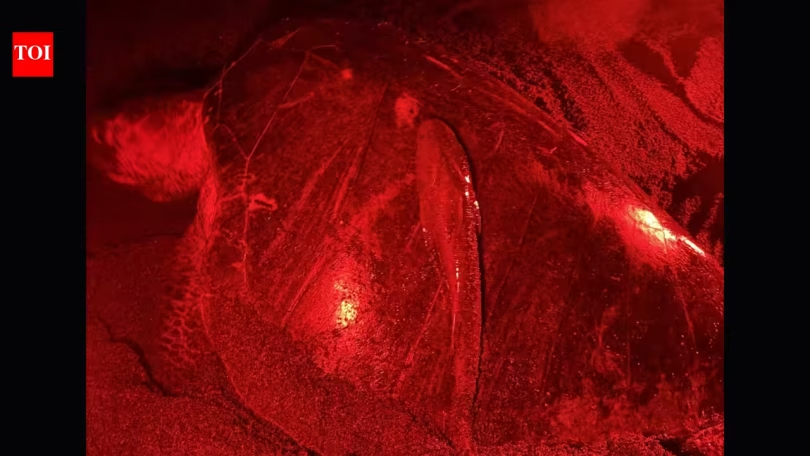
A mother sea turtle crawled onto a Costa Rican beach to lay her eggs, carrying an unexpected passenger that refused to let go even after leaving the ocean.Gripping tightly to the turtle’s shell with a suction disc on its head, a live suckerfish stayed attached and survived in the open air for 19 minutes.The rare encounter took place on Pejeperro beach in September 2025.Field workers monitoring nesting turtles on the beach spotted the olive ridley turtle emerging from the waves with the fish stuck to her back. Suckerfish, also known as remoras, regularly hitch rides on sharks, rays, and turtles in the ocean to save energy, but following their hosts onto dry land is almost unheard of.
Surviving out of the water
Witnesses on the beach were surprised to see the fish breathing on land.“My coworkers and I were certainly surprised and slightly bewildered that [the remora] was still attached and breathing,” says Megan Bullock, who observed the encounter alongside fellow researchers Vicente Peña Eisele and Emily Yeager.Observation notes recorded that “during the 19 minutes of observation, the remora remained relatively still except for periodically flexing its opercula” (gill coverings).The team eventually removed the fish so they could measure the turtle’s shell. As soon as they put the fish back into the ocean, it swam away quickly.“The remora began to writhe and quickly moved away from the researcher once it was returned to the ocean,” the observers noted, “indicating that it was still alive despite being removed from the water for an extensive period.”Bullock admitted she did not expect the fish to have so much energy left after its time on land.“19 minutes is certainly a long time for most fish to be out of the water so I was definitely surprised,” Bullock says. “I was even more so surprised that the remora was still so energetic when we removed it from the turtle. It thrashed a lot for an animal that hadn’t been in the water for so long.”
A rare sight for researchers
Remoras use a modified fin on top of their heads to act like a suction cup. Hundreds of thousands of sea turtles come ashore every year to lay eggs, yet observers almost never see remoras stick around for the trip.“Until I connected with Emily and began researching this topic, I’d never heard of remoras leaving the water with their host, much less seemingly by its own choice,” says Bullock.Even among experienced beach patrols, the sight was a complete shock.“You get to hear about a lot of the strange things that your coworkers encounter,” she says, “and yet this was something I’d never even heard rumours of.”
Mystery over how it survived
How the fish managed to stay alive out of the sea remains a mystery. Most fish suffocate quickly on land because their gills collapse without water passing over them.“We’re honestly not too sure,” says Bullock. “Like most fish, remoras need flowing water over their gills and will suffocate without it over time.”Bullock wonders if remoras can handle low oxygen better than other fish. Learning more about these unexpected travels helps scientists better understand how different ocean species live together, which Bullock notes “can help us better protect them.”
The mechanics of a relentless grip
The secret behind a remora’s ability to cling to a host on land lies in the evolutionary design of its suction disc. Situated on the top of the fish’s head, this specialised organ is actually a heavily modified dorsal fin. It features a fleshy outer lip that forms a tight seal against smooth surface areas, like a turtle’s shell, while internal slat-like structures called lamellae create a vacuum when pulled backward.In open water, this attachment allows remoras to feed on leftover food scraps and parasites from their hosts while saving vital energy on swimming. However, maintaining that hold on dry land requires overcoming an entirely different set of physical forces. Without the natural buoyancy of water supporting the fish’s body weight, gravity exerts a constant downward drag.The fact that the suction disk held fast while the turtle dragged itself across the sand suggests the seal is remarkably strong and completely mechanical. It requires almost no active muscular effort from the fish to remain locked in place. As long as the outer seal remains moist and unbroken, the vacuum holds, allowing the hitchhiker to stay attached even during a rough trip across the beach.