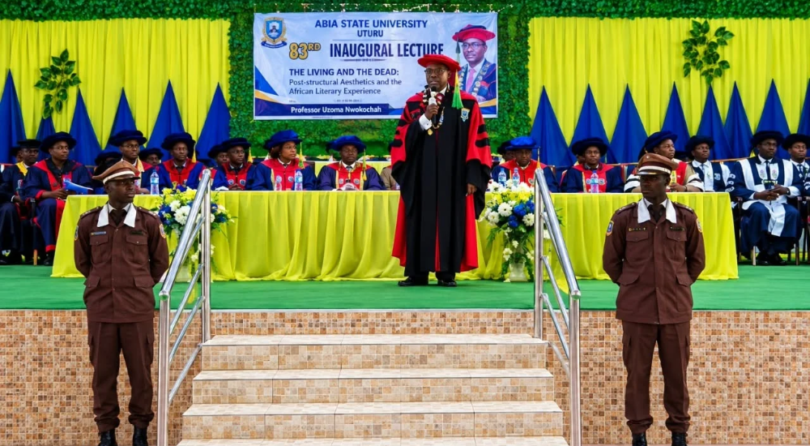
Abia State University (ABSU), Uturu, on Wednesday held its 83rd inaugural lecture, with scholar Uzoma Nwokochah examining post-structuralist aesthetics and the African literary experience.
The lecture, titled “The Living and the Dead: Post-structural Aesthetics and the African Literary Experience,” took place at the university auditorium.
Speaking during the lecture, Nwokochah described the opportunity to deliver the address as “a great privilege,” while reflecting on the change in its date.
He said the change was a “double-edged sword” because it also provided an opportunity to reach out to friends and well-wishers.
The lecturer also expressed appreciation to Abia State Governor, Dr Alex Otti, for responding to the university’s demand with a new alert, which he said helped ensure the smooth conduct of the programme.
Post-structuralist criticism challenges fixed interpretations of literary texts by examining how language, cultural assumptions and contradictions shape meaning. Its application to African literature provides a framework for exploring themes such as identity, history and cultural experience.
Nwokochah is a scholar of English Language and Literature whose research interests include literary post-structuralism, deconstruction and African literary criticism.
According to his academic profile, he obtained his Bachelor of Arts degree in English Language and Literature from ABSU in 1988, a Master of Arts degree in Literature in 1991 and a PhD in English Language and Literature in 2017.
He has also held several administrative positions at the university, including Director of the Institute for Computer Studies, Director of the University Examinations Centre and Dean of Student Affairs. His profile identifies him as the Director of the Business Resource Centre.
His academic publications include “Cannibalistic Okonkwo: A Deconstructive Perspective of Achebe’s Things Fall Apart,” which examines Chinua Achebe’s novel through the lens of deconstruction.
The inaugural lecture provided a platform for examining approaches to literary interpretation and their relevance to African literature, particularly in understanding the complexities of language, identity and cultural representation.