
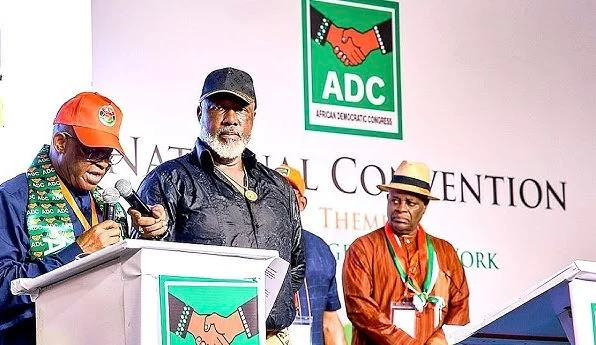
The African Democratic Congress (ADC) has unveiled its governorship and deputy governorship candidates for the 2027 general elections in 28 states.
The party released the names of its candidates on Friday, presenting them as part of its effort to offer Nigerians an alternative political platform ahead of the 2027 elections.
Among the prominent names on the list are Gbadebo Rhodes-Vivour, who will contest the Lagos governorship election; Isa Mohammed Ashiru in Kaduna; Great Ogboru in Delta; Senator Ahmad Babba Kaita in Katsina; and former Attorney-General of the Federation, Abubakar Malami, in Kebbi.
The ADC also unveiled candidates in states including Akwa Ibom, Cross River, Rivers, Oyo, Ogun, Kano, Plateau, Zamfara, Adamawa, Benue, Borno, Ebonyi, Enugu, Gombe, Jigawa, Kwara, Nasarawa, Niger, Sokoto, Taraba and Yobe.
The party said the candidates would carry its banner into the 2027 elections with a commitment to providing Nigerians with credible leadership and what it described as a “real alternative.”
The development comes as the ADC continues to position itself as a major opposition platform ahead of the 2027 general elections, amid growing political realignments and efforts by opposition figures to challenge the ruling All Progressives Congress.
In Lagos, Rhodes-Vivour, who previously contested the 2023 governorship election on the platform of the Labour Party, has been selected to lead the ADC ticket, with Gbadamosi Babatunde Olalere as his running mate.
In Kaduna, the party picked Ashiru, who was also the Peoples Democratic Party candidate in the 2023 governorship election, with Kantiok Irmiya Ishaku as deputy governorship candidate.
Great Ogboru will contest in Delta State alongside Afiari Gloria, while Senator Ahmad Babba Kaita will fly the ADC flag in Katsina with Aminu Yar’adua Ahmed as his running mate.
In Kebbi, Malami will contest the governorship election alongside Zagi Musa Mohammed.
The party’s candidates for other states are Kalu Kalu Agu and Alozie Ogadinma Darlington in Abia; Modibbo Hammantukur Ribadu and Aguwa Kevin Iliya in Adamawa; Akpanudoedehe John James and Nsien Mkpombuk Tommy in Akwa Ibom; Senator Halliru Dauda Jika and Sama’ila Mohammed Kabir in Bauchi; Herman Iorwase Hembe and Abba John Abba in Benue; and Babagana Buhari and Mamman Dauda in Borno.
In Cross River, the ADC selected Nkoyo Toyo with Okwoche Andrew Adagbor as deputy, while Ukpai Mba Udeh and Onwe Daniel Ede will contest in Ebonyi.
Ocho Obodoeze Chukwuma and Eze Arinze Christopher will fly the party’s flag in Enugu, while Bala Bello and Bala Sani Isa will contest in Gombe. Sabo Mohammed Nakudu and Musa Ya’u Balarabe were selected for Jigawa.
The party also named Ibrahim Ali Amin and Shehu Abdulkadir Bari for Kano; Zakari Mohammed and Olawuyi Julius Olayide for Kwara; Nuhu Angbazo and Ahmed Yusuf for Nasarawa; and Dr Mohammed Kpautagi and Musa Mamman for Niger.
In Ogun, Biodun Collins Ogundipe will contest alongside Muraina Oluwaranti Oluyemi, while Taofeek Adegboyega Adegoke and Wahab Adeniyi will represent the party in Oyo State.
The ADC picked Brig. Gen. John Sunday Sura and Pwajok-Kele Chundung Bitrus for Plateau, Gabriel Pidomson and Okumgba David Amapakaye for Rivers, and Manir Mohammad Daniya and Isah Bello Ambarura for Sokoto.
In the North-East, Abubakar Umar Tutare and Kwetishe Haruna Kwenyan were selected for Taraba, while Kassim G. Gaidam and Kori Lawan Mohammed will contest in Yobe.
Shinkafi Bilyaminu Yusuf and Muhammad Abdulmuddalib Auwal will represent the party in Zamfara.
The unveiling of the candidates comes shortly after the ADC criticised the economic policies of President Bola Tinubu’s administration, particularly following Uber’s decision to end its operations in Nigeria after 12 years.
The party had described Nigeria as a “graveyard of businesses,” arguing that the exit of major companies reflected what it called a difficult operating environment.
ADC National Publicity Secretary, Bolaji Abdullahi, said the government’s reported economic growth had not translated into improved living conditions for ordinary Nigerians.
“Certainly, a 0.2% growth does not justify the extreme hardship that Nigerians are suffering,” the party said.
The ADC also challenged the Federal Government to explain how its economic policies had improved household incomes, food affordability, transportation and employment.
“When the President and his party say things are getting better, we expect them to tell us what has improved in the lives of Nigerians,” it said.