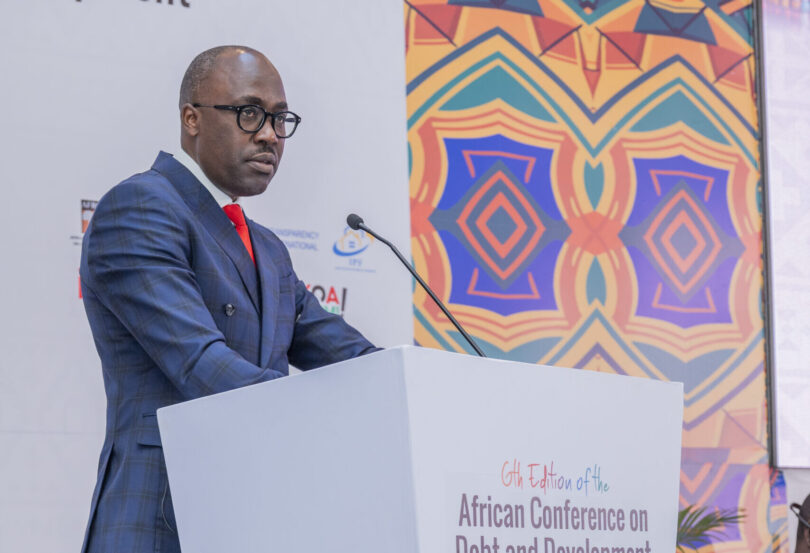
“Africa pays $90 billion a year in debt service. That is more than aid and climate finance combined,” Mr Sing’oei said.
African countries spend about $90 billion every year servicing debt and pay another $75 billion in additional interest because of the high risk premium attached to borrowing, Kenya’s Principal Secretary for Foreign Affairs, Korir Sing’oei, has said.
He spoke on Friday in Nairobi, Kenya, at the closing ceremony of the sixth African Conference on Debt and Development (AfCoDD VI), organised by the African Forum and Network on Debt and Development (AFRODAD).
“Africa pays $90 billion a year in debt service. That is more than aid and climate finance combined,” Mr Sing’oei said.
He noted that the continent’s debt burden was not simply the result of frequent defaults, arguing that African countries generally default less than is often assumed. Rather, he said, they pay more because of the risk premium attached to African borrowing.
He described the additional $75 billion paid in interest as a “trust tax”.
“This Africa risk premium forces an unpleasant choice between servicing expensive debt and investing in the health, education and climate resilience of our people,” he said.
The pressure is also visible in Nigeria, where the government says it incurred N10.61 trillion in additional debt-service costs between June 2023 and December 2025.
The amount was N4.14 trillion more than the N6.47 trillion spent on strategic infrastructure during the same period, according to a scorecard released by the Ministry of Finance.
The bulk of the additional cost — N9.37 trillion — was linked to the depreciation of the naira and its effect on external debt servicing, while higher interest rates added another N1.24 trillion to domestic debt-service costs.
Together, the additional debt-service costs represented about 34.6 per cent of the government’s N30.64 trillion incremental expenditure during the period, compared with 21.1 per cent for strategic infrastructure.
The Nigerian figures offer a local illustration of the broader problem Mr Sing’oei was spotlighting: governments can secure financing, but changes in exchange rates and interest rates can substantially increase what they ultimately pay.
Nigeria’s Finance Minister and Coordinating Minister of the Economy, Taiwo Oyedele, has acknowledged that the economic reforms that contributed to those costs have imposed a significant burden.
The Nigerian government attributed the increase in external debt-service costs largely to the depreciation of the naira following foreign exchange reforms, while higher monetary policy rates increased the cost of domestic borrowing.
Mr Sing’oei said the cost of capital had become a major foreign policy issue for Africa and should no longer be left mainly to finance ministries and national treasuries.
“In the 1960s, foreign policy on the continent was about political independence and political sovereignty,” he stated.
“In the 1990s, when state capacity was hollowed out through structural adjustment programmes, it shifted to aid, when Africa was knocking on doors for more aid.
“Today, I submit, the central theme of foreign policy for Africa is the cost of capital.”
He explained that Africa’s financing needs were too large for foreign policy institutions to remain on the sidelines of discussions about debt, bonds, equities, securities and other financial instruments.
According to him, many foreign policy officials do not have enough expertise in complex financial matters, while officials in finance ministries may not always have a sufficient understanding of the geopolitics and history behind international lending.
He said the gap sometimes leaves African countries negotiating financing arrangements on terms that are less favourable to them.
The nature of Africa’s creditors has also changed considerably, making debt negotiations more complicated.
Mr Sing’oei stated that about 70 per cent of Africa’s debt was owed to Paris Club creditors in the 1990s.
Today, he said, about 40 per cent is held by private bondholders in financial centres including London, Hong Kong and the Gulf states.
He noted that the change has made debt restructuring more difficult.
He cited Zambia, where the restructuring of the country’s debt took four years amid disagreements between China and the Paris Club.
Kenya’s own Eurobond negotiations, he said, involved traders in Paris, London, New York and elsewhere.
“This is not just a loss of finance; it is also a loss of sovereignty,” Mr Sing’oei stated.
He noted that some loans came with explicit conditions, including collateral and mineral offtake arrangements, while other forms of leverage were less direct.