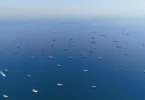
Missile attacks targeted QatarEnergy’s Ras Laffan production hub on 18 and 19 March, leading to the shutdown of two major LNG production lines and a gas-to-liquids conversion line. [Getty]
One hundred days after QatarEnergy announced a halt to liquefied natural gas production at the Ras Laffan and Mesaieed industrial facilities following Iranian missile attacks, the Qatari economy is facing an unprecedented export-revenue shock concentrated in the energy sector, affecting public finances, the balance of payments, and the domestic market.
The Iranian air strikes caused damage to two processing units and a gas-to-liquids conversion line, disrupting about 17% of Qatar’s LNG export capacity, equivalent to 12.8 million tonnes annually, with estimated revenue losses of about $20 billion a year if the disruption persists over the long term.
Missile attacks targeted QatarEnergy’s Ras Laffan production hub on 18 and 19 March, leading to the shutdown of two major LNG production lines and a gas-to-liquids conversion line.
The company declared “force majeure” on gas supply contracts with four countries, indicating that the disruption had moved beyond a short-term operational incident into a prolonged crisis with complex commercial obligations.
The gas liquefaction unit was completely shut down, with expectations that restarting operations could take weeks, increasing the risk of sustained revenue losses.
Sharp decline in exports
Qatar’s LNG exports recorded an unusually sharp decline in the first quarter of 2026, falling to 14.7 million tonnes from 22 million tonnes in the same period in 2025, a decrease of 33.2%.
The decline pushed Qatar from second to third place globally in LNG exports, behind the United States and Australia, while its share of global trade contracted to about 13%.
Gas prices in Europe rose by 50% following the announcement of the production halt, reflecting the scale of the shock to global energy market balances.
Qatar’s LNG exports to Pakistan also fell by 27% to 1.29 million tonnes in the first quarter of 2026, down from 1.77 million tonnes in the same period last year.
Export destinations declined to only four countries compared with their previous diversity, while Qatar’s helium exports dropped by 14%, reflecting the spread of the impact to secondary products linked to the gas value chain.
Impact on public finances and growth
The direct financial impact of the shock was reflected in the state budget, which recorded a deficit of 10.3 billion Qatari riyals ($2.8 billion) in the first quarter of 2026.
Total revenues fell by 23.5% year-on-year to 37.8 billion riyals, while oil and gas revenues declined from 42.5 billion riyals the previous year to 32.7 billion riyals in the first quarter of 2026.
Expenditure decreased by 3.7% to 48.1 billion riyals, reflecting government efforts to control spending amid the revenue shock.
However, the budget deficit is not the only indicator of the crisis’s depth.
The decline in hydrocarbon exports is also placing pressure on nominal GDP and the external surplus, threatening medium-term balance-of-payments stability if the disruption continues.
Nevertheless, available data do not yet indicate a collapse in the domestic market or severe disruption to domestic consumption, as Qatari markets have remained relatively stable, with no notable disturbances despite ongoing regional tensions.
Unprecedented economic shock
Commenting on these indicators, Jalal Qannas, a professor at the College of Business and Economics at Qatar University, told The New Arab that Qatar is facing an unprecedented structural economic shock 100 days after LNG production stopped at the Ras Laffan and Mesaieed facilities and QatarEnergy declared “force majeure”.
He noted that the crisis has put Qatar’s economic resilience model to a genuine test, forcing a shift in the global energy map and an immediate decline of nearly 80% in industrial output in the energy sector.
Qannas said that despite the severity of the external shock, the domestic economy has shown notable resilience due to strong local consumption and the non-oil economy.
Gas supplies destined for domestic consumption, power stations, water facilities and pipeline exports through the “Dolphin” line have continued, thanks to the integrity of offshore North Field facilities and the concentration of damage at coastal liquefaction plants.
By contrast, the balance of payments has faced significant pressure due to the temporary loss of key market shares to competitors such as the United States, before innovative shipping strategies and international de-escalation efforts helped partially restore some flows.
Regarding public finances, the 2026 state budget shifted into a temporary deficit due to declining hydrocarbon revenues.
Qannas said the efficiency and activity of the domestic and non-oil economy, together with Qatar’s balanced fiscal and monetary policies, remain important strengths.
He stressed that the Qatar Investment Authority, the sovereign wealth fund, serves as the first line of defence by providing necessary liquidity.
Authorities can also draw on reserves or issue debt instruments supported by the country’s strong credit rating, avoiding pressure on current expenditure.
In domestic markets, strategic investments in food security made since 2017 during the blockade period have prevented shortages of consumer supplies.
Meanwhile, continued spending on major projects, such as the North Field expansion, has maintained confidence among local and international business communities and supported stock market stability.
Falling revenues, shrinking surpluses
Academic and economist Abdul Rahim Al-Hour told The New Arab that the LNG sector has represented the central pillar of the Qatari economy, serving as the main source of government revenue, exports and foreign currency inflows.
Therefore, he said, the halt in LNG production at Ras Laffan and Mesaieed and the declaration of force majeure constitute an exceptional event with broad economic and strategic dimensions.
Given the nature and production structure of the Qatari economy, the crisis can be considered a compound economic shock that combines reduced export capacity with declining public revenues, placing direct pressure on public finances, the balance of payments and economic growth rates.
He added that assessing the effects of the shock requires distinguishing between short-term impacts and long-term strategic consequences.
Despite the scale of potential losses in the energy sector, no indicators support the assumption of a comprehensive economic collapse or a severe financial crisis in the foreseeable future, given Qatar’s substantial financial reserves, large sovereign assets, and strong ability to manage economic shocks and finance government obligations over extended periods.
As a result, he said, the direct impact of the crisis will be more visible in lower export revenues, reduced fiscal and trade surpluses, and increased pressure on state financial planning, as well as the reprioritisation of public spending and investment.
Al-Hour expects these developments to be reflected in macroeconomic indicators through slower economic growth, reduced foreign currency inflows, and shrinking energy-sector surpluses.
He noted that the state’s ability to use its financial tools and sovereign reserves provides a broad scope to contain these effects and prevent them from developing into a domestic economic crisis.
In this context, the economist argued that “a distinction should be made between the impact on the national economy as a whole and the impact on the daily lives of individuals and institutions.
For most individuals and small and medium-sized enterprises, the direct effect is likely to remain relatively limited in the short and medium term due to the weak link between their daily economic activities and gas export revenues.
Continued state financing of public spending and essential services should also maintain a high degree of economic and social stability.”
According to Al-Hour, “The same largely applies to government employees, as the crisis does not appear likely to affect salaries or employment benefits directly in the foreseeable future, given the state’s ability to finance operating expenditures through reserves and sovereign assets accumulated over past decades.
Therefore, the most visible effect on individuals may be limited to inflationary pressures resulting from higher transportation, insurance and supply chain costs, and any accompanying decline in purchasing power if the crisis continues for a prolonged period.”
He continued, “However, the limited direct impact on individuals does not mean the crisis poses only limited risks to the state. The core challenge appears to be strategic rather than related to living conditions. Persistent disruption of a significant portion of LNG production and export capacity could lead to lower sovereign revenues over the long term and weaken the fiscal surpluses that have been among the most important pillars of Qatar’s economic strength in recent years.”
Al-Hour said that if the disruption continues for an extended period, competing producers could strengthen their positions in global markets and reshape some contracting and supply patterns in international energy markets.
This could affect Qatar’s future market share and strategic position in the LNG sector.
Article translated from Arabic by Afrah Almatwari. To read the original, click here.