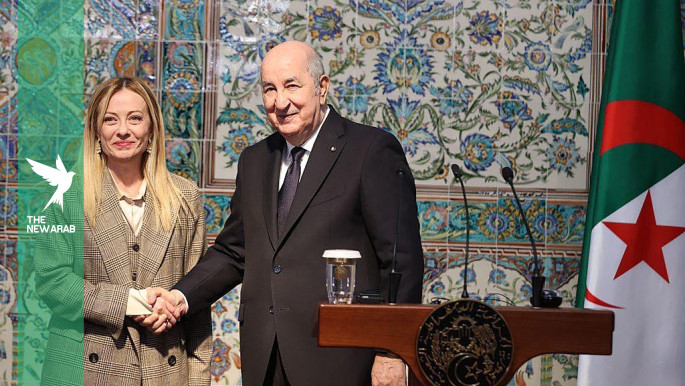
The Algerian President Abdelmadjid Tebboune receives Italian Prime Minister Giorgia Meloni at the presidential palace in Algiers, Algeria, on March 25, 2026, during an official meeting. [GETTY]
Weeks of the US-Israel war on Iran disrupted global energy flows through the Strait of Hormuz, sending prices soaring. Since then, European governments have been turning to Algeria, the North African supplier, with pipelines already connected to their continent.
When Iran retaliated against the Americans and Israelis, also implicating Gulf states that host US military bases, it shelled Qatar’s Ras Laffan facility, which is the world’s largest liquefied natural gas (LNG) hub. The attack caused significant damage and disrupted supplies, thus triggering an energy price surge.
While tanker traffic through the Strait of Hormuz dropped abruptly, gas prices in Europe rose by 35%, intensifying fears of a persistent supply squeeze.
In the Maghreb, oil-exporting countries such as Algeria and Libya seem to be the beneficiaries of the windfall. However, energy importers such as Mauritania, Morocco, and Tunisia are impatient to see the war end so that trade can be restored and oil prices lowered. Rising energy costs for these countries immediately translate into a cost-of-living crisis, energy shock, squeezing household budgets, and cascading effects throughout the economy.
Algeria sees the war as an opportunity to consolidate its position in European oil and gas markets. The country holds the tenth-largest proven natural gas reserves globally and has already strengthened its position since the Russian-Ukrainian war broke out in 2022, when European countries cut back on Russian gas. Italy and Spain are now in talks with the Algerian authorities to buy more LNG.
Spain has been largely reliant on Algerian gas, which accounted for more than 29% of the country’s gas imports. According to Reuters, Spain and Algeria are considering increasing deliveries by up to 10%.
Against this backdrop, Italian Prime Minister Giorgia Meloni’s visit to Algiers (her second since taking office), aimed at “securing energy supplies and reinforcing bilateral ties.”
Roughly 30% of Italy’s gas supply is sourced from Algeria, mainly via the TransMed subsea pipeline. And Rome is working to secure additional volumes whilst supplies from Qatar are interrupted. “We have decided to reinforce our already very solid cooperation,” Meloni said during her visit.
This trend signals a widespread rush across Europe to secure energy, as uncertainty remains following the conflict in the Persian Gulf, which continues to disrupt production and transport routes.
Iranian drones crashed into refineries in Saudi Arabia and Kuwait, as well as US bases in Bahrain and the UAE.
Despite rising demand, many observers believe that Algeria cannot entirely replace lost Gulf supplies. They claim Algeria’s LNG capacity is roughly half of Qatar’s, and ramping up production is not an overnight process.
Conversely, with 2.4 trillion cubic meters of demonstrated, recoverable natural gas and 12.2 billion barrels of proven oil reserves, Algeria is a major oil producer and Africa’s top gas exporter. This is the reason Algiers sees that high oil prices and constrained European gas supply are creating a substantial fiscal windfall, positioning the country as a key energy “lifeline” for Europe.
Because Algeria supplies gas via the TransMed and Medgaz pipelines, under the Mediterranean, rather than shipping it through threatened maritime routes, it is seen as a safer, more reliable partner for Europe during the current crisis.
With soaring oil prices reaching $114 per barrel in March, this will unquestionably provide a significant boost to the Algerian treasury. It will allow Algeria to improve its foreign exchange reserves, help narrow a budget deficit estimated at over $70 billion for 2026, and consolidate its position during the ongoing free trade agreement (FTA) negotiations with the European Union (EU).
With these windfall profits, the regime in Algiers is strengthening its strategic geopolitical position, despite high levels of corruption and weak governance.
As Algeria negotiates its complex position in the escalating war—balancing strategic ties with Iran against relationships with the US and Gulf states—it faces a precarious diplomatic dance.
Aware that public opinion in Algeria is fundamentally hostile to the US-Israel war against Iran, the Algerian regime is pursuing a pragmatic strategy: not to alienate the Trump administration by defending its ideological principles, while concurrently profiting from mounting energy prices. A guaranteed substantial additional revenue that helps the Algerian powers that be to carry on buying social peace. But not only that.
Algeria’s rulers have always masterminded their own enrichment. By leveraging the country’s hydrocarbon sector, which generates 97% of foreign export earnings, they have utilised earnings from gas and oil exports to finance a money-spinning import sector and to operate a spoils system. They also practiced clientelism and exercised cronyism, while the rank-and-file have been, and continue to be, disenfranchised by the effects of deregulation.
Willy-nilly, the war in Iran has elevated Algeria’s standing on the White House’s and the EU’s agendas as a “reliable supplier,” affording the country much-needed diplomatic weight and importance in Western energy independence strategies.
Dr. Abd-el-Kader Cheref is a Professor of Africana Studies at Southern Illinois University in Carbondale, USA. As a former Fulbright scholar, he holds a PhD from the University of Exeter in the UK. His research interests, as an academic and a freelance journalist, are primarily about politics in Africa, the MENA region, and decolonial/postcolonial studies.
Follow him on Twitter: @Abdel_Cheref
Have questions or comments? Email us at: editorial-english@newarab.com
Opinions expressed in this article remain those of the author and do not necessarily represent those of The New Arab, its editorial board or staff.