
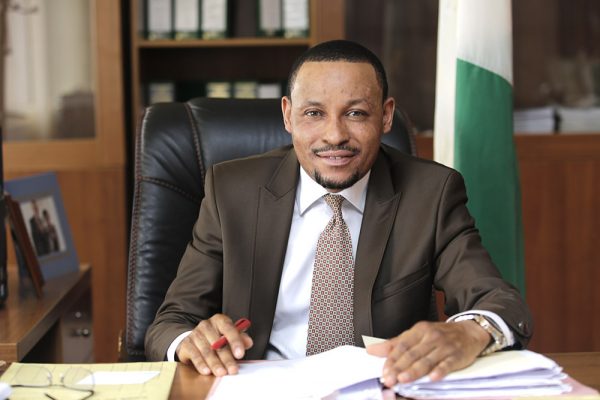
A Federal Capital Territory High Court, Maitama, on Wednesday admitted Danladi Umar, a former chairman of the Code of Conduct Tribunal (CCT), to Bail in the sum of N100 million.
In addition, the defendant is to produce one surety in like sum with proof of property ownership in Abuja.
Justice Peter Kekemeke admitted Umar to bail after his counsel, Sunday Edward, argued for it, though the prosecution counsel, Christopher Mshelia, objected.
Justice Kekemeke, in granting the bail, held that the prosecution did not prove that the defendant would interfere with proceedings.
He then adjourned until October 29 for the commencement of trial.
The Economic and Financial Crimes Commission (EFCC) had charged Umar with abuse of office in a four-count charge.
It was alleged that in 2021 he used his wife’s bank account to collect N5.5 million from a contractor engaged to paint the headquarters of the CCT in Abuja.
The anti-graft agency further alleged that on January 25, 2024, the defendant also used his wife’s account to collect N6 million from a contractor who handled the digitisation of the CCT’s records.
The defendant was also accused of directing another contractor to pay N2.43 million for the tuition fee of his daughter at Baze University, Abuja.
He was said to have committed offences that are punishable under section 19 of the Corrupt Practices and Other Related Offences Act, 2000.
Umar, however, pleaded not guilty to the charges.
Earlier, Edward, the defendant’s counsel, urged the court to grant the defendant bail.
He submitted that the defendant cooperated with the EFCC during its one-year investigation and always honoured its invitations.
He also told the court that Umar did not jump bail after the EFCC granted him one.
However, EFCC’s counsel, Mshelia, opposed the bail application, saying that the gravity of the offence carries a punishment of five years upon conviction.
He added that the nature of the evidence was different from the time he was not charged.
Mshelia told the court that the witnesses worked under the defendant.
“There is a likelihood of interference, he argued.
The court then asked him, during the investigation, “Did you grant him bail? Did he run? Mshelia replied, “No.”
The prosecution counsel further explained that during the investigation, there was no certainty that the investigation would lead to a charge, while the circumstances differed.
Thereafter, Justice Kekemeke said that he had considered their arguments and that a defendant was innocent until proven guilty.
He held that unless the prosecution proves that the defendant would interfere with the evidence, commit another crime, intimidate witnesses, conceal or destroy evidence, the defendant has the right to bail.