
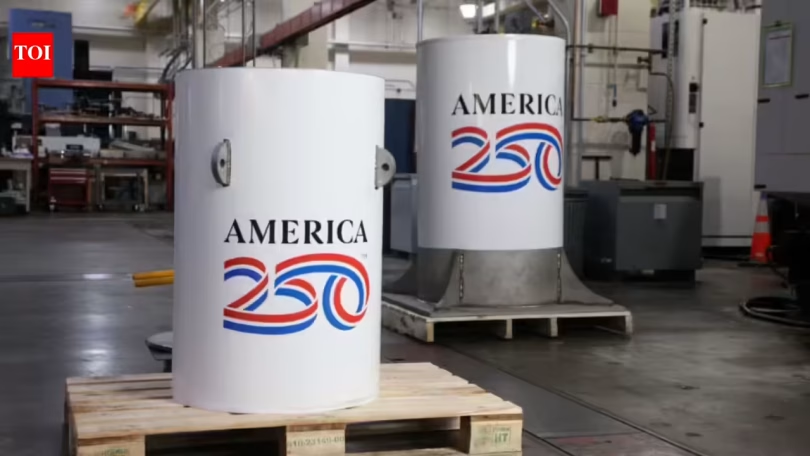
The United States has now marked its 250th anniversary, but one part of the celebration has only just begun. Beneath the ground in Philadelphia, a specially engineered time capsule has been buried with instructions that it should not be opened for another 250 years. Intended as a message to people living in 2276, it brings together objects and documents from across the country rather than focusing on a single version of American history. Every state, the District of Columbia, the five US territories and all three branches of the federal government contributed something, creating a collection that reflects different places, traditions and moments in time. The project took years to prepare, with equal attention given to preserving the contents and deciding what future generations might one day discover about life in 2026.
How America’s 250-year time capsule was built to survive for centuries
The time capsule was created under legislation passed in 2016 that established the bipartisan America250 Commission, which was responsible for organising commemorations marking 250 years since the signing of the Declaration of Independence.Rather than producing a symbolic container for display, engineers were asked to create something capable of surviving underground for two and a half centuries. The result is a stainless steel cylinder weighing roughly 900 pounds, designed specifically to resist moisture, which remains the greatest threat to long-term preservation.Its shape was carefully chosen. Cylinders distribute pressure more evenly than square containers, reducing the risk of structural damage over time. Once sealed, the capsule was enclosed inside a second protective shell that traps air around the inner chamber, helping keep groundwater away from the contents.Engineers also compressed a soft metal seal between the lid and the body of the capsule to create an airtight and watertight barrier. Before closing it permanently, every item placed inside had been stabilised at carefully controlled humidity levels intended to preserve paper and other delicate materials for generations.The capsule has been buried around ten feet below ground, where soil temperatures remain relatively stable and weather events are unlikely to affect it.
The unique items hidden inside America ‘s 250-year time capsule
Rather than asking every participant to submit the same type of object, organisers allowed each state and territory to decide how it wished to represent itself.That freedom produced an unusually varied collection. Many governments chose archival paper, sending letters, historical records, posters, poems and postcards that captured aspects of local culture, history or daily life. Others selected objects linked more directly to regional identity.New Hampshire included material reflecting its role during the American Revolution, while California looked towards the future instead of the past. State officials asked an artificial intelligence chatbot to imagine California in the year 2276. The prediction suggested highways would disappear, grizzly bears would return to the landscape, and California would become part of a fictional “Pacific Federation” alongside Oregon, Washington and British Columbia.Elsewhere, contributions ranged from historical keepsakes to highly unusual artefacts.Utah assembled one of the largest submissions, including commemorative cards, coins, documents, pins, granite discs and printed material. Arizona used nano-etching technology to reproduce the complete text of both the Declaration of Independence and the US Constitution onto a stainless steel coin.Maine contributed a bone from the endangered North Atlantic right whale, while Arkansas chose to send one of the state’s most recognisable natural resources: a diamond.
How science influenced what was sealed inside
Selecting the contents involved more than choosing meaningful objects. Every submission also had to meet strict conservation standards.Anything likely to decay over time was rejected, regardless of how strongly it represented a state’s identity. Maryland’s proposed contribution of Old Bay seasoning, for example, could not be accepted because organic materials may deteriorate during centuries underground.Native American beadwork submitted with an elk-hide backing also required changes before approval. The artwork itself remained, but it had to be mounted on a more stable fabric capable of lasting far longer than untreated animal hide.Those decisions reflected the project’s unusual balance between historical storytelling and scientific preservation. Cultural importance alone was not enough if the materials themselves could threaten the long-term survival of the collection.
How the time capsule captures life in America in 2026
The capsule does not present a single national narrative. Instead, it combines contributions that celebrate achievements alongside reminders of difficult periods in American history.Project organisers have said they deliberately avoided prescribing exactly what each participant should contribute. That approach resulted in a collection reflecting different experiences, traditions and perspectives rather than one carefully curated national message.Alongside state submissions are contributions from Congress, the presidency, the federal judiciary and America250 programmes organised throughout the anniversary year.The overall collection captures ordinary printed material, technological achievements, local history and cultural identity in equal measure. Future generations opening the capsule are likely to find as much about everyday life in 2026 as they do about major historical milestones.
America’s long tradition of national time capsules
This is not the first national time capsule linked to a major anniversary of American independence. The 1876 Centennial celebrations included the creation of the Century Safe, which remained closed until 1976, when it was opened by President Gerald Ford during the bicentennial.Another official bicentennial time capsule, prepared in 1976, remains stored at the US National Archives and is scheduled to be opened in 2076.A separate capsule is also planned for display at the US Capitol Visitor Center, meaning several generations will eventually experience different snapshots of American history prepared at different points in time.
How the US plans to preserve the time capsule until 2276
Creating the capsule was only part of the challenge. Organisers also needed a way to make sure people centuries from now know exactly where it is.The National Park Service has incorporated records about the burial site into its long-term succession planning so information can be passed between future custodians. A marker has also been installed above the burial location identifying what lies beneath and when it should be opened.For the engineers involved, the project was about more than preserving physical objects. Inside the capsule is a photograph of the construction team together with a letter written on their behalf, addressed directly to whoever eventually opens it in 2276.Rather than attempting to predict the future, the letter simply introduces the people who built the capsule and expresses the hope that the collection offers an honest picture of the country at the time it was sealed. By the time it is opened, everyone involved will be long gone, leaving the capsule itself to speak across 250 years of history.