
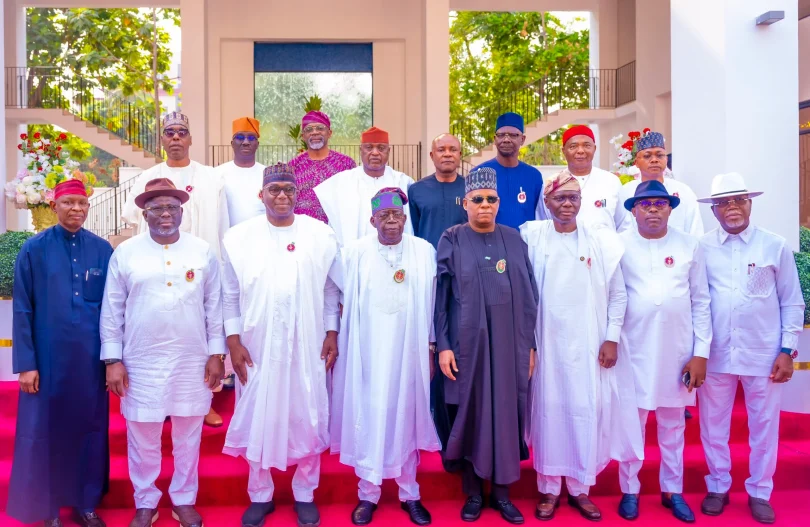
Supporters argue that decentralising the police will bring security closer to the people, improve intelligence gathering and strengthen local responses to crime.
When President Bola Tinubu transmitted the state police constitutional amendment bill to the Senate, the debate largely revolved around insecurity, banditry and the inability of the Nigeria Police Force to police a country of over 200 million people effectively.
The Senate passed the bill after more than two-thirds of senators voted in support via a manual voting process in which they raised their hands. The House of Representatives had earlier passed the bill on 11 June before proceeding on a two-week recess.
The Senate is expected to transmit its version of the bill for concurrence or harmonisation if there are areas of difference before forwarding it to the state houses of assembly for approval. The bill must receive support from at least two-thirds (24) of the 36 state houses of assembly before it is sent to the president for assent.
Supporters argue that decentralising the police will bring security closer to the people, improve intelligence gathering and strengthen local responses to crime.
But beyond security concerns, it could fundamentally alter Nigeria’s political tradition, particularly the balance of power between the federal government and state governors during elections. State governments running their own police may significantly reduce the influence that the federal government or the ruling party traditionally exercises through the police during elections.
For decades, control of the Nigerian Police Force has been one of the strongest political instruments available to the party controlling the federal government. State police could change that equation.
Currently, the president appoints the Inspector-General of Police, while operational control rests with federal authorities. Commissioners of police in the states ultimately answer to Abuja rather than to governors.
Although governors are officially the “chief security officers” of their states, in reality, they possess little direct authority over the police and other federal security agencies. Governors frequently lament that they cannot issue orders to commissioners of police, even though they are held responsible by citizens whenever security breaches occur.
The same structure also gives federal administrations substantial influence over political developments across the country.
During elections, the deployment of police personnel, security operations, enforcement activities, and election-day movement restrictions is largely coordinated from Abuja, where the president runs the country.
Opposition politicians have repeatedly accused federal administrations of using security agencies to intimidate rivals, restrict political activities or influence electoral outcomes. Whether such allegations are proven or not, the perception that control of the police translates to political advantage has remained a recurring feature of Nigerian politics.
The proposed constitutional amendment substantially alters the current arrangement.
The bill establishes state police services and state police service commissions.
Section 17 of the bill, which deals with appointment, command, direction and tenure, provides that while the Federal Police Service shall be headed by the Inspector-General of Police, the State Police Service shall be headed by a Commissioner of Police appointed by the governor of the state, subject to confirmation by the state’s House of Assembly.
Section 17(6) states that a state governor may give lawful written directives of a general policy nature to the commissioner of police of the state on matters relating to the maintenance of public safety and public order.
These sections give governors significant influence over state policing institutions, while state houses of assembly would provide legislative oversight.
The governors will also rely on Section 22, which prescribes the establishment of a State Police Service Commission to recruit personnel, oversee promotions and discipline officers within the state police structure.
The state government would also bear substantial responsibility for funding and administering the state police. Although the bill does not expressly state how governors would finance the police, the significant role assigned to state governments suggests that much of the funding would come from the states.
This arrangement effectively gives governors considerable influence over the appointment and supervision of commissioners of police in their respective states.
Under the proposed arrangement, the authority presently concentrated in Abuja would be shared with state governments. This redistribution of security powers could have profound electoral consequences.
Since 1999, federal incumbency has often carried enormous advantages. Control of security institutions has been one of those advantages.
A ruling party at the centre could deploy federal agencies nationwide, including in states controlled by opposition parties.
But state police may reduce that leverage.
If governors have control over policing institutions within their states, they may become less dependent on federal security structures.
A governor whose political interests conflict with those of the ruling party at the centre may rely on his police to resist perceived federal interference, especially during elections.
In practical terms, a governor may challenge the dominance of federal security agencies during elections if state police authorities answer primarily to the state government.
With this, there would be a more competitive political environment in states controlled by opposition parties.
Opposition parties currently control five of Nigeria’s 36 states. These are Anambra, governed by APGA; Osun, controlled by the Accord Party; and Abia, under the Labour Party. Oyo and Bauchi states are governed by the Allied Peoples Movement (APM),
The ruling APC controls 31 states as well as Abuja.
Under the existing arrangement, the federal government maintains a substantial security presence in every state through the Nigeria Police Force. However, under a state policing system, opposition governors would possess greater capacity to protect their political interests before, during and after elections.