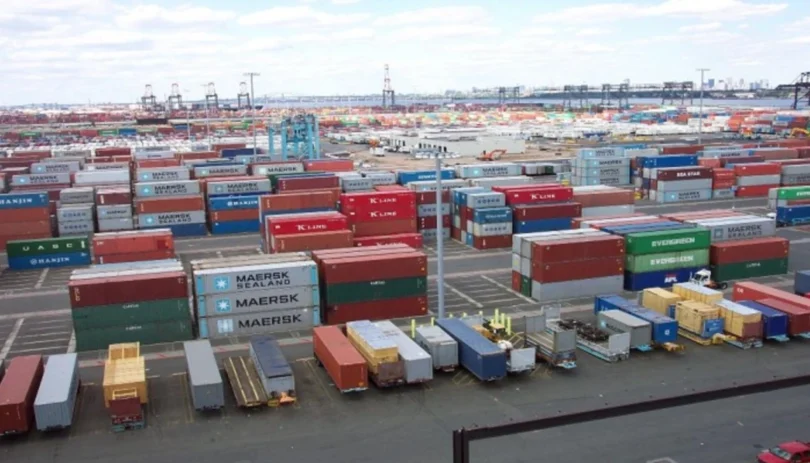
The Nigeria Customs Service (NCS), Apapa Area Command, recorded N28.1 billion in revenue in a single day on August 18, 2026, setting a new record for the command.
The development was disclosed by the command’s Public Relations Officer, Chief Superintendent of Customs Isah Sulaiman, according to a statement by the Service on Sunday.
The command collected exactly N28,102,000,914.61 within 24 hours, surpassing its previous single-day revenue record of N20.1 billion set in September 2025.
What they are saying
The Customs Area Controller, Apapa Area Command, Comptroller Emmanuel Oshoba, said the new revenue record goes beyond the amount collected, stressing its contribution to national development.
He attributed the performance to the continued support for Customs modernisation, automation and reforms, while commending compliant importers, exporters, licensed Customs agents and other stakeholders.
- “The Nigeria Customs Service (NCS), Apapa Area Command, has set a new single-day revenue record, generating N28.1 billion within 24 hours on Tuesday, 18 August 2026.
- “According to the Command’s Public Relations Officer, Chief Superintendent of Customs Isah Sulaiman, the Command generated N28,102,000,914.61, surpassing its previous daily record of N20.1 billion achieved in September 2025,” the statement read in part.
The latest record comes weeks after the command generated an unprecedented N323 billion in revenue in July 2026.
Get up to speed
The strong revenue performance at Apapa comes as the Nigerian Ports Authority (NPA) targets N1.489 trillion in internally generated revenue for the 2026 fiscal year, up from its N1.468 trillion projection for 2025.
- The NPA has linked future revenue growth to the modernisation of major ports, particularly Apapa and Tin Can Island ports, which are ageing and require significant infrastructure upgrades.
- Apapa Port is about 100 years old, while Tin Can Island Port has operated for more than 50 years.
- Earlier in March, the Federal Government unveiled a £746 million financing agreement with the United Kingdom, backed by UK Export Finance, to support the modernisation of key seaports, including Apapa and Tin Can Island.
- The programme is expected to introduce advanced cargo-handling systems, expand port capacity and digitalise operations to reduce congestion.
The government has also launched Phase 1 of the National Single Window, which is aimed at reducing average cargo dwell time from 21 days to under seven days by 2026.
What you should know
Apapa Port remains Nigeria’s dominant trade gateway, but the Lekki Deep Sea Port is steadily gaining ground as cargo activity becomes more distributed across the country’s major ports.
Nairametrics reached this conclusion after reviewing the National Bureau of Statistics (NBS) Q1 2026 Foreign Trade in Goods Statistics Report and comparing its “Trade by Top 10 Posts/Ports of Operation” data with the corresponding Q1 2025 figures.
- Apapa recorded N15.48 trillion in exports in Q1 2026, down from N17.74 trillion in Q1 2025, while its share of total exports fell from 86.12% to 73.14%.
- Lekki’s exports rose to N3.29 trillion from N303.62 billion, lifting its share of total exports from 1.47% to 15.53%. Its imports increased to N2.51 trillion from N1.70 trillion, raising its share from 10.99% to 18.43%.
- Tin Can Island Port recorded N1.95 trillion in imports, unchanged from the previous year, while exports declined to N883.93 billion from N1.49 trillion.
- Onne Port recorded N1.23 trillion in imports and N743.18 billion in exports, while Lagos Free Trade Zone recorded N309.12 billion in imports and N83.84 billion in exports.
The Lekki Deep Sea Port, which became operational in April 2023, has increasingly served companies operating around the Lekki Free Trade Zone, including major industrial and manufacturing investments such as the Dangote Refinery. Its growth places Lekki ahead of Tin Can Island Port and Onne Port in overall trade contribution and reinforces its emergence as a major secondary hub in Nigeria’s maritime network.