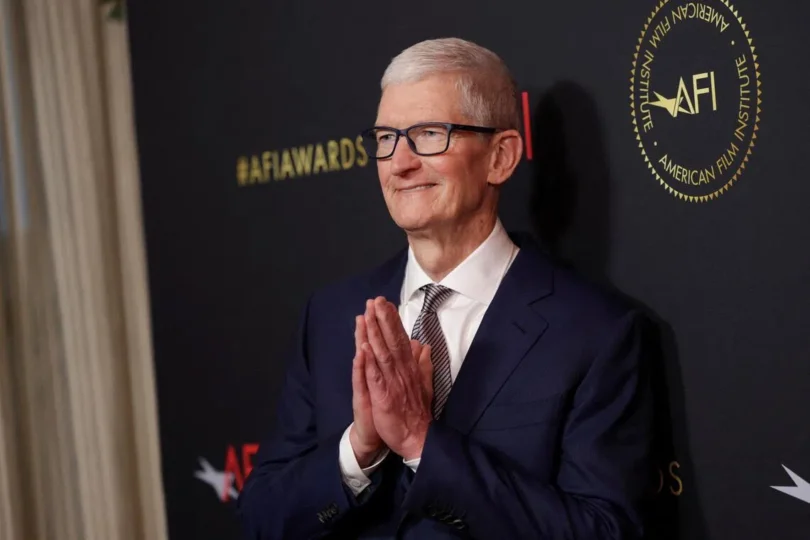
Fifteen years after succeeding Steve Jobs, Mr Tim Cook is handing over the top leadership position at Apple to hardware specialist John Ternus.
The outgoing chief executive officer, who’ll stay on as executive chairman, built up an unprecedented record of success over his tenure. Here are some of the numerical highlights.
Cupertino, California-based Apple was already a hugely influential company back in 2011, but with Mr Cook as CEO the company grew its market capitalisation tenfold.
Valued at just under US$350 billion (S$445 billion) on Aug 24, 2011 – when he took over – it was the first to set several new highs for market valuation and currently sits at US$4.01 trillion.
Apple’s market value is today roughly equivalent to the size of Britain’s economy, the world’s fifth largest. Remarkably, that lofty number isn’t enough to make Apple the most valuable business, as Silicon Valley peers Alphabet and Nvidia have pulled ahead in the AI age.
The fiscal year ending September 2025 brought in US$112 billion in net income for Apple, eight times what the company achieved in September 2010.
That 699 per cent profit improvement has come despite a plateauing of smartphone sales, the Covid crisis, supply chain snarls and geopolitical tensions between the US and Apple’s main manufacturing base, China.
Mr Cook expanded the budding iPhone and App Store ecosystem with a succession of complementary devices, from iPads at various sizes to Apple Watches at multiple price points and an expansive range of Made for iPhone accessories.
Under his leadership, Apple never returned to the nomenclature of starting new product names with “i”, but he did everything to maximise the earning potential of that portfolio.
“When Tim Cook came over, there was a ton of doubt,” said Gerber Kawasaki Wealth and Investment Management co-founder and CEO Ross Gerber. But “he’s done a phenomenal job over the years”.
Apple in January reported it has an installed base of more than 2.5 billion active devices. The company sold its billionth iPhone in the summer of 2016, when Mr Cook held up the boxed handset at a staff meeting.
“We never set out to make the most, but we’ve always set out to make the best products that make a difference,” the CEO said at the time.
The most recent holiday period was a record across several company metrics: revenue, iPhone sales and income from services.
While Mr Cook hasn’t broken much new ground with entirely novel products – the Apple car project was scrapped and the Vision Pro remains a niche – he’s built up a cohesive ecosystem that keeps people coming back for more.
Cook inherited one of the world’s most-respected retail operations, and built it up. He’s added roughly 200 stores to Apple’s global network and, importantly, expanded its mainland China presence dramatically.
Apple now has 50 stores across locations like Chongqing, Guangdong, Hubei and Yunnan, reaching vastly more consumers in the world’s biggest market for smartphones and PCs.
Apple’s success in China stands out among US Big Tech peers, with many like Google and Meta Platforms largely shut out from the consumer arena.
In 2017, Apple and Samsung Electronics made the fateful decision to test the US$1,000 boundary for smartphone pricing. The two global leaders both introduced devices that for the first time nudged up against and, with upgrades, pushed beyond that threshold.
Each year since then has produced pricier options and additions – with Apple’s expansion into Pro and Max variations of the iPhone levelling up the average selling price each year.
After the original iPhone was famously lampooned by then-Microsoft-CEO Steve Ballmer for being too expensive at US$500 with subsidies, modern-day editions of the smartphone habitually cost twice as much.
In 2011, Apple’s average selling price for iPhones was US$712, but by 2025 that figure stood at US$1,070, according to market research firm IDC.
Mr Cook oversaw the move up into higher pricing strata, which in 2026 helped Apple withstand the memory chip crunch better than Chinese rivals more dependent on budget devices.
Mr Cook has championed several environmental efforts at Apple, including greater use of recycled metals and cutting down on greenhouse gas emissions and excess packaging.
Apple avoided the use of 15,000 tons of plastic over the past five years – the rough equivalent of 500 million plastic bottles – by redesigning its packaging, according to its environmental report in April.
The new MacBook Neo ranks as Apple’s lowest-carbon MacBook ever, according to the company, with 60 per cent of its materials coming from recycling. It still has significant work ahead to achieve its ambition of carbon neutrality across its value chain by 2030.
Apple Park, the expansive and futuristic headquarters that Jobs first envisioned years earlier, came to fruition under Mr Cook’s leadership in 2017. The 175-acre (70.8ha) campus – large enough to accommodate 100 American football fields with room to spare – houses more than 12,000 staff, 17 megawatts of rooftop solar energy generation and two miles of parkland paths for employees.
It also has an orchard, meadow and a pond, according to Apple, which now habitually features its home base as the setting for new product launch videos.
As of the end of September, Apple had 166,000 global employees, with millions more employed in the production and supply chain for its products.
A major part of Mr Cook’s legacy will be a US$600 billion US spending commitment he made in 2025.
Apple’s biggest investment plan ever, the outlay will go toward supporting 20,000 new jobs, data centre expansion, Apple Intelligence infrastructure and production of servers in Houston, the company said.
The announcement was part of his work with the Donald Trump administration to avert punishing tariffs on iPhone imports to the US.
As his successor, Mr Ternus will have to live up to Mr Cook’s promises while also striking a fine balance between Apple’s interests at home and those in key overseas markets like China. Bloomberg