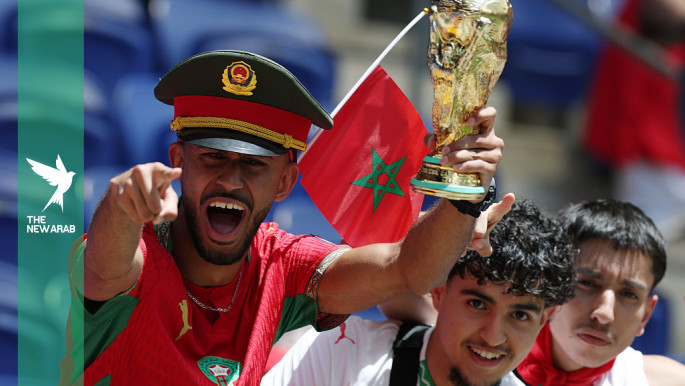
When Morocco beat Portugal and Spain and stood ninety minutes from a World Cup final, the entire Arab world held its breath and allowed itself to believe the impossible, writes Melo Doumani. [GETTY]
She was born in England, raised in England, and supports England. But when you ask her where her heart is, she doesn’t hesitate. Egypt. Always Egypt. She was one of dozens of Arab fans I spoke to in Dubai while documenting football communities across the Gulf. What she said confirmed something I had been hearing, in different words, from Moroccans, Jordanians, Saudis, Lebanese, Iraqis, and Emiratis alike. “This isn’t an attractive World Cup,” she told me. “Not because of the football. Because of everything around it.”
That tension between loving the game and resenting the tournament is the story of Arab fans at the 2026 World Cup. It is a story that most English-language coverage will miss entirely.
There is genuine pride in Arab football this summer. Iraq qualified. Jordan qualified. Saudi Arabia, Morocco, Egypt, Algeria, Tunisia, and Qatar are all represented. For fans scattered across a diaspora that stretches from London to Amman to the Gulf, seeing a national flag on a shirt at a World Cup carries an emotional weight that no broadcaster can fully translate.
The Arab commentator understands this instinctively. Even in a goalless draw between two nations with no Arab connection, they will find the human story. The inflated tension, the manic excitement, the insistence of hope — because that is what the Arab viewer navigates towards. Not the spectacle. The humanity.
But humanity has been systematically stripped from this tournament before a ball has been kicked. Omar Abdulkadir Artan, a Somali Muslim referee, the continent’s best of his year, was denied entry to the United States. Moroccan fans have been blocked at the borders. Iranian players were exiled despite earning the right to compete in specific American cities. Not to mention, the extortionate ticket prices, travel costs, and accommodation price out the very people the tournament claims to celebrate.
FIFA president Gianni Infantino called this a “celebration of humanity.” The fans watching from Dubai, Cairo, Beirut, and Amman are watching a celebration of something else entirely. They know it. They have learned to accept it. And that acceptance is itself a kind of grief.
The format makes it worse. Forty-eight teams. A group stage that functions as a warm-up. The tournament doesn’t truly begin until the round of thirty-two. And when Algeria faces Argentina, a match that carries enormous weight for Arab fans across North Africa, it will kick off at five in the morning UAE time. Prime time for the Americas. An afterthought for the Arab world, as well as many regions around the world.
The message is not subtle. Geopolitically, commercially, and logistically, Arab fans have been told to take the back seat. They have learned to accept being devalued. And this indifference runs through every decision the organisers have made.
So why will they watch? Why will millions of Arab fans across the diaspora set their alarms, gather in living rooms, crowd into sports bars, and feel everything they have always felt?
Because their team was never supposed to be there. Because when Morocco beat Portugal and Spain and stood ninety minutes from a World Cup final, the entire Arab world held its breath and allowed itself to believe the impossible. Because when Saudi Arabia beat the eventual winners of that tournament, Argentina, in 2022, arguably the greatest upset in the tournament’s modern history, it was a moment of collective joy.
The intensity overwhelmed every grievance, every slight, every visa denial, overpriced ticket and disrespectful kick-off time.
That animalistic joy, the kind that gives you goosebumps, that turns to tears before you understand why you are crying, is not something that politicians or corporations or host nations can manufacture or take away. It lives in the connection between the fan and the player, in the sweat-drenched shirt, in the weight of its flag, and in the name of the country sung by a commentator who means every word.
I know this feeling from the inside. In the summer of 2006, Israel was bombing Beirut. Not metaphorically. Not as a news headline from a safe distance. From where I sat, in a near-deserted city, I watched the World Cup on a sixteen-inch television because there was nothing else to do with the fear except refuse to let it win. The streets were quiet in ways they should never be. The tournament was a distraction, and we knew it was, and we chose it anyway.
My friend and I watched the final together — France against Italy — and when Zinedine Zidane, the greatest player of his generation, an Algerian-French son of immigrants, was sent off for headbutting Marco Materazzi in the chest, we were in shock. That moment is now immortalised, literally cast in bronze in the Arab Museum of Modern Art in Doha. We celebrated Italy’s win. He braved the streets on his return home while bombs were still falling somewhere not far enough away.
That friend still lives through it. His family still lives through it. And yet he will find a bar, pull up a stool, and watch the World Cup this summer. Not because the tournament deserves his attention, but because the game offers what nothing else can in that moment. A reason to feel something other than what the bombs, the blockades, and the borders are trying to make him feel.
The 2026 World Cup is emblematic of all of it. The obstacles, the injustices, the design of a tournament that makes Arab fans feel like outsiders to something that belongs to them. But they will show up. They always do. Because the game and the tournament are two entirely different things. FIFA owns the tournament. Nobody owns the game.
Arab fans will watch the 2026 World Cup not because the tournament deserves them. They will watch because when their team scores, when their players win, when the impossible briefly becomes real on that pitch, they will feel human again. They will feel again. And in a tournament that has done everything in its power to make them feel otherwise, that moment of joy is an act of resistance.
Football is a money game, and the FIFA World Cup is the goldmine that will never run out. What FIFA has failed to comprehend, despite their insistence, is that football doesn’t belong to them. It belongs to everyone who appreciates the art of the gesture, the beauty of simplicity, and the spontaneity of emotions. It belongs to the fans. Without the fans, there is no football.
W. Melo Doumani is a football journalist and documentary filmmaker based in Dubai. He has 13 years of experience across Arab News, The Watch Post, and Meer, and is the founder of The Reflective Football — a fan-first documentary media network covering football communities across the UAE. He is currently documenting the World Cup at multiple venues across Dubai including the Coca-Cola FanZone in Dubai. The content lives on YouTube @TheReflectiveFootball. His philosophy: Football is nothing without the fans.
You can follow Melo on Instagram: @TheReflectiveFootball
Have questions or comments? Email us at: editorial-english@newarab.com
Opinions expressed in this article remain those of the author and do not necessarily represent those of The New Arab, its editorial board or staff.