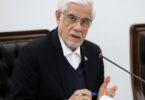
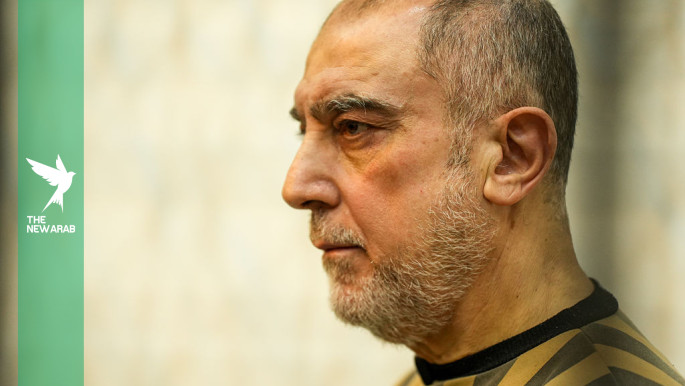
Atef Najib, cousin of former leader Bashar al-Assad, appears before a court in Damascus on 10 May 2026. [Getty]
A former Assad security official accused of human rights abuses during the 2011 Syrian uprising denied all charges against him during the second session of his ongoing trial on 10 May.
Atef Najib – the cousin of former dictator Bashar al-Assad – has been charged with acts amounting to “war crimes” during his time leading the political security branch in Daraa province.
The alleged abuses include the arrest and torture of children and the use of lethal force against peaceful protesters.
A video of the court proceedings released by the justice ministry on Saturday showed Najib denying all the charges and claiming that other security agencies were responsible for the crimes.
The opening of Sunday’s session was shown on Syrian TV before the judge ordered the live broadcast be suspended for witness and the defendant’s testimonies.
When questioned by the judge, Najib denied that his branch had detained children accused of writing anti-regime slogans on the walls of a Daraa school and claimed the military security branch had been responsible.
He also accused air force intelligence and the military and state security branches of opening fire on demonstrators. He claimed to have resisted pressure from the then-national security chief, Hisham Bakhtiar, to violently crack down on the protests.
Najib has been accused of authorising the killing of protesters staging a sit-in in Daraa’s Al-Omari Mosque in March 2011. He is also accused of overseeing “torture leading to death” at the branch’s detention facilities.
The landmark proceedings mark the first time an Assad official has stood trial for crimes committed during the uprising.
Security forces arrested Najib in Latakia province in January 2025 amid efforts by the new government to locate former regime officials. He is one of many figures currently awaiting trial.
Najib oversaw political security in Daraa, where the arrest and torture of students who wrote anti-Assad graffiti sparked the broader revolution.
He first appeared in the Fourth Criminal Court for a preparatory hearing on 26 April before returning on Sunday.
During the session, he told Judge Fakhr al-Din al-Aryan that he had headed the political security branch for only a few days after the start of the uprising and was dismissed on 22 March.
He also denied that his proximity to the president gave him influence over other agencies involved in the suppression of the protests.
The revolution began in Daraa on 15 March 2011 after the detention and torture of the students triggered protests.
Security forces violently cracked down on peaceful demonstrations and fired live ammunition to disperse sit-ins at several locations.
The next session of the trial will be held on 19 May.