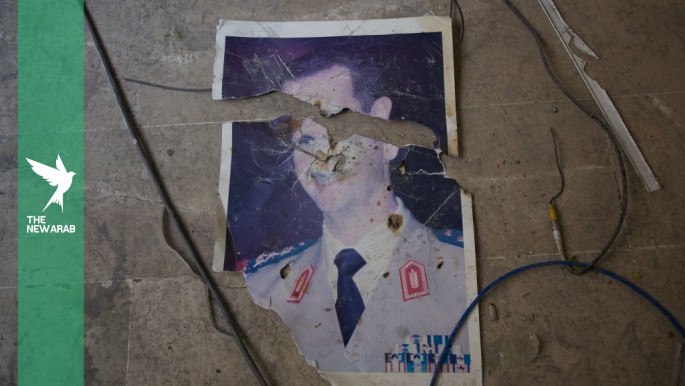
The trials are the first against those of officials of the now fallen Assad regime [Getty]
Several figures from the former Assad regime are set to go on trial in Damascus in the coming days, as Syria prepares to launch its first public prosecutions under a transitional justice process.
Many Syrians are awaiting the start of the trials, which are being framed as part of efforts to hold former officials accountable for abuses committed during the years of the Syrian uprising and conflict.
Atef Najib, a former brigadier general under the ousted regime, is set to appear on Sunday before the Criminal Court in Damascus, becoming the first defendant to stand trial as part of the country’s transitional justice track.
“The judicial bodies overseeing this case, including prosecution, investigation, referral, and the criminal court, belong to the specialised judiciary for transitional justice,” lawyer Radif Mustafa, a member of the Transitional Justice Commission, told The New Arab.
Najib is the former head of political security in south Syria’s Daraa province, where the Syrian uprising first broke out in March 2011. He is accused of orchestrating a brutal crackdown there, in which scores of unarmed protesters were killed.
Najib is also a cousin of Bashar al-Assad.
Legal expert Ghazwan Qaranfal described the move to put him on trial as broadly positive but raised concerns about the legal framework.
“The trial of any person accused of committing crimes against Syrians, whether war crimes, genocide, or crimes against humanity, is a positive step that responds to public demands,” he told The New Arab.
However, he added that it would have been preferable to first adopt a dedicated transitional justice law to guide the process.
“I still believe it would have been better for a specific transitional justice law to be issued first, providing a clear framework for its various tracks, including accountability,” he said.
The Syrian parliament is due to vote on the law soon.
“Yes, what happened [under Assad] can be described as murder or causing death under current law, but that would be an insulting characterisation for the victims. It would have been better to expedite the issuance of a transitional justice law,” he added.
Fadel Abdul Ghany, head of the Syrian Network for Human Rights, said the organisation would monitor the proceedings, describing delays in bringing defendants to court as “natural”, noting that investigations take time.
Last year, Syria’s public prosecution initiated cases against several figures from the former regime who were arrested and referred to an investigating judge.
Those set to be tried after Najib include former Grand Mufti Ahmad Badr al-Din Hassoun, who is accused of inciting the killing of Syrians, as well as Mohammad al-Shaar, a former interior minister, and Ibrahim al-Hweija, the former head of Air Force Intelligence, widely regarded as one of the most lethal and abusive security bodies during the rule of the Assad regime.
The ministry official said trials would follow for another of Assad’s cousins, Wassim al-Assad, who was the head of death squads and militias during the war, as well as allegedly being responsible for large-scale smuggling operations of the drug Captagon.
Since the fall of the regime in December of the previous year, the interior ministry has detained a large number of individuals accused of committing or participating in massacres against civilians during the years of the uprising.
Among them are army and security officers, pilots, and militia members, including Amjad Youssef, the main suspect in the notorious 2013 Tadamon massacre in southern Damascus, in which dozens of unarmed civilians were executed by regime forces.
In May 2025, an independent body known as the National Transitional Justice Commission was established.
Its mandate includes uncovering the facts regarding serious violations committed under the Assad regime, holding those responsible accountable in coordination with relevant authorities, providing restitution to victims, and promoting principles of non-recurrence and national reconciliation.