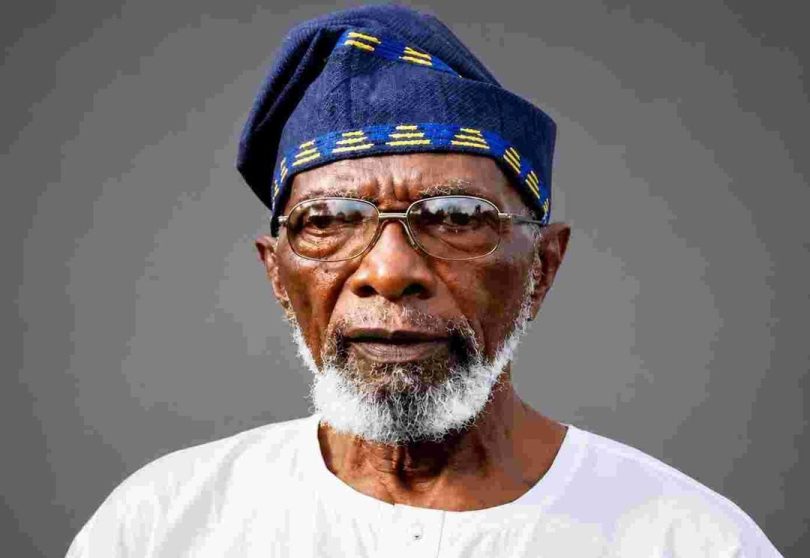
Writing in tribute, political scientist Jibrin Ibrahim remembered Mr Osoba not just as a brilliant historian but as one of a rare kind.
On the morning of 14 May, in his quiet bedroom in Ijebu Ode, Ogun State, an old man’s breathing simply stopped; the final breath left the modest bedroom of a man who had spent ninety-two years refusing to let power write its own history.
Samuel Olusegun Osoba, one of Nigeria’s best-known social historians, closed his eyes, and in that soft, unremarkable moment, Nigeria lost one of its last living links to a genuinely radical intellectual tradition.
He was not a kingmaker, not a court historian, but an academic rebel. For a generation of Nigerian scholars who came of age cutting their teeth on his lectures, who learned the mechanics of class struggle and colonial extraction rather than the genealogies of emirs, obas, and governors, Mr Osoba’s death was never felt as the mere end of a career. It landed, instead, like the slow, heavy shutter of a library door closing on an entire canon of subversive thought.
Those who sat in his classes remember a teacher with no patience for “great men” history, the kind told through statues and state portraits. To Mr Osoba, history was the record of an ongoing fight between the people who did the work and the people who took the profit: between the farmer, the trader, the schoolteacher, and the political class that took over from the British in 1960 and, as he saw it, simply put on new clothes over the old arrangement.
Toye Olorode, a professor of plant genetics and one of Mr Osoba’s closest comrades from their days together as socialists at the University of Ife, now Obafemi Awolowo University, put it simply when he marked his friend’s passing: Osoba was “a foremost patriot, social historian, committed socialist, exemplary teacher, and humanist.”
That could have been read as the standard kindness people offer the dead, except that nearly fifty years earlier, those same convictions had already produced something the Nigerian establishment worked hard to make everyone forget.
Writing in tribute, political scientist Jibrin Ibrahim remembered Mr Osoba not just as a brilliant historian but as one of a rare kind, a scholar who held together learning, principle, mentorship, and public purpose all at once. Mr Ibrahim mourned that Mr Osoba belonged to a generation that measured itself by conviction rather than by what it accumulated, and worried openly that Nigeria is running short of young intellectuals cut from the same cloth. He pointed to three essays he believes anyone serious about understanding Nigeria’s political economy should still be reading today: “Ideological Trends in the Nigerian National Liberation Movement,” “The Nigerian Power Elite, 1952–65,” and “The Deepening Crisis of the Nigerian National Bourgeoisie.” Taken together, Mr Ibrahim argued, these essays remain some of the clearest explanations anywhere of why Nigeria’s ruling class never built the nation it promised after independence.
That refusal to chase status for its own sake ran through Mr Osoba’s whole career, not just his writing. Fully qualified for a professorship, and at one point approved for it, he was denied the promotion under a vice-chancellor in the 1980s, and rather than resubmit and play along, he simply never applied again. For the rest of his working life, he stayed “Dr Segun Osoba,” a small, quiet protest that outlasted the men who tried to hold him back.
A younger generation of Mr Osoba’s fiercest disciples, Ibrahim Abdullah, a professor of history at the University of Sierra Leone, contended that “Osoba’s unbundling of the contradictory tendencies within what he calls the national liberation movement; the centrality of ethnicity and regionalism in contouring these movements; and the perennial factionalism from the 1930 to the era of decolonisation, became foundational in a context where history writing became fused with history making. At every point in this denouement of nation-making/unmaking, from the 1930s right up to the immediate post-colonial period, the contending social forces and their conflicting economic interests are presented and analysed.”
On a more laudatory level, however, the now-famous historian, Toyin Falola, student of Mr Osoba, currently professor at the University of Texas, generously described him as his “most consequential university teacher,” offering that “Dr Osoba lived simply, taught fiercely and conscientiously, and remembered every student who passed through his class.” To sit in Mr Osoba’s lecture room, Mr Falola remarked, “was to have Nigeria rearranged in your head: the kings and generals moved to the background, the farmers, workers, women, minorities and the ‘hoi polloi’, in general, moved to the front. That was him, his morality, and the way he saw life.”
It was that same stubbornness that shaped what remains his most defiant piece of work. In 1976 and 1977, as the military government of the day convened a Constituent Assembly to write what would become the 1979 constitution, Mr Osoba and his fellow Marxist historian Yusufu Bala Usman refused to sign the version everyone else agreed on. Instead, the two men wrote sixty-five pages of open dissent: the “Minority Report and Draft Constitution for the Federal Republic of Nigeria, 1976.”
Their argument was blunt: the document on the table wasn’t a compact for the nation; it was a compact for the elite. Where the majority draft wrapped sitting presidents and governors in immunity, Mr Osoba and Mr Bala Usman wanted that immunity torn away. Where it offered only nice-sounding promises about welfare, they demanded a justiciable “Fundamental Objectives and Directive Principles of State Policy” language that would have let ordinary Nigerians actually sue the government for failing to deliver free education, healthcare, and jobs.
The report was rejected, and Nigeria got its elite pact anyway. But it never quite disappeared. Scholars and activists keep dusting it off whenever the country’s governance failures make its warnings sound less like radical fantasy and more like something Mr Osoba and Mr Bala Usman simply saw coming.
Now, more than two months after his death, the community of scholars and activists he helped build is gathering again not to grieve a second time, but to put his arguments back to work.
On Tuesday morning, 28 July, the Second Symposium in Honour of Dr Segun Osoba will be held at the BON Elvis Hotel, 2 Monrovia Street, Wuse 2, Abuja, under the theme “Segun Osoba, Radical Historiography and the Defence of the Common People.” Human rights lawyer Femi Falana, whose own career reads like an extension of Mr Osoba’s convictions, will chair the event. The speakers are people whose thinking Mr Osoba shaped directly: Toye Olorode; Jibrin Ibrahim, a professor of political science and public intellectual; Hauwa Mustapha, radical trade unionist; and Olutayo Adesina, a history professor.
The symposium carries the fingerprints of the institution most tied to Mr Osoba’s later years, the Yusufu Bala Usman Institute, which he chaired until his final days, and which keeps the minority report in print, now reissued with a new introduction bearing both his name and his late co-author’s. Behind the logistics of Tuesday’s event is the Centre for Information Technology and Development (CITAD), the Kano-based civic organisation.
For a man who spent his whole scholarly life insisting that history belongs to ordinary people and not to the powerful, that may be exactly the kind of tribute he would have wanted. Not a statue. Not a renamed street. Just a room full of people still willing to argue his case. As the organisers put it, in words plain enough that Mr Osoba himself might have approved, all are cordially invited.