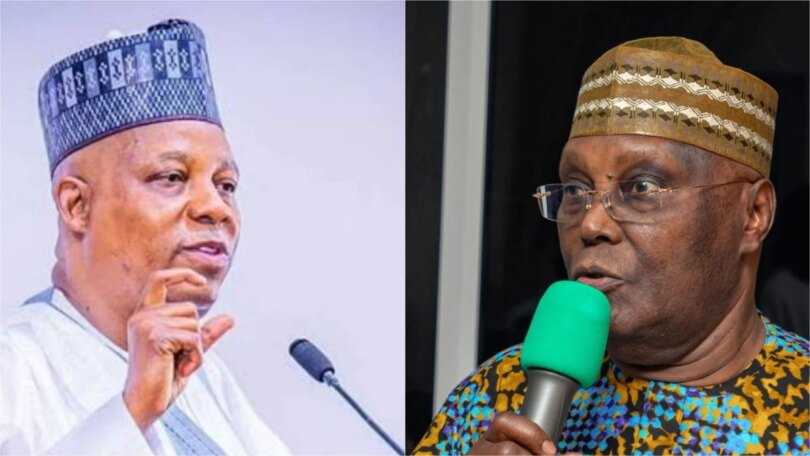
Vice President Kashim Shettima has criticised former Vice President Atiku Abubakar over his proposal to restore the petrol subsidy.
The former Borno State governor questioned Atiku’s ability to manage Nigeria’s modern economy.
Shettima argued that Atiku’s proposal would return the country to poverty, accusing the former vice president of supporting the policy for political convenience rather than prioritising the economic interests of the country.
The vice president made the remarks on Monday while speaking at the Nigerian Economic Summit in Abuja.
At the summit, Shettima defended the administration of President Bola Tinubu over its decision to remove the petrol subsidy in May 2023.
“One of the leading presidential candidates is advocating for the return of the subsidy scheme. He wants us to backslide into penury for political convenience,” Shettima said.
He subsequently questioned Atiku’s professional background, referring to his training at the Kano School of Hygiene as he challenged his ability to manage the country’s economy.
“I dare to put forward that his skill set — he was trained in sanitation at the Kano School of Hygiene — so he doesn’t have the skill set to govern a modern economy. That’s the painful truth,” the vice president said.
Shettima also questioned Atiku’s knowledge of environmental sanitation.
“Even his decisions in environmental sanitation, I do not think he can make a distinction between flu and even Ebola,” he added.
The vice president urged Nigerians, particularly members of the country’s economic community, to carefully consider the policies and qualifications of political leaders before making decisions about the country’s future.
“Nigerians must have to decide and those of you here cannot afford to play the ostrich,” Shettima said.
Atiku, who is seeking the presidency on the platform of the African Democratic Congress (ADC), has advocated the restoration of the petrol subsidy as part of his proposed approach to managing Nigeria’s economy.
The disagreement over the subsidy has become a major issue in the political exchanges between the ruling All Progressives Congress (APC) and opposition parties ahead of the 2027 elections.
President Tinubu announced the removal of the petrol subsidy during his inauguration on May 29, 2023, declaring that the government could no longer sustain the arrangement. The administration has defended the decision as necessary to reduce the financial burden on public finances and redirect resources towards other areas of national development.
However, the policy has been accompanied by higher petrol prices and increased living costs for many Nigerians, with opposition figures repeatedly questioning the government’s handling of the resulting economic hardship.
As previously reported, the vice president earlier dismissed the presidential credentials of Nigeria Democratic Congress (NDC) candidate Peter Obi, claiming that the former Anambra State governor had little to offer Nigerians beyond quoting economic statistics.
Speaking at the event in Abuja, Shettima said he respected Obi for stating that he would not restore the petrol subsidy but argued that the former governor relied excessively on economic figures.
“I respect Peter Obi for having the courage to say he’s not going to restore the petrol subsidy, but beyond spouting some statistics, Mr Peter Obi has absolutely nothing to offer,” Shettima said.
He also called on members of Nigeria’s economic community to support the Tinubu administration, arguing that the government’s policies were necessary to address longstanding problems in the country’s economy.
The vice president compared petrol prices in Nigeria with those in neighbouring countries, citing figures of approximately N1,148.36 per litre in Niger Republic, N1,729.29 in Benin Republic and N1,945.50 in Cameroon, compared with N1,390 in Nigeria.
“What is the price of fuel in our neighbouring communities? A few years ago, Nigeria was consuming around 67 million litres of fuel per day,” he said.
“The comparison is wide. Nigeria was Christmas for other African countries,” Shettima added.