
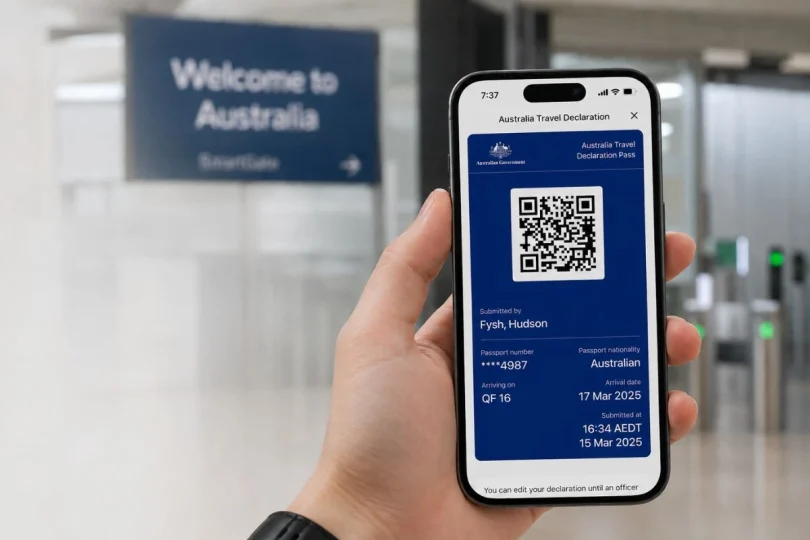
Australia has begun rolling out a new digital travel declaration system that will gradually replace the long-standing paper Incoming Passenger Card used by international travellers entering the country.
The Australian government announced the initiative, as part of a broader effort to modernise border processing and improve passenger experience at airports and seaports.
The project is backed by an investment of A$56.1 million over four years and is expected to be fully implemented nationwide within the next 12 to 18 months, Travel Biz reported.
The new Australia Travel Declaration will allow travellers to submit customs, travel and biosecurity information digitally before departure, reducing paperwork upon arrival and enabling border authorities to process passenger information more efficiently.
What they are saying
Under the current pilot arrangement, eligible passengers receive invitations through the Qantas mobile application and can complete the declaration up to 72 hours before departure.
- Once submitted, travellers receive a QR code that can be presented to border officials upon arrival in Australia.
- The Australian government has indicated that future versions of the system will likely be integrated into airline applications, enabling passengers to complete travel declarations seamlessly as part of their travel preparation process.
- Authorities have yet to announce a full airport-by-airport rollout schedule or launch a public portal for all international travellers.
- Australian officials have clarified that the digital travel declaration will not replace existing visa requirements.
Travellers will still be required to obtain the appropriate Australian visa or Electronic Travel Authority (ETA) before travelling. The new declaration is intended solely to replace the paper arrival card currently completed during flights or upon arrival.
The declaration will collect information related to customs, travel history and biosecurity compliance, helping authorities assess potential risks before passengers enter the country.
More insight
While the nationwide rollout is only beginning, the digital declaration has already undergone extensive testing.
- Australia first introduced pilot trials in October 2024 on selected Qantas flights arriving from New Zealand before expanding the programme to major gateways including Sydney, Melbourne and Brisbane.
- According to Australian authorities, more than 450,000 passengers have already completed the digital declaration during the testing phase, providing confidence for a wider rollout across the country.
Perth and Adelaide are expected to join the expanded pilot programme before the end of 2026 as authorities continue preparations for nationwide implementation.
What you should know
Earlier this year, Nairametrics reported that Australia raised the minimum salary threshold for employer-sponsored visas to AUD 76,515 (about $52,545) for most skilled migration categories. The revised income benchmark was introduced to align foreign workers’ wages with domestic pay standards and ensure migrant workers are not underpaid relative to Australian employees.
The policy applies to several major employer-sponsored visa pathways, including the Skills in Demand (subclass 482), Employer Nomination Scheme (subclass 186), Skilled Employer Sponsored Regional (subclass 494), and Regional Sponsored Migration Scheme (subclass 187).
In November 2025, Australia also confirmed 20,350 places for its 2025/2026 skilled migration programme across the Subclass 190 (Skilled Nominated) and Subclass 491 (Skilled Work Regional) visas. While the programme reflected tighter migration planning, it remained part of the country’s strategy to address persistent labour shortages.