
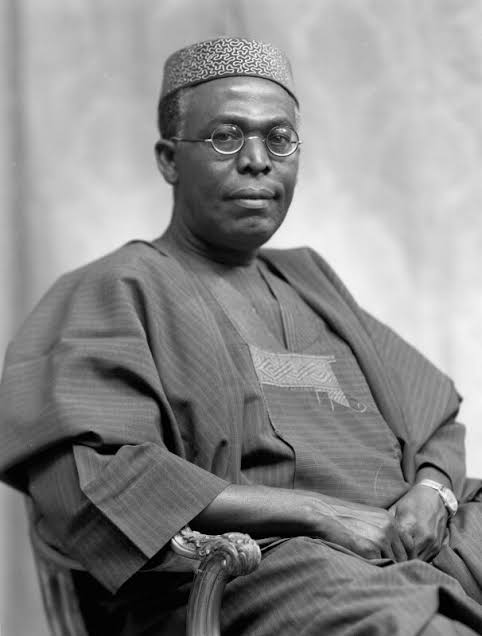
The Hero Loved in Yorubaland, the Leader Blamed in Biafra — And the History Between Them
History is rarely as simple as the heroes and villains into which later generations sometimes divide it.
Few Nigerian political figures illustrate this better than Chief Obafemi Awolowo.
To millions of Yoruba people, Awolowo remains one of the most consequential political leaders Nigeria has produced a visionary who transformed the old Western Region through free education, healthcare expansion, agricultural development, industrialisation and investment in infrastructure.
Yet, to many people in the former Eastern Region, particularly those whose families experienced the Nigerian Civil War, Awolowo’s name is inseparably connected with one of the most painful episodes in Nigeria’s history: the blockade and economic policies imposed on Biafra during the war.
Both memories exist.
Both deserve to be examined.
And neither should be erased in the interest of political convenience.
THE POLITICS OF THE FIRST REPUBLIC
The political rivalry between Awolowo and Dr Nnamdi Azikiwe was one of the defining contests of Nigeria’s First Republic.
Awolowo led the Action Group and dominated politics in the Western Region, while Azikiwe’s NCNC was a major political force with a strong base in the East and considerable influence in Lagos.
The struggle was not simply ethnic rivalry. It was also a contest over political power, regional autonomy, economic policy and competing visions of Nigeria’s future.
Lagos became particularly important.
The city’s constitutional status and its relationship with the Western Region generated intense political disagreement. Azikiwe and the NCNC advocated a national conception of Lagos, while the Action Group resisted moves that it believed would weaken the Western Region’s political and economic position.
Those battles left political scars that continued to shape relationships among Nigeria’s emerging political elite.
But reducing the entire history of Awolowo and Azikiwe to personal hatred would be an oversimplification.
1967: WHEN NIGERIA BROKE APART
The most consequential chapter came after the political crisis, coups and massacres of 1966.
In May 1967, Lt. Col. Yakubu Gowon divided Nigeria into 12 states. Lt. Col. Odumegwu Ojukwu rejected the arrangement and, on May 30, declared the independence of the Republic of Biafra.
The civil war followed.
Awolowo, who had been released from political detention and appointed Federal Commissioner for Finance, remained committed to the Federal side.
That decision has remained one of the most controversial aspects of his political legacy.
His supporters argue that Awolowo believed in preserving Nigeria as a political entity and protecting the interests of the Yoruba and other communities within it.
His critics, particularly among people who suffered during the war in Biafra, argue that his role in the Federal Government’s economic strategy contributed to devastating civilian suffering.
Both positions form part of the historical debate.
THE QUESTION OF THE YORUBA
One persistent argument is that the Yoruba should have followed Biafra into secession.
But the political circumstances of 1967 were far more complicated.
The military governors of the regions and states were not operating as a single Southern bloc. David Ejoor was associated with the Midwest, Mobolaji Johnson governed Lagos, while Adeyinka Adebayo was military governor of the Western Region.
They did not collectively join Ojukwu’s secession.
The idea that Awolowo could simply have ordered a Yoruba secession and mobilised an independent army therefore ignores the constitutional, military and political realities of the period.
Nigeria was already in a civil war.
The question facing Awolowo was not merely whether he personally liked Ojukwu’s cause. It was whether the Yoruba should join a secessionist war whose consequences were impossible to predict.
He chose Nigeria.
That decision cannot be separated from his broader political philosophy.
THE BLOCKADE AND THE QUESTION OF STARVATION
This is where Awolowo’s legacy becomes most difficult.
As Federal Commissioner for Finance, he was closely associated with the Federal Government’s economic policy during the war.
The blockade of Biafra contributed to severe shortages of food and medicine, and the resulting humanitarian catastrophe became one of the darkest features of the conflict.
Awolowo’s often-cited position was essentially that resources should not be supplied to a territory engaged in fighting the Federal Government.
His defenders regard that as wartime strategy.
His critics regard the policy as morally indefensible because civilians — particularly children — bore much of its consequences.
The distinction matters.
A military blockade can be understood as a conventional instrument of war. But the fact that a policy is strategically motivated does not erase the human suffering that follows from it.
That is precisely why the issue remains so emotionally charged decades later.
THE OTHER SIDE OF THE STORY
But there is another part of the story that deserves attention.
The Nigerian Civil War did not create hostility between every Yoruba and Igbo person.
Thousands of people of Igbo origin lived and worked in Western Nigeria before, during and after the conflict. Lagos, Ibadan and other Yoruba-majority communities remained important centres of commerce and refuge.
The broader history of relations between the Yoruba and Igbo is therefore not simply a story of hatred.
There were political disagreements, ethnic tensions and terrible violence. There were also friendships, commercial relationships, intermarriages and communities that continued to coexist.
The conduct of ordinary citizens cannot simply be reduced to the decisions of political leaders.
WHY YORUBAS REMEMBER AWOLOWO DIFFERENTLY
To understand why Awolowo remains almost an institution in Yoruba political consciousness, one must look beyond the Civil War.
The Western Region under his leadership pioneered a series of social and economic programmes that became landmarks in Nigeria’s development history.
Free primary education dramatically expanded access to schooling.
The region invested heavily in healthcare and rural development.
Industrial and agricultural development was pursued alongside major infrastructure projects.
Cocoa production became an important source of regional revenue.
Cocoa House in Ibadan became a symbol of the region’s economic ambition.
Liberty Stadium reflected the era’s investment in public infrastructure and sport.
Western Nigeria also established one of Africa’s earliest television stations.
These achievements explain why Awolowo occupies such a powerful place in Yoruba memory.
For many of his admirers, he was not merely a politician.
He represented an idea of what regional development could achieve when education, agriculture, infrastructure and public investment were deliberately pursued.
BUT LEGACY MUST NOT BECOME MYTHOLOGY
Yet admiration should not require historical amnesia.
Awolowo was a political strategist operating in a deeply divided country.
He made decisions.
Some produced extraordinary developmental outcomes.
Others remain controversial.
The same man who became the architect of some of the Western Region’s most ambitious social programmes also became a central figure in the Federal Government’s wartime economic strategy.
That contradiction is not a reason to erase Awolowo.
It is a reason to study him more seriously.
HISTORY SHOULD NOT BE AN ETHNIC WEAPON
Perhaps the greatest danger is turning Awolowo’s legacy into an argument between entire ethnic groups.
Not every Igbo person blames Awolowo for the Civil War.
Not every Yoruba person agrees with everything Awolowo did.
And no Nigerian should inherit the political grievances of 1967 as an obligation to hate another Nigerian in 2026.
The Civil War belongs to history.
Its victims deserve remembrance.
Its decisions deserve scrutiny.
Its lessons deserve to be taught.
But history becomes dangerous when it is converted into an inherited ethnic grievance.
THE AWOLOWO PARADOX
Awolowo’s story contains two powerful and seemingly contradictory memories.
To many Yoruba people, he was the leader who demonstrated what purposeful government could accomplish.
To many people in the former Biafran territory, his wartime role remains associated with suffering and loss.
Neither memory should be dismissed.
The mature approach is to hold both realities together and ask the harder questions.
What did Awolowo accomplish?
What decisions did he make?
What were the consequences?
What alternatives existed at the time?
And what lessons should today’s Nigeria draw from the political failures that eventually produced civil war?
That is how history should be confronted.
Not by turning Awolowo into a saint.
Not by turning him into a demon.
And certainly not by turning the Yoruba and Igbo into permanent enemies.
The real lesson of Awolowo’s two sides is that political leaders are larger than the slogans built around them and history is more complicated than the ethnic arguments through which later generations sometimes remember it.
Nigeria does not need another generation to inherit the bitterness of its past.
It needs the courage to study it.