Over the past weeks, UNESCO has raised concerns that US-Israeli airstrikes have damaged historic buildings in Iran.
This comes amid incendiary rhetoric from US President Donald Trump, who threatened to decimate “a whole civilisation” and bomb Iran “back to the Stone Age”.
These remarks have lent credence to growing speculation that the war’s ultimate intent is “civilisational erasure.”
Attacks on Iran’s centuries-old heritage sites, either through direct bombardment or neglect, are spurring calls for a “cultural security” campaign in the region in the face of what some warn may amount to culturecide.
When these sites are hit by drones and missiles, it is not just buildings that are destroyed, but the histories and stories they carry, some of which may be lost for good.
Across the border from Iran, this danger is known all too well in Iraq.
From the Mongol sack of Baghdad in the 13th century to the US-led invasion in 2003, and the devastation wrought by ISIS, much of its ancient heritage has been damaged, looted or reduced to rubble.
It is against this long memory of loss that even the smallest remnants take on outsized meaning.
Enter a crumbling riverside house on the banks of the Tigris in Baghdad, which has become an unlikely cause célèbre.
Local and regional newspapers have returned to it repeatedly, drawn by the suggestion that Agatha Christie and her husband, the archaeologist Max Mallowan, once stayed within its fading walls in what is now a neglected corner of the Karrada district.
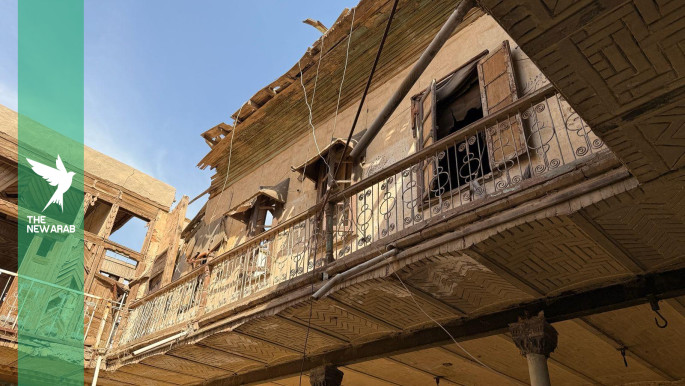
The building itself is badly derelict. Balconies sag over the river, plaster peels from the walls.
In the courtyard, a small family of chickens clucks, indifferent to the sudden attention focused on the ruin. The caretaker gestures toward an upstairs room.
“There,” he routinely tells visitors, “that’s where Miss Christie wrote her novels.”
It is, of course, impossible to verify, or even to reach.
Authorities have warned against climbing the unstable stairs, let alone stepping onto a floor that is constantly at risk of collapse.
Whether Christie ever lived there may never be definitively proven. Archival records are scarce, and those who might have remembered those days are long gone.
Yet buildings, even in ruin, have stories to tell. This house holds clues not only to a famous visitor but also to a way of life and to a Baghdad now largely erased.
Beyond the Christie question
The idea of an “Agatha Christie House” offers a ready-made narrative — international, literary and exportable — and it is hardly surprising that it has captured public imagination.
Attention has filtered upward: inspections have reportedly been ordered, and senior figures have made visits.
Recently, Iraq’s First Lady, Shanaz Ibrahim Ahmad, visited the house and called for its restoration and conversion into a museum to safeguard the Iraqi capital’s cultural legacy for future generations.
Yet beneath the headlines, uncertainty remains.
No document conclusively places Christie there. Oral histories are patchy, and any paper trail that once existed has long since been lost or destroyed.
Public fascination, however, rarely lingers on ambiguity. It gravitates toward celebrity.
While such attention may yet save the house, it also risks eclipsing a more compelling truth. Its significance does not rest solely on who may have passed through its doors.
Stripped of speculation, the house still speaks with remarkable clarity. Its architecture tells a story independent of any famous guest; how Baghdad’s riverside families once lived, moved and understood their city.
The courtyard, now cracked and overgrown, was the social heart of the home: a place for conversation, meals and respite from the heat.
The balconies oriented toward the Tigris, known as shenasil in Iraq, were not ornamental but practical, catching the breeze and keeping daily life in constant dialogue with the river below.
Layered thresholds reveal an intricate choreography between public and private space, hospitality and retreat.
Houses like this once lined the banks; few survive today.
With their disappearance comes not only architectural loss, but the erosion of social life, environmental comfort and neighbourhood cohesion.
In this sense, the building is not merely a decorative footnote to someone else’s story. Reading They Came to Baghdad today, Christie’s novel offers a lens into a Baghdad that has largely vanished, even if it cannot serve as evidence of her actual stays.
Her characters, many of whom were multilingual, mobile, and culturally fluent, bear more than a passing resemblance to real historical figures who moved effortlessly across the late-Ottoman and early-Iraqi landscapes.
Henry “Fakir” Carmichael is the most vivid of these figures: a British agent in his early thirties, born in Kashgar, in China’s Xinjiang Province, where his father was a government official, a childhood that saw him grow up speaking many Middle Eastern languages and dialects, making him “an expert at blending in”.
He is described in the novel as fluent in Arabic, Kurdish, Persian, Armenian, Hindi, Turkish and “numerous mountain dialects”. He is befriended by tribesmen, at ease across borders.
Carmichael slips between Arab and Western identities as circumstances demand. In one scene, dressed as an Arab, he encounters an old Eton schoolmate in the British Consulate’s waiting room in Basra.
Figures like Carmichael, the archetypal “third culture kid”, were common in a city defined by hybridity.
Diplomats, archaeologists, merchants and local elites who spoke multiple languages, navigated shifting political boundaries and lived lives that blended cultures and traditions.
Steamships, languages, and the making of a river cosmopolitan
Christie did not invent this type from whole cloth. One striking real-life parallel is Lieutenant Commander Charles Henry Cowley, a British naval reserve officer born in Baghdad in 1872 and raised on the banks of the Tigris.
The son of a senior captain with the Euphrates and Tigris Steamship Navigation Company and a woman of Armenian-Persian descent — at a time when borders across what are now Armenia, Iran, and Iraq were far more porous, allowing for this kind of fluidity — Cowley grew up among river pilots, merchants, interpreters and steamship captains, absorbing languages and cultures along Iraq’s waterways.
Educated in Liverpool, he returned to Baghdad after his father’s death to work in the river trade, eventually becoming the company’s senior captain.
During the First World War, tasked with ferrying British troops and supplies up the Tigris, he became a persistent menace to Ottoman forces, who dubbed him “the pirate of Basra.”
Fluent in Arabic and other regional languages, Cowley embodied an older Mesopotamian cosmopolitanism rooted in trade rather than borders.
During the doomed 1916 attempt to break the siege of Kut, regarded as Britain’s worst military defeat of the war, his ship was ambushed.
Captured, Cowley was almost certainly executed, but later awarded the Victoria Cross.
[Tanya Goudsouzian]
From Baghdad to Lima
In contrast, Western historiography has relied heavily on figures such as Gertrude Bell and T.E. Lawrence, producing simplified narratives of loyalty, identity and empire that obscure the city’s everyday cosmopolitan networks.
Christie’s fiction, however, captures the ambiguity and overlap of such lives.
It was these hybrid existences that shaped spaces like the riverside house: courtyards designed for conversation, balconies for observation, thresholds that moderated public and private life.
In accommodating hybridity, the architecture reflects a society at ease with fluid identities, making the house a testament to a cosmopolitan Baghdad that literature preserves even as time steadily erases it.
Yet the reality of preserving the house is stark. Many of its original features may be impossible to save.
Architects and engineers who have glimpsed the interiors warn that any serious restoration could run into the millions of dollars, a daunting figure for a single derelict property.
Such costs are compounded by the absence of an effective preservation policy.
Heritage institutions are underfunded, lack enforcement power and operate without the political backing needed to protect historic buildings, most of which remain in private hands.
Faced with these realities, the economic question is inevitable: why pour funds into a ruin when a shopping mall promises steady returns, or a residential tower guarantees far greater profit?
Yet this purely financial lens carries a hidden cost: heritage, when measured solely by short-term gain, often loses out.
Buildings like this house do more than provide shelter; they preserve memory, architecture, and urban identity, much as places like Istanbul’s Pera Palace Hotel or the steamships that once carried Agatha Christie down the Nile have come to embody histories far larger than their original function.
When market pressures dominate, the city risks erasing these windows into its past.
The challenge is to recognise that the value of preservation cannot always be reduced to dollars.
Some legacies are priceless, even if they do not promise immediate returns.
In terms of architectural history, this house is connected to a broader Islamicate culture.
Its spatial organisation centres on an interior courtyard, a form shared by Moroccan riads and the cármenes of Andalusia in southern Spain.
The wooden shenasil balconies, known as mashrabiyya in standard Arabic, travelled westward to Seville during the city’s Muslim period, and were later carried by the Spanish as far as Lima, Peru.
The same Iraqi balcony tradition would centuries later inspire the Mosul-born architect Dame Zaha Hadid, who reinterpreted it in her designs for a modern high-rise hotel in Qatar.
A fragile witness to the past
As the Tigris flows past its crumbling walls, the house is a witness to a past that can no longer speak for itself.
Heritage is a civic responsibility, and the attacks on Iran’s historical sites are a reminder that they are a global public good that the international community should denounce when targeted during wartime.
Fragile though it may be, the riverside house functions as a civic asset, a pedagogical tool and a spatial archive of a bygone Baghdad that cannot be fully conveyed through books or photographs alone.
Its preservation is a duty of the state, as custodian of the public good.
Should the house vanish, the loss would extend far beyond the uncertainty of an Agatha Christie connection.
We may never know who once slept within its rooms, whether “the Queen of Crime” or another forgotten guest.
What is certain is this: the house itself holds stories. Whether preserved, partially restored or carefully documented, it deserves to be heard before it disappears.
Even in ruin, it still speaks if we choose to listen.
Tanya Goudsouzian is a Canadian journalist who has covered the Middle East and Afghanistan for over two decades and is a former Opinion Editor at Al Jazeera English Online
Ibrahim al-Marashi is an associate professor of Middle East history and visiting faculty at The American College of the Mediterranean. His publications include Iraq’s Armed Forces: An Analytical History (2008), The Modern History of Iraq (2017), and A Concise History of the Middle East (2024)