
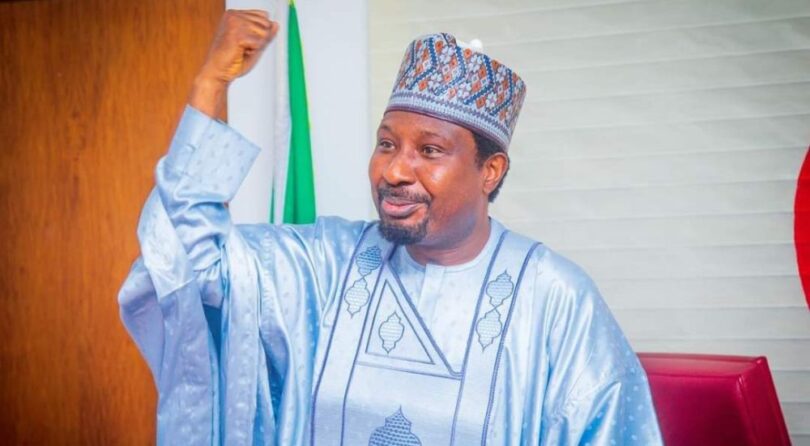
As Nigeria’s political atmosphere gradually thickens ahead of the 2027 general elections, the conversation around continuity versus disruption is gaining renewed urgency. At the centre of this debate stands Barau I. Jibrin, a figure whose political trajectory has come to symbolize endurance, influence, and calculated consistency.
For many pundits, Barau’s journey is not merely about longevity in office but about how power can be consolidated and sustained over time. Since 1999, he has remained embedded in Nigeria’s legislative architecture, navigating shifting political tides with remarkable dexterity.
This kind of staying power is rare, particularly in a system where political fortunes can change overnight. Yet, Barau has not only survived; he has expanded his influence, building a structure that appears increasingly difficult to dismantle.
His early days in the House of Representatives laid the foundation for what would become a formidable legislative career. As Chairman of the Appropriation Committee, he occupied one of the most strategic positions in governance—one that shapes national priorities through budgetary allocations.
Replicating that same role in the Senate elevated his status even further. It was not just a personal milestone; it was a signal of deep institutional trust and political weight. Few, if any, can boast of such dual-chamber dominance.
For challengers contemplating 2027, this record alone presents a daunting reality. Taking on a politician who understands the machinery of government at such depth is no small undertaking. It requires more than ambition, it demands structure, experience, and timing.
Beyond Nigeria’s borders, Barau’s leadership of the ECOWAS Parliament adds another dimension to his profile. It places him within a broader diplomatic and legislative network, further strengthening his credentials.
This regional exposure is not just symbolic. It enhances his stature at home, reinforcing the perception of a leader whose influence transcends national boundaries. For voters, this can translate into pride and confidence in representation.
However, the true backbone of Barau’s political strength lies at the grassroots. His consistent investment in education has created a ripple effect that continues to reshape lives across his constituency.
Scholarships, academic support programmes, and institutional interventions have collectively built a generation of beneficiaries who see his leadership as transformative. This is not abstract policy, it is lived experience.
For political opponents, this presents a unique challenge. It is one thing to criticize a leader; it is another to counter a legacy that is visibly impacting people’s daily lives.
Equally important is his expansive empowerment framework. By targeting women, youth, and vulnerable groups, Barau has cultivated a broad coalition of support that cuts across traditional political divides.
These interventions are not occasional gestures; they are sustained efforts that reinforce loyalty and deepen political roots. In many ways, they function as both governance and strategy.
His reputation for generosity further complicates the calculus for challengers. In Nigerian politics, where personal connection often matters as much as policy, Barau’s human-centered approach gives him a distinct advantage.
He is widely perceived as accessible and responsive, qualities that resonate strongly with voters. This perception, whether shaped by direct interaction or community narratives, strengthens his political brand.
As a result, any serious contender must contend not just with a politician, but with a well-established system of influence. Dislodging such a figure requires more than popularity, it requires dismantling an ecosystem.
This is why many analysts argue that potential challengers must think twice before stepping into the ring. The risk is not just electoral defeat, but the exposure of structural weaknesses in their own political machinery.
In Kano’s dynamic political environment, where alliances are fluid and competition is intense, Barau’s consistency stands out as a stabilizing force. He has managed to remain relevant without appearing stagnant, a delicate balance in politics. This a Senator who was not only instrumental to the establishment of universities for his people but among others ,facilitated the establishment of the North west Development Commission for the benefit of his people and the entire people of North western part of Nigeria.
Looking ahead to 2027, the question is not whether Barau will be a factor, but how dominant that factor will be. His track record suggests a politician who is not only prepared for the contest but is likely to shape its direction.
For now, the road to 2027 appears to favor continuity, at least in Barau’s case. His blend of experience, grassroots connection, and institutional influence creates a formidable barrier for any would-be challenger.
In the end, the politics of continuity may prove decisive. And for those eyeing his seat or influence, the message is clear: confronting Barau I. Jibrin is not just a political move, it is a high-stakes gamble that demands careful reconsideration. A word is enough for the wise.
-Mustapha Auwalu Gwarzo is a social commentator, can be reached @ [email protected]