A digital exhibition in Berlin is giving visitors rare insight into the brutal and sombre architecture of Syria’s infamous Sednaya prison, where political prisoners and others were held captive, tortured and executed.
Established as Military Prison One in 1987 under the rule of Hafez Al-Assad, the prison was liberated in December 2024 when the regime of his son, Bashar, collapsed.
Entitled Sednaya: Syria’s Architecture of Repression and Death, the exhibition is taking place at the Berlin-Hohenschönhausen Memorial, which was a secret prison site operating between the 1940s and 1980s.
The location of the exhibition in the German capital is also significant as it is home to one of the country’s largest Syrian communities, formed as a result of citizens fleeing the 2011 war in Syria.
The small yet immersive exhibition was mainly organised by the Syria Prisons Museum, a Berlin- and Damascus-based NGO comprising investigative journalists, analysts, translators, filmmakers, architects, and 3D model designers, among others, founded in 2025 to document prison crimes in Syria.
Their initiative has produced three-dimensional (3D) virtual tours, photographs, documents, and written texts of life in prison.
While documenting Sednaya prison was a major task of the NGO, the team has also carried out recording work in more than 170 Syrian and Iraqi prisons.
On a deeper level, aside from raising awareness and exposing truths, they are seeking to “preserve collective memory and the lived experiences of prisoners and victims of enforced disappearance and commemorate the victims and pursue the search for the missing,” according to a statement shared on their website.
Amer Mater is the founder of the NGO, and the exhibition is deeply personal for him, since he was himself a political prisoner under the Assad regime. Until this day, his brother remains missing as a prisoner.
“For Syrians, prison is rarely an abstract subject,” Amer told The New Arab. “Almost every family has some personal connection to it: a former prisoner, a missing relative, or someone whose life was shaped by one of the detention systems imposed by different authorities over the years.”
Located 30 kilometres north of the capital Damascus, the Y-shaped Sednaya prison, dubbed “the human slaughterhouse,” has a notorious reputation.
According to the Syria Prisons Museum, the prison symbolises “the Assad regime’s expansive system of detention served to crush any dissent and spread a specific form of terror throughout the Syrian population. Many prisoners, in the vast majority, political prisoners, did not survive the torture (extreme and widespread). Those who did suffer long-term physical and mental health effects.”
Seeing the unseen
The exhibition features a variety of exhibits, including a 3D model of the structure, a large, detailed wall map of the multi-level, complex site, forensic videos of the liberated prison, and audiovisual testimonies from former detainees recounting their harrowing experiences in captivity.
They went into details, speaking of the prison’s lack of hot water (one person even said that his showers were allowed to last for only ten seconds), harsh treatment of officers, forms of physical torture endured, symbols they saw in their dreams, and the spread of skin diseases.
A key highlight of the exhibition is the presence of virtual reality headsets (an experience held on Tuesday afternoons), allowing visitors to navigate certain parts of the prison digitally, from group cells to execution sites.
“Our work starts from the idea that prisons are not neutral buildings. Architecture can actively shape repression,” explained Amer.
“At the Prisons Museum, we study each prison we document as a spatial system: how people enter it, how movement is controlled, how cells are distributed, where surveillance is concentrated, where isolation happens, and how punishment is built into the structure itself. We do not only ask what happened in a prison, but how the building itself made certain forms of violence possible,” he added.
“In each case, we analyse the architecture to understand its carceral uses: the relationship between entrances, corridors, solitary cells, group cells, guard rooms, control points, visitation areas, punishment spaces, and execution-related sites. This helps us discover how prison life was organised and how repression was embedded in the built environment.”
Fragments of hope from a place of despair
There is also a personal and human touch in the exhibition, where some displayed items hail from the archive of Palestinian former detainee Ahed Sheikh Hassan (1956 – 1996), who was imprisoned by the Syrian regime in Sednaya between 1987 and 1994 for his communist views.
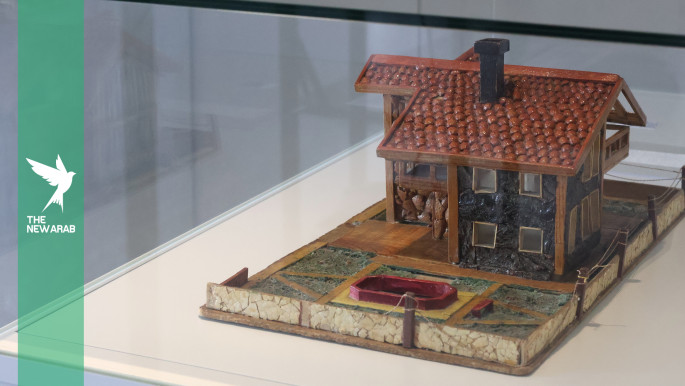
The display includes long scrolls of handwritten letters penned in small Arabic writing smuggled to his wife (sharing his innermost thoughts and instances of daily life in captivity), family photographs, a selection of books from prison, including One Thousand and One Nights (Ahed was briefly prison’s librarian), and a small house model that he meticulously created by using basic materials found in prison, including olive pits and aubergine skins.
“It was important for us to include Ahed Sheikh Hassan because his archive brings the human dimension of prison life into the exhibition in a direct and deeply personal way,” remarked Amer.
“It reminds visitors that prisons are not only systems of violence, but also places where people struggled to preserve meaning, love, and memory. There is hope in the exhibition, but it is not abstract hope. It comes from the ways prisoners held on to dignity, memory, imagination, and human connection under impossible conditions.”
The house was apparently sent as a gift to Ahed’s children, Ola and Alaa. According to the exhibition, Alaa is commemorating Hassan’s memory by digitally publishing in Arabic and English some 100 of his writings through a project entitled House of Dreams.
“Ahed wrote extensively during his imprisonment,” reads a statement on the project’s website. “His papers – part diary, part letter, part testament – document daily survival, political reflection, and the construction of an inner life under confinement.”
In one of his letters, Ahed writes of both hope and despair: “What I am trying to write is not poetry. I know very well that I am not good at that. It is only an idea. Today, while I was walking, this came to my mind: Fear is a sea, and I am a fish in it. Freedom is a star, and I reach out to catch it. Hope is a butterfly that always escapes from my hand.”
Through the free exhibition, Amer hopes Syrians can learn from their past, even if reopening old wounds is difficult.
“The Berlin exhibition is not only about Sednaya itself. It is part of a larger effort to write the dark history of our country so that it is not repeated,” said Amer.
“We are trying to transform prisons from hidden spaces of terror into public spaces of knowledge, where evidence can be preserved, memory can be protected, and future generations can better understand what Syrians lived through.”
Sednaya: Syria’s Architecture of Repression and Death is on view at Berlin-Hohenschönhausen Memorial until 27 September 2026
Rawaa Talass is a freelance journalist focusing on art and culture emerging from the Middle East. Her work has been published in Art Dubai, Arab News, Al Arabiya English, Artsy, The Art Newspaper, Kayhan Life, Dubai Collection, and The National
Follow her on Instagram: @byrawaatalass