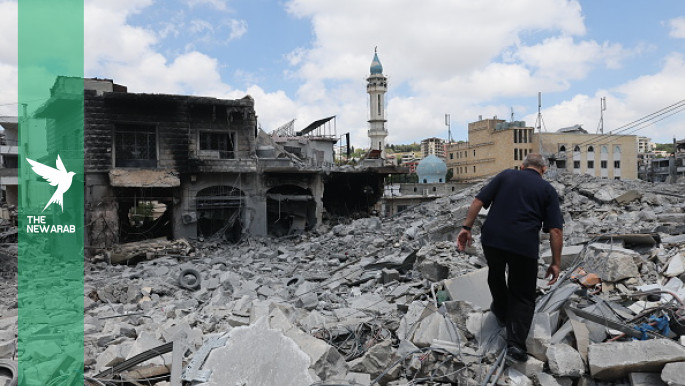
A view of the destruction in the southern Lebanese city of Nabatieh following Israeli strikes [Getty]
Lebanese Parliament Speaker Nabih Berri has insisted that Israel must fully withdraw from occupied Lebanese territory under the terms of the US-Iran memorandum of understanding, rejecting a proposed “pilot zone” arrangement and warning that any prolonged Israeli presence in southern Lebanon would violate the spirit of the agreement.
Berri’s remarks came as Iranian Foreign Minister Abbas Araghchi declared that ending the war in Lebanon was “an integral part” of the agreement between Tehran and Washington and that any Israeli attack on Lebanon or continued occupation of Lebanese territory would constitute a breach of the memorandum.
“The end of the war in Lebanon is an integral part of ending the war with Iran, and includes Israel’s withdrawal from occupied Lebanese territories,” Araghchi told reporters on Tuesday.
According to sources cited by Lebanon’s Al-Akhbar newspaper, Iran insisted during the final hours of negotiations on adding language committing the United States, Iran and a number of regional and international guarantors to safeguarding Lebanon’s sovereignty, territorial integrity and the unity of its entire territory.
The reported amendment linked an end to the conflict not only with a cessation of hostilities but also with ending any form of occupation or infringement on Lebanese sovereignty.
Speaking to reporters on Tuesday, Berri said Israel would not enjoy freedom of military action under the memorandum and stressed that the priority now was ensuring a complete Israeli withdrawal from southern Lebanon.
The veteran Shia politician also rejected proposals for so-called “pilot zones” in southern Lebanon, under which Israeli troops would withdraw from selected areas before the Lebanese Army moved in and dismantled Hezbollah infrastructure.
“Lebanon is divided into districts, not pilot zones,” Berri said, arguing that such proposals risked prolonging the occupation for years rather than securing a rapid withdrawal.
The proposal reportedly received support from President Joseph Aoun and Prime Minister Nawaf Salam during discussions with US and Israeli officials, but has faced opposition from both Berri and Hezbollah.
The issue comes as Lebanon prepares for a fifth round of US-sponsored talks in Washington on 22 June aimed at securing a permanent ceasefire, a full Israeli withdrawal from Lebanese territory, the release of Lebanese detainees and the launch of reconstruction efforts.
Earlier on Tuesday, Aoun and Salam welcomed the US-Iran agreement, describing it as a positive development that could help lower tensions and create conditions for political solutions.
Following a meeting at Baabda Palace, the presidency said both leaders remained committed to Lebanon’s position in the Washington talks, including a permanent ceasefire, the withdrawal of Israeli forces from occupied Lebanese territory, the deployment of the Lebanese Army to the international border, the return of Lebanese prisoners and the start of reconstruction efforts.
In a separate message marking the Islamic New Year, Aoun expressed hope that recent developments would “end our people’s suffering, liberate our occupied land and help achieve what the Lebanese aspire to in terms of dignity, stability and peace of mind”.
Dispute over Lebanon’s future
The question of whether Israel’s withdrawal from southern Lebanon is explicitly covered by the US-Iran agreement has emerged as one of the most contentious.
While US and Israeli officials have reportedly argued that the issue falls outside the memorandum, Berri and Hezbollah insist the agreement includes a timetable for Israel’s withdrawal from Lebanese territory.
Hezbollah has repeatedly argued that Lebanon cannot be separated from the broader regional negotiations involving Iran and has called on the government to abandon direct talks with Israel in favour of indirect negotiations under Arab and international sponsorship.
The group has also maintained that it will not discuss its weapons before Israeli forces leave Lebanese territory and attacks on Lebanon cease.
Lebanese officials, however, continue to support the Washington track, arguing that negotiations reportedly offer the best chance of securing a complete withdrawal, returning displaced residents and beginning reconstruction.
Beirut views the US-Iran agreement positively and hopes it can help cement the ceasefire and accelerate Israeli withdrawal, while warning that attempts to obstruct negotiations remain a concern, official Lebanese sources told The New Arab.
Uncertainty over Israel’s next move
The debate comes amid growing uncertainty within Israel’s political and military establishment over the future of its operations in Lebanon.
According to Israeli newspaper Maariv, military commanders are awaiting political instructions on whether to maintain current deployments, escalate operations or begin withdrawing troops.
“We continue operating in the area along the Blue Line. We are conducting reconnaissance missions and raids in villages near the line, but we do not know where we are headed,” a military source told the newspaper.
Israeli Prime Minister Benjamin Netanyahu said on Monday that Israeli forces would remain in southern Lebanon, where they continue to occupy several areas despite mounting international pressure for a withdrawal.
US President Donald Trump has meanwhile urged Israel to scale back its attacks on Lebanon and said he was unhappy with a recent Israeli strike on Beirut’s southern suburbs.
Despite a noticeable reduction in fighting in recent days, Israeli attacks have continued.
Lebanon’s National News Agency reported on Tuesday that an Israeli drone strike targeted a vehicle on the Haddatha-Haris road in the Bint Jbeil district.
Since fighting resumed on 2 March, at least 3,798 people have been killed in Israeli attacks on Lebanon, according to the Lebanese Health Ministry.