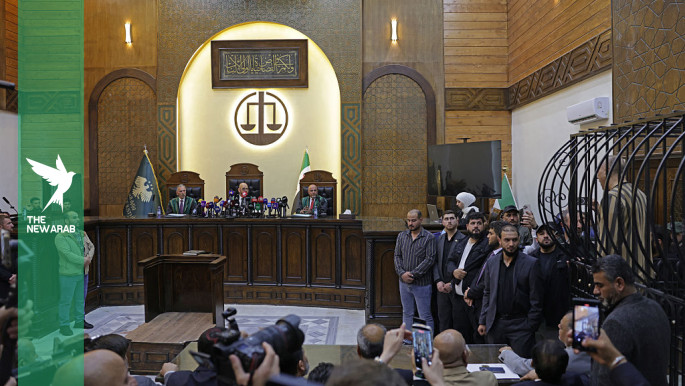
Former head of political security in south Syria’s Daraa province, Atif Najib (R) attends the first trial session at the Palace of Justice, in Damascus on April 26, 2026. [GETTY]
The start of high-profile arrests and domestic prosecutions in Syria has understandably given rise to wild celebrations across a country where almost every person has been impacted by the crimes of the former Assad regime.
However, there are serious concerns that Syria’s current legal framework is not designed to deliver justice. A new report does, however, present pathways for a criminal justice process “that is grounded in human rights principles, [and responsive to] the needs and desires of the Syrian people.”
On 25 April, Syria’s Minister of Justice announced that “the moment long awaited by the victims: the launch of public trials … for the henchmen of the fallen regime” had come. On the same day, Atef Najib, a former head of political security in Daraa and a cousin of former President Bashar al-Assad, appeared in court, launching what appears to be the first in a series of prominent trials.
Those named in court and to be tried in absentia included the former president and his brother.
Since the fall of the Assad regime on 8 December 2024, Syrians have waited for a sign that those responsible for past abuses would be brought to account. So, news that trials were finally beginning has been met with massive celebrations. At the same time, the suddenness and lack of clarity regarding the overall accountability processes have raised immediate questions.
Key uncertainties remain: who will be prosecuted, under what charges, and through which legal framework? Will perpetrators face charges for international crimes such as war crimes, genocide, or crimes against humanity, given that these crimes are not currently established in domestic Syrian law? And if trials proceed under a judiciary that has yet to be fully reformed, can they meet fundamental standards of fairness?
Concerns have already been raised about the release of a video confession by Amjad Youssef, which appears to violate due process and risks undermining the credibility of proceedings. Confessions belong in court, and the justice – and right to truth – that victims deserve will only come through fair trial procedures that are meticulously followed and independently observed.
In addition, there are real concerns that accountability measures will be applied only to the former regime. On 23 April, the interim Syrian president formally received Essam al-Buwaydhani, former commander of the Jaysh al-Islam rebel group in Eastern Ghouta, after facilitating his release from detention in the UAE. Among other grave violations, Jaysh al-Islam is widely believed to be responsible for the abduction and disappearance of four prominent human rights activists – Samira Khalil, Razan Zaitouneh, Wael Hammadeh, and Nazem Hammadi – in 2013 in the city of Douma, eastern Ghouta. Their fate remains unknown.
Transitional justice
Countries undergoing difficult transitions after lengthy periods of oppression have all faced similar challenges: dealing with the past, securing justice for victims, restoring trust among citizens and between citizens and the state, and ensuring the non-repetition of past crimes and atrocities.
Though each experience is unique, there is a broad consensus that, where possible, a nationally coordinated approach encompassing a range of recognised tools and processes is most effective. This is often termed “transitional justice,” although the methods and sequencing vary from country to country.
These tools can include courts, truth commissions, legal and institutional reforms, including vetting and security sector reform, reparations programs, support for families, including mental health and psychosocial services, and memorialization initiatives.
Why are these processes useful? In part, because they demonstrate to citizens that meaningful change has occurred and that impunity is no longer tolerated.
More fundamentally, they signal that justice is not only about punishing perpetrators, but about transforming institutions and norms, ensuring that laws and state bodies serve to protect rather than oppress. They also centre victims and survivors by advancing their rights through reparations, recognition, and sustained support.
Trials are an integral part of this holistic approach and should therefore be embedded within a broader national strategy. The good news for Syria is that a national Transitional Justice Commission has already been established and, once ratified by parliament, could take the lead in overseeing this process.
The interim authorities have also drafted a transitional justice law that is currently under consultation.
There is also significant international support available. Three international mechanisms (the Commission of Inquiry; the International, Impartial and Independent Mechanism; and the International Impartial Mechanism for Missing Persons in Syria) are specifically mandated to assist Syria in this area, alongside a Special Envoy’s office appointed by the United Nations Secretary-General.
Syrians have long been prepared
Perhaps most importantly, Syria is fortunate to have a capable and vibrant civil society, both inside the country and in the diaspora. Syrians have been preparing for this moment and are ready to play an integral role in shaping these domestic accountability processes.
For instance, in anticipation of the accountability challenges ahead, 27 Syrian organisations have been meeting over the course of eight months to assess options, identify risks, and engage with experts, families, and relevant authorities.
Pathways to Criminal Accountability in Syria, a report that was released by the coalition of organisations, anticipates many of the questions outlined above and offers practical options and solutions. It situates criminal justice within a broader transitional justice framework, while drawing on comparative experiences and highlighting the forms of support the international community can provide.
For example, regarding judicial mechanisms, the report explores options ranging from local (including tribal) and domestic courts to “internationalised” hybrid tribunals and even fully international tribunals. It recommends that Syria should integrate relevant components from multiple accountability models, assessing their suitability to the Syrian context and international obligations.
It also addresses jurisdiction, recognising the urgent need for comprehensive criminal law reform in Syria, while outlining options grounded in established definitions of international crimes – such as genocide, crimes against humanity, and war crimes – even as key choices remain open.
The report further considers whether accountability efforts should focus solely on crimes committed during the conflict or extend to the past five decades under the long-standing Assad regime, and whether such efforts should include crimes committed after December 2024. It also examines whether accountability should apply to all parties to the conflict or be limited to Syrian actors, and how responsibility should be apportioned across different levels.
Central to all proposed options is the importance of consulting victims and their families, not only as beneficiaries of justice processes, but as essential sources of legitimacy and credibility.
What is now needed is an openness from the interim Syrian authorities to cooperate with Syrian civil society organisations that have developed clear and thoughtful pathways to justice, alongside a willingness to seek support from international expert bodies.
Syrian civil society organisations and families’ groups should establish a new forum that can enter into an agreement with the Transitional Justice Commission and authorities for regular consultations and progress reports (notwithstanding regular public consultations and reports).
The interim authorities and national commissions should also move in a timely manner to deepen their relationships with international expert bodies by formalising their on-the-ground presence or through memoranda of understanding.
Such collaboration will be essential to ensuring that accountability efforts are credible, inclusive, and ultimately capable of supporting a genuinely Syrian-owned and Syrian-led transition.
This article was originally published in Just Security.
Hanny Megally is a former Commissioner on the UN Independent International Commission of Inquiry on Syria, a Distinguished Fellow at New York University’s Center on International Cooperation and Advisory Board Member of the Independent Institution on Missing Persons in the Syrian Arab Republic. He is a human rights and transitional justice expert with decades of experience in conflict-affected regions.
Have questions or comments? Email us at: editorial-english@newarab.com
Opinions expressed in this article remain those of the author and do not necessarily represent those of The New Arab, its editorial board or staff.