
The real agricultural revolution begins when the tractor stops being a symbol of government procurement and becomes a dependable tool in the hands of the farmer.
For decades, the story of agricultural mechanisation in Nigeria has been one of great promises followed by disappointing outcomes. Governments announce the purchase of tractors, millions of naira are committed, machinery is unveiled with considerable fanfare, and yet the ordinary farmer often continues to cultivate his land with a hoe and cutlass.
A tractor parked in a government compound does not cultivate a hectare. A tractor without fuel, a trained operator, spare parts and proper maintenance is little more than an expensive piece of metal. And a tractor that cannot be accessed by the farmer at the critical moment of the farming season cannot deliver the agricultural transformation for which it was purchased.
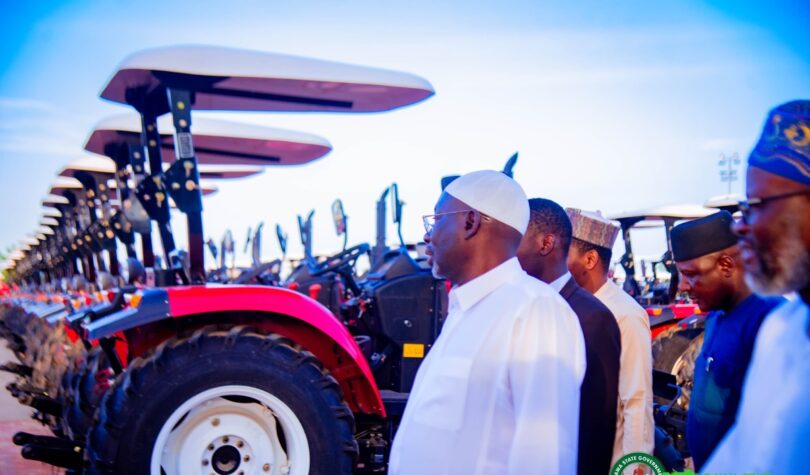
Tractors procured by the Namadi administration for mechanised agric transformation in Jigawa State
This is why the emerging agricultural mechanisation strategy in Jigawa State deserves attention. Under Governor Umar Namadi, the emphasis appears to be shifting from the traditional question of “How many tractors can government buy?” to a much more important question:
“How can we build a system that ensures farmers can consistently access mechanisation when they need it?” That is a fundamentally different approach.
The establishment of mechanisation service centres across the state, investment in tractors and harvesters, deployment of agricultural extension workers, training of technical personnel, digital monitoring and efforts to bring mechanisation closer to farming communities suggest an attempt to build an agricultural ecosystem rather than simply distribute agricultural equipment.
And this distinction could determine whether the investment becomes another chapter in Nigeria’s long history of underutilised agricultural machinery—or the beginning of something genuinely transformative.
For many years, agricultural mechanisation programmes across Nigeria have followed a familiar pattern. A government purchases tractors. The machines are allocated to farmers, cooperatives or government agencies. After some time, however, questions begin to emerge about their utilisation, maintenance and accountability.
Some machines become unserviceable because of inadequate maintenance. Others are difficult to deploy because of fuel and operational costs. In some cases, machinery is simply not available to the farmers who need it during the critical planting and harvesting windows.
The result is that enormous public investments may fail to generate corresponding agricultural output.
This is why Jigawa’s approach deserves to be examined not merely from the perspective of how many machines have been acquired, but from the perspective of the institutional structure surrounding those machines.
Thirty young Jigawa technicians sent to China for training on agric Mechanisation pose with some officials
The establishment of the Jigawa State Farm Mechanisation Service Company is potentially one of the most important components of the programme. The philosophy is straightforward: farmers do not necessarily need to own tractors in order to benefit from mechanisation.
What they need is reliable and affordable access to tractor services. This distinction is particularly important in Jigawa, where the majority of farmers are smallholders.
It would be unrealistic to expect individual smallholder farmers to purchase tractors, maintain them, employ trained operators and bear the cost of spare parts and repairs. A properly managed mechanisation service can solve this problem.
Instead of each farmer purchasing a tractor, the government or a professionally managed mechanisation company can operate a fleet of tractors and provide services to farmers for land preparation, planting, spraying and harvesting. One tractor can therefore serve many farmers during a farming season.
This is the principle behind commercial equipment-hiring systems around the world, and it has the potential to make mechanisation more accessible to smallholder farmers.
The reported establishment of 60 mechanisation service centres across Jigawa’s 30 constituencies is particularly significant. Agricultural machinery must be located close enough to farming communities to be useful.
The farmer cannot afford to wait several weeks for a tractor to arrive when the rains have already started. Timing is everything in agriculture.
A farmer who plants late may experience reduced yields. A farmer who cannot harvest on time may suffer significant losses. Mechanisation therefore has value not simply because it reduces physical labour but because it enables farmers to perform agricultural operations within the appropriate period. Bringing machinery closer to farmers can therefore have a direct impact on productivity.

The tractor is only the beginning. It is important, however, not to make the mistake of thinking that agricultural transformation ends with tractor procurement. A tractor is only one component of a much larger agricultural system.
Farmers need improved seeds, fertiliser, irrigation, extension services, crop protection, storage, processing facilities, transportation and access to markets.
If a farmer has a tractor but lacks good seeds, yields may remain low. If he produces a large harvest but has nowhere to store it, post-harvest losses may undermine his income.
 If he produces more food but cannot access profitable markets, increased production may not translate into improved livelihoods. Therefore, mechanisation must be integrated into a broader agricultural value chain.
One particularly encouraging component of Jigawa’s agricultural strategy is the attention being given to extension services. Agricultural extension workers serve as the bridge between scientific agricultural knowledge and the farmer.
They can advise farmers on improved varieties, planting techniques, fertiliser application, pest and disease control, soil management and other practices capable of increasing productivity.