
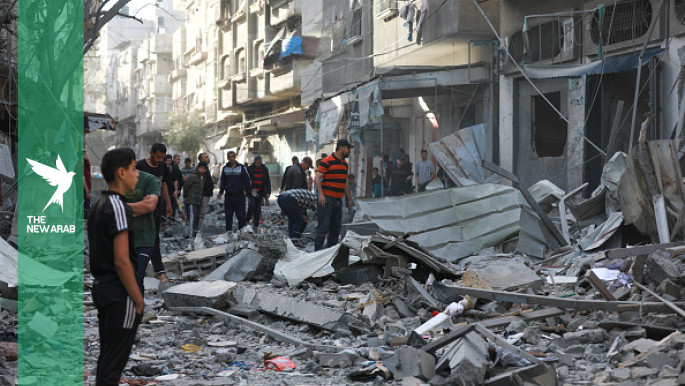
The ceasefire in Gaza, in effect since 10 October, is being violated on a daily basis [Getty/file photo]
The Gaza high representative of US President Donald Trump’s “Board of Peace” warned on Thursday that the status quo in the divided and devastated territory – including an imperfect ceasefire – risks becoming “permanent” reality.
In its first report to the UN Security Council, the board called Hamas’s refusal to disarm and relinquish control “the principal obstacle” to moving to the second phase of the ceasefire deal.
But Gaza high representative Nickolay Mladenov told the council that implementation of the deal “cannot advance through Palestinian obligations alone”.
Gaza remains gripped by daily violence as Israeli strikes continue. On Thursday, at least six Palestinians were killed, including a 13-year-old boy.
“The continued killings, Israeli restriction affecting humanitarian flows are not abstract issues,” said Mladenov, who appeared by video.
Violations like the still-rising death toll were impacting Palestinians’ belief in whether Gaza’s safety and recovery could ever become a reality, he said.
“I want to be clear about the risks of inaction by the parties,” he said. “The risk is that the deteriorating status quo becomes permanent: a divided Gaza, Hamas holding military and administrative control over two million people across less than half the territory.”
“Those people are likely to remain trapped in the rubble, dependent on aid with no meaningful reconstruction, because reconstruction financing will not flow where weapons have not been laid down,” Mladenov said.
The ultimate result of leaving a generation of traumatised children to grow up in tents would be “no security for Israel, and no viable pathway to Palestinian self-determination,” he said.
In January, Washington said it was moving into the second phase of the peace plan that calls for the disarmament of Hamas.
It also calls for the gradual withdrawal of Israeli forces and the deployment of an international stabilising force.
Hamas spokesman Hazem Qassem denounced Mladenov’s comments as an attempt to “pressure” Hamas, saying in a statement that it amounted to “adopting the Israeli narrative and an attempt to create justifications” for occupation of Gaza.
He affirmed Hamas’s commitment to the ceasefire and stated that it was “ready to immediately and fully hand over governance to the National Committee for the Administration of the Gaza Strip,” which is to manage the territory during a transitional phase.
Addressing the Council, Israeli representative Jonathan Miller accused Hamas of “using the delay to consolidate control, rebuild its capabilities, and strengthen its grip over the civilian population.”
“This is not a political organisation transitioning to diplomacy,” Miller said. “This is a terrorist army preserving its capabilities for the next war.”
The ceasefire officially came into effect on 10 October, a few days after the second anniversary of the start of the war on 7 October, 2023, which has killed over 72,00 Palestinians.
The first phase of the truce saw the release of the last captives seized in October 2023 in exchange for hundreds of Palestinians held in unlawful detention by Israel.
The transition to the second phase– involving Hamas’s disarmament and a gradual withdrawal of the Israeli army, which still controls more than 50 percent of the Gaza Strip – has been stalled for weeks as international attention has been focused on Iran and the Strait of Hormuz.