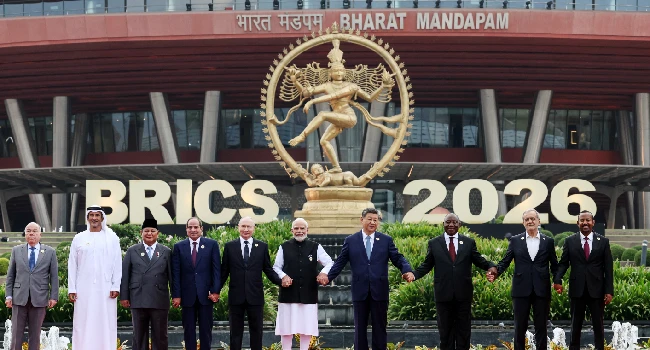
The 45-page New Delhi declaration was adopted on Saturday, the first day of the BRICS leaders’ annual summit.
The BRICS group of nations adopted a new declaration calling for conflict prevention, stronger multilateral ties, and condemning terrorism as well as unilateral trade measures.
The New Delhi Declaration 2026 was adopted at the 18th BRICS Summit, held in India this weekend. It was a two-day summit that brought together Brazil, Russia, India, China, South Africa, Egypt, Ethiopia, Indonesia, Iran, and the United Arab Emirates, alongside partner countries such as Nigeria, collectively accounting for about 40 per cent of the world’s GDP and about half of the world’s population.
The 45-page New Delhi declaration was adopted on Saturday, the first day of the BRICS leaders’ annual summit.
It followed intensive negotiations, including efforts to resolve tensions between the UAE and Iran over the Middle East conflict.
“No member has raised any objection. The New Delhi Declaration 2026 is adopted unanimously,” said Indian Prime Minister Narendra Modi.
The New Delhi Declaration stressed the need to protect civilians and civilian infrastructure and opposed attacks that could threaten nuclear safety.
It also urged settling disputes through diplomatic means. It recommended dialogue and consultation, rather than military escalation.
“We express deep concern over the continued escalation of tensions in the Middle East…call for exercising maximum restraint…avoiding actions that could further aggravate the situation,” the declaration stated.
Aside from these, BRICS criticised the growing use of unilateral tariffs and non-tariff barriers, arguing that they distort trade and hurt developing economies. This comes against the backdrop of US tariffs on several countries.
“We condemn the imposition of unilateral coercive measures that are contrary to international law,” the declaration said.
It called for the elimination of the tariffs, while noting that they undermine international law and the principles of the UN Charter.
The BRICS countries also declared their support for cross-border payments and trade settlements using member countries’ local currencies.
They also pointed out that creating a BRICS Payment Task Force (BPTF) will help identify practical ways to make payments between BRICS countries easier and faster.
It will also help BRICS states be less dependent on existing international payment systems.
On the sidelines of the summit, the Nigerian government reaffirmed its commitment to the World Trade Organisation (WTO) and the multilateral trading system.
During a meeting with WTO Director-General Ngozi Okonjo-Iweala, Vice President Kashim Shettima said no country can prosper in isolation from the global community.
He also noted that migration is a key driver of innovation, saying immigrants have historically contributed to nations’ development.
The Vice President is expected to present Nigeria’s partnership and foreign investment opportunities to BRICS leaders when he addresses the summit on Sunday.