British-Pakistani actor and playwright Asif Khan has always written to challenge mainstream perceptions of British Muslims. So, when he came across an article about three hijab-wearing sisters from Hull who skateboard, inspiration struck.
“These three sisters, Amaya, Layna and Maysa — they were between the ages of 10 and 13, all wearing the hijab and skateboarding, and I immediately thought it would make a good starting point for a play,” Asif tells The New Arab.
“They had gathered quite a lot of attention on their own through their social media account, where they post videos of their skateboarding and raps that they had written. Seeing Muslim girls skateboarding just counters some of the negative narratives people have in their heads about Muslims, and it breaks a lot of stereotypes,” he adds.
Using the Hull sisters’ story as a starting point, Asif began writing Sisters 360, an energetic and inspiring play about two 10-year-old step-sisters from his hometown: Fatima and Salima, who are training for the ‘Tiny But Mighty’ skateboarding competition.
Along the way, they face all sorts of hijinks and adversity on their path to the tournament, as the story moves between school, their bedroom, a skatepark, and journeys from Bradford to London.
Because of the health and safety risks posed by skateboarding on stage, the performance simulates skating using wobble boards — much to the relief of the play’s two main actors, Sara Abanur, who plays Fatima, and Farah Ahmed, who plays Salima.
“I used to go to the Southbank skate park — it was a nice place to just chill with friends,” Farah reflects, speaking about her earlier experiences with skateboarding.
“We had this one friend who learned how to skateboard, and she tried to teach me, but it wasn’t for me. I’ve learned a little bit, and I’ve got more confidence with the board, I will say that — but I’m no Salima or Fatima,” she says with a laugh.
Sara also recalls how intense the wobble-board rehearsals initially felt.
“We needed to gear ourselves up — it felt like the air was being sucked out of the room. It was so intense,” she remembers.
“Then we had this group of kids come in for a focus group. They asked if they could have a go on the boards, and they just jumped straight on. For us, it was this big thing, but the kids didn’t have even an ounce of apprehension. It’s all in the mind, I think,” she continues.
Breaking stereotypes
After performances in London, Leeds and Bradford last summer, the play is now on a nationwide tour.
For Asif, some reactions from non-Muslim audience members have reinforced why a story like Sisters 360 needs to be told on British stages.
“These two girls are ambitious, they’re fiery, they’re confident. They have a goal: they want to be the best skateboarders. They are talented skateboarders. That’s not what people from outside the Muslim community, who might not know any Muslims or only get information about Muslims through the media, would expect,” Asif explains.
“I remember seeing a comment once that said, if it were not for the true story behind the play, you would never believe that Muslim, hijab-wearing girls would be on skateboards. I thought it was ridiculous, and it shows you where we still are in terms of perceptions,” he adds.
As he continues striving for multidimensional storytelling about British Muslims, Asif chose to centre the story around a multicultural, non-nuclear family.
The step-sisters are from different ethnic backgrounds: Fatima is British-Somali, while Salima is British-Pakistani. Throughout the play, they also navigate their parents’ separation, which threatens to tear their sisterhood apart.
“I could have easily set it as two Pakistani Muslim girls from Bradford, but I want to represent a diversity of Muslims and really challenge people’s perceptions,” he says.
“There’s lots of comedy and adventure in the play, but there’s also how these two sisters are dealing emotionally with their parents separating, and a lot of children out there might be able to relate to that. We often don’t give children credit for picking up on these more complex, serious themes, but they do,” he continues.
With just the two sisters on stage, the writer and the actors can explore the intricacies of the characters and their relationship in greater depth.
“We experimented with the differences between the two sisters. Salima is more nerdy and less confident in the beginning, while Fatima is a bit more reckless and less organised, but more energetic and confident,” Asif notes.
Love in different forms
The two-actress set-up also reflects the intensity of the sisters’ relationship within a non-traditional family structure.
Farah, who moved between the UK and Pakistan as a child, spent periods separated from her own sister, whom she describes as her “champion and cheerleader.”
“There is something about the non-traditional, non-nuclear family set-up, and separations as well, that really does make siblings grow a lot closer,” Farah explains.
“There are lots of kids, and so many people that I know, who don’t have that traditional nuclear family set-up. When you’re told growing up that this is how a family is supposed to be, and your family isn’t like that, you might think: ‘What does that make me then? Am I lesser than? Do I not have as much?’
“To know that this love exists in other ways, despite the differences — I think it’s quite an important message,” she adds.
Sara, one of four sisters and eight siblings altogether, also says she relates closely to the ups and downs of sisterhood portrayed in the play.
“I have three sisters, and we have this sisterhood through which we really support each other through whatever,” she says.
“We’re both quite lucky in that we have sisters and we know what that’s like — fighting intensely and genuinely almost hating each other, and then the next second being like: ‘Right, besties, what are we doing? Where are we going?’ That felt really easy to tap into,” she explains.
Why representation matters
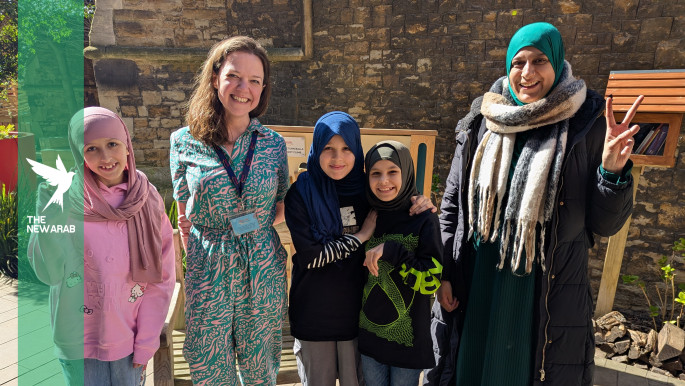
The worlds of the fictional sisters and the real-life skateboarding trio have since collided, with the Hull sisters attending a performance of the play themselves.
“Meeting them was like meeting these historical heroes,” Sara recalls. “They had this poise and optimism. They felt almost untouchable. I don’t know how to describe it.
“We were so nervous — we really wanted them to like it. Those three were the most important reviewers. They said that they loved it, and they felt honoured as well, because it was the first play they had seen, and it was about them,” she continues.
The play has become part of a wider chain of inspiration. Olympic skateboarder Sky Brown, who was just 12 when she competed for Great Britain at the 2020 Summer Olympics in Tokyo, inspired the real-life skateboarding trio. They, in turn, inspired Asif to write the play, and now children and adults alike may feel encouraged to try skateboarding or pursue something they previously thought was not for them.
Sara says she is now even considering joining a girls’ skating group herself.
“It’s just a matter of setting aside the time to do it,” she says.
For Asif, that sense of possibility sits at the heart of the play.
“There’s a lot in this play about these girls’ ambition and what they want to do, and that just because they are Muslim, nothing should hold them back,” he says.
“They’ve got a dream, so why not go for it? If a boy can have those dreams and go for those dreams, why can’t they?” he asks.
‘Sisters 360’ will be showing across various locations soon, with upcoming dates including 23 May 2026 at Warwick Arts Centre (Coventry), 24 May 2026 at Attenborough Arts Centre (Leicester), 27 May 2026 at Town Hall Theatre (Hartlepool), 29 May 2026 at Mercury Theatre (Colchester), 6 June 2026 at Norwich Theatre Stage Two (Norwich), and 27 June 2026 at Aberystwyth Arts Centre (Aberystwyth).
Shahla Omar is a freelance journalist based in London
Follow her on Instagram: @shahlatan