
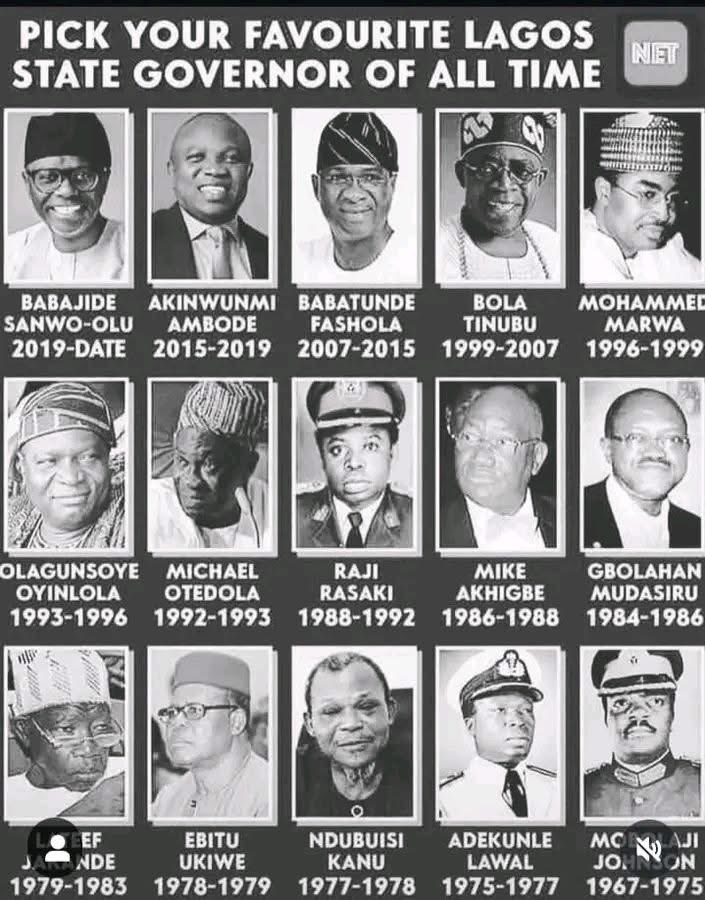
Lagos is a story of layered leadership — each era adding a brick to the city’s foundation. From military administrators to democratic governors, the transformation of Lagos into Africa’s leading megacity reflects continuity, vision, and resilience. In Yorùbá thought, legacy is often measured not merely by power held, but by the lasting impact left on the people and the land.
The journey began under the stewardship of Mobolaji Johnson (1967–1975), Lagos State’s first governor. His administration provided the structural foundation for the young state after its creation in 1967. Major infrastructure such as the Lagos Executive Development Board projects and the early planning framework that later shaped metropolitan Lagos took root during this period.
The Second Republic brought a defining era under Lateef Jakande (1979–1983), whose government became synonymous with people-centered development. Jakande’s low-cost housing estates in places like Jakande Estate (Ajah, Isolo, and others), massive expansion of public schools, and investments in public transportation and media infrastructure left an imprint that many Lagosians still reference today. His administration demonstrated that government could directly improve everyday life for ordinary citizens.
Decades later, democratic governance returned and Lagos entered a new phase of institutional and economic reform. Under Bola Ahmed Tinubu (1999–2007), Lagos undertook sweeping structural changes. Tinubu expanded the state’s internally generated revenue system, strengthened local governance structures, and laid the financial and administrative groundwork that allowed future administrations to execute large-scale projects.
Building on that framework, Babatunde Raji Fashola (2007–2015) focused heavily on urban renewal, road infrastructure, environmental reforms, and modernization of public institutions. His tenure is widely remembered for visible improvements in traffic management, judicial reforms, and urban planning.
The administration of Akinwunmi Ambode (2015–2019) emphasized infrastructural expansion, including road networks, security infrastructure, and modernization of transport corridors. Projects such as the Oshodi Transport Interchange symbolized attempts to reorganize key urban hubs.
Currently, Lagos continues its development trajectory under Babajide Sanwo-Olu (2019–present), whose government has pursued large-scale projects including the Lagos Rail Mass Transit (Blue Line and Red Line), coastal road developments, and technology-driven governance initiatives as part of the THEMES development agenda.
From a Yorùbá cultural perspective, legacy is often judged through the proverb: “Orúkọ rere sàn ju wúrà àti fàdákà lọ” — a good name is better than gold and silver. Leadership is remembered not only by monuments, but by how deeply it improves the lives of the people.
Many historians and Lagos residents often highlight three administrations for their enduring impact:
Mobolaji Johnson for laying the foundational governance structure of Lagos State.
Lateef Jakande for people-focused social infrastructure in housing and education.
Bola Tinubu for financial and institutional reforms that empowered modern Lagos.
Together, these eras represent foundation, social development, and structural economic reform — three pillars that continue to shape Lagos today.
But history remains a conversation, not a closed chapter.
.fb-background-color {
background: #ffffff !important;
}
.fb_iframe_widget_fluid_desktop iframe {
width: 100% !important;
}