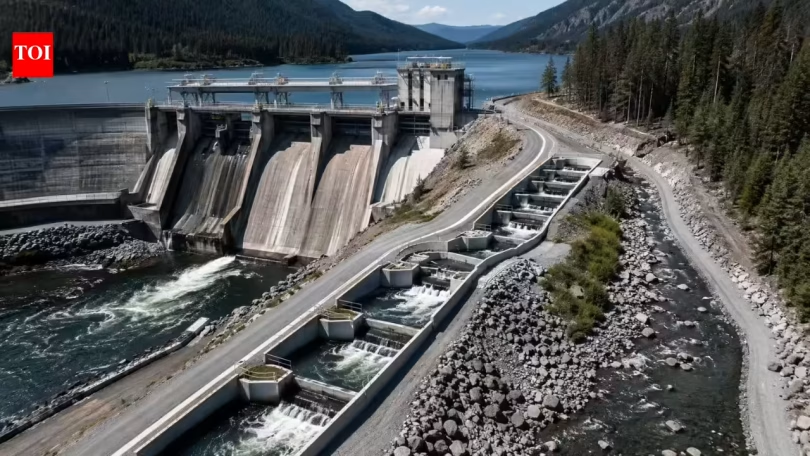
When Mud Mountain Dam was completed in 1948 along Washington State’s White River, its purpose was straightforward. The earthen structure was built to reduce flooding across downstream communities, protecting homes, businesses and farmland from damaging seasonal flows. Fish passage existed from the beginning, but it reflected the engineering standards of another era. As salmon populations declined and environmental protections strengthened over the following decades, the ageing system no longer matched the needs of native species. That gradual shift in priorities eventually led to one of the largest ecological infrastructure projects ever undertaken at a US flood-control dam, combining modern engineering with long-term efforts to restore fish migration while preserving the dam’s original role in protecting communities.
How Mud Mountain Dam protects 400,000 homes while helping salmon reach their spawning grounds
Mud Mountain Dam sits between Buckley and Tacoma in Washington State and has remained an important part of regional flood management for generations. According to the U.S. Army Corps of Engineers, Seattle District, the dam protects more than 400,000 homes and businesses across the White and Puyallup river valleys while continuing to operate as a flood-risk management structure.When construction was underway during the 1940s, engineers also developed a trap-and-haul fish passage system. Instead of allowing salmon to swim naturally through the dam, fish were captured below the structure, transported upstream and released so they could continue towards their spawning grounds. At the time, the arrangement met operational expectations and was designed to move roughly 20,000 fish each year.As migration patterns changed and conservation priorities developed, however, the original facility increasingly struggled to cope with modern demands.
Why Mud Mountain Dam’s old fish passage system could no longer handle salmon
The existing passage facility was never intended to handle the volumes that eventually arrived during some migration seasons. Reportedly, pink salmon runs in odd-numbered years could require the movement of more than 20,000 fish in a single day, far exceeding what the 1941-built infrastructure had originally been designed to accommodate.The challenge extended beyond sheer numbers. Several fish populations using the White River later received protection under the US Endangered Species Act, including Puget Sound Chinook salmon, Puget Sound steelhead and coastal bull trout. Those listings increased pressure to improve passage conditions while maintaining flood-control operations at the dam.By the early 2010s, federal agencies had examined how the project operated. Biological opinions issued by the National Oceanic and Atmospheric Administration (NOAA) Fisheries in 2014 and the US Fish and Wildlife Service in 2015 recommended substantial changes, with a completely new fish passage facility becoming the most significant proposal.
How the $112 million fish passage project became a reality
In March 2018, the U.S. Army Corps of Engineers, Seattle District announced that Kiewit Infrastructure West Company had been awarded a $112 million contract to construct what it described as the largest trap-and-haul fish passage facility in the United States.According to the Corps, construction planning placed considerable emphasis on delivering an operational system as quickly as possible because of the importance of improving conditions for protected fish species. Mobilisation was expected to begin during May 2018, with completion targeted for December 2020.The project drew on an unusually broad design effort. The Corps said more than 150 employees from three US Army Corps districts worked alongside two architecture and engineering firms, while organisations including NOAA Fisheries, the Muckleshoot Indian Tribe, Cascade Water Alliance, the Puyallup Indian Tribe and the Washington Department of Fish and Wildlife contributed throughout the planning process.
New fish passage facility can move up to 60,000 fish a day
The replacement facility represents a substantial increase in capacity rather than a simple refurbishment of the older system.According to the U.S. Army Corps of Engineers, the new infrastructure has been designed to move as many as 60,000 fish in a single day, allowing annual transfers of up to 1.2 million fish during years when pink salmon returns are especially large.The upgraded system is intended to transport both protected and non-protected species around Mud Mountain Dam. Besides ESA-listed Chinook salmon, steelhead and bull trout, the facility will also accommodate coho and pink salmon using the White River.Officials believe these improvements will help fish continue reaching upstream spawning and rearing habitat that has remained difficult to access through the ageing passage system.
How Mud Mountain Dam combines flood control with fish conservation
Although Mud Mountain Dam continues to serve its original flood-control purpose, the surrounding project now reflects a broader balance between public safety and environmental management.Officials worked with landowners, including the Muckleshoot Indian Tribe and Cascade Water Alliance, to secure easements needed before construction could begin. The Corps also acknowledged that projects of this scale inevitably face uncertainties ranging from labour availability and weather conditions to unexpected ground conditions.The investment illustrates how infrastructure built in the middle of the twentieth century can be adapted to meet twenty-first-century environmental standards. Rather than replacing the dam itself, engineers focused on modernising one of its supporting systems so that flood protection and fish conservation could continue alongside one another for decades to come.