
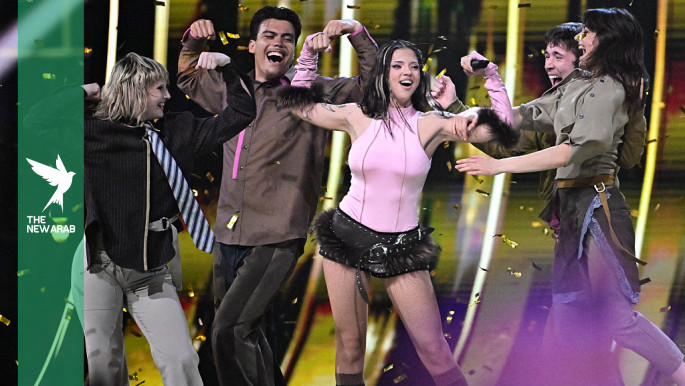
The Eurovision Song Contest’s final got underway in Vienna, overshadowed by the boycott of five nations over Gaza [GETTY]
Bulgaria wins the 70th Eurovision Song Contest on Saturday with the party anthem Bangaranga, beating 24 other countries with 516 points, while protests went underway over Israel’s participation in the contest over its war on Gaza.
Dara, who was declared the winner early Sunday, was not among the favourites ahead of the show but gained traction during Eurovision week with her high-energy and highly choreographed dancing on the catchy floor-filler “Bangaranga”. Israel finished in second place.
The Eurovision Song Contest’s final got underway in Vienna, overshadowed by the boycott of five nations over Gaza.
The garish and usually good-natured competition involving pop acts from countries across Europe and beyond, now in its 70th year, has been plunged into crisis by a dispute over Israel’s genocidal war on Gaza, which has killed over 72,000 Palestinians since October 2023.
The public broadcasters of heavyweights Spain, the Netherlands and Ireland, as well as Iceland and Slovenia, are not taking part in the protest at Israel’s participation.
“We will not be in Vienna, but we will do so with the conviction that we are on the right side of history,” Spanish Prime Minister Pedro Sanchez said on X on Friday.
Israel has alleged a global smear campaign against it.
Finland’s entry, “Liekinheitin,” or Flamethrower, a love song in Finnish featuring violinist Linda Lampenius and pop singer Pete Parkkonen on a burning set, is the favourite this year, followed by Australia’s “Eclipse”, a celestial-themed love ballad sung by national pop star Delta Goodrem.
They performed their routines without any mishaps.
Further down the bookmakers’ rankings was Israel’s Noam Bettan, whose trilingual love song Michelle was notable for courting less controversy than Israel’s entry last year, which was sung by a survivor of the 7 October attack.
Israeli public broadcaster KAN did, however, receive a formal warning from organisers a week ago over videos posted online in which Bettan courted votes too aggressively, after a similar controversy involving Israel last year.
KAN said it plays by the rules, and the videos were immediately taken down.
Smallest contest in two decades
The boycotts cut the number of contest entries to 35, the fewest since 2003, which will almost certainly reduce the global television viewership of an event that was estimated last year at 166 million people, more than the Super Bowl’s 128 million.
There will be 25 countries, including Israel, taking part in Saturday’s final. “We’re going through some challenging times at the moment,” Eurovision Song Contest director Martin Green told a press conference before the show.
Green urged viewers to set the world’s problems aside during the show, which started at 9 PM CET (1900 GMT).
“Just for a moment, well maybe 4-1/2 hours, maybe close the curtains to the outside world and dream that something else is possible,” he said.
Protests in Vienna
The mood in the Austrian capital has been tense and subdued, with protests over Israel’s participation drawing only small crowds. Police said they were bracing for protests on Saturday, but the anticipated “blockades and disruption attempts” did not materialise.
A protest near the venue drew just a few hundred people, a fraction of the 3,000 organisers had said they expected.
There was a brief disruption during Tuesday’s semi-final, when one protester chanted “Stop, stop the genocide” and “Free, free Palestine” within range of a television microphone.
He and three others “were removed from the arena for disruptive behaviour,” the European Broadcasting Union and Austrian national broadcaster ORF, the organiser and host, said in a joint statement. Bettan told Reuters he heard some booing as he took the stage on Tuesday.