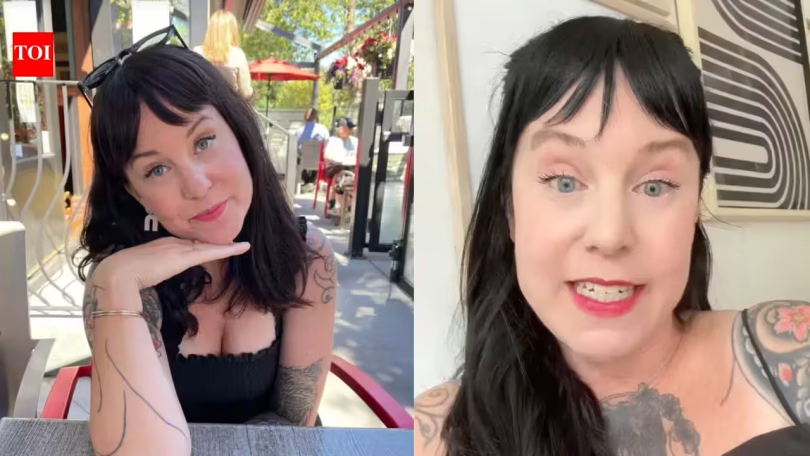
A Canadian social media influencer who documented her battle with early-onset Alzheimer’s has died through the country’s assisted dying programme after saying she could no longer cope with the effects of the disease.Rebecca Luna, 49, died on Saturday in British Columbia after accessing Medical Assistance in Dying (MAID), her eldest daughter Maya said on a fundraising page, according to The New York Post.She added that Luna died peacefully while surrounded by loved ones.Luna was diagnosed last year with young-onset Alzheimer’s, a form of dementia that affects people under the age of 65. She built an online following of more than 90,000 people by sharing her experiences of living with the disease.In a TikTok video posted shortly before her death, Luna said she had decided to bring forward the date of her assisted death because of her declining health.“Prior to the dates changing for the last year and a half has been legally and medically not my choice,” she said. “But for the last two weeks I’ve been making the decision. And it’s a hard decision to make, because I’m living in a body that doesn’t feel comfortable, safe, good, nothing.”She said waiting another two weeks had become too difficult and planned to spend her remaining time with family and close friends.“It’s been a hard 24 hours obviously. This is not what I wanted. I would have never chosen young onset Alzheimer’s for myself,” she said.Luna also reflected on her life before the diagnosis, speaking about experiences of abuse, neglect and addiction. She said overcoming those challenges had helped her remain sober despite her illness.“At the same time, the suffering has brought me to this place of ‘I really know who I am and I really know that I have a good f—king heart. I’m so loyal. I will fight for you till the end of time.'”She had previously said doctors estimated her life expectancy at between five and seven years following her diagnosis.Medical Assistance in Dying (MAID) is Canada’s legal framework allowing eligible adults to request medical help to end their lives. Introduced in 2016, it permits a doctor or nurse practitioner to administer or prescribe life-ending medication to patients who meet strict legal criteria and give informed consent.The law originally applied only to those whose natural death was reasonably foreseeable, but was expanded in 2021 to include some people with serious and incurable conditions even if death is not imminent.Further expansion is set for 2027, when eligibility is expected to extend to some individuals whose sole underlying condition is mental illness.
Canadian TikToker with early-onset Alzheimer's ends her life through assisted dying