“For profiteers, control of water is becoming the new petroleum,” he said.
Community activists and a representative of labour organisations have urged the Lagos State Government to invest in public water infrastructure rather than rely on private operators, warning that long-term concessions and prepaid meters could make water less affordable for low-income households.
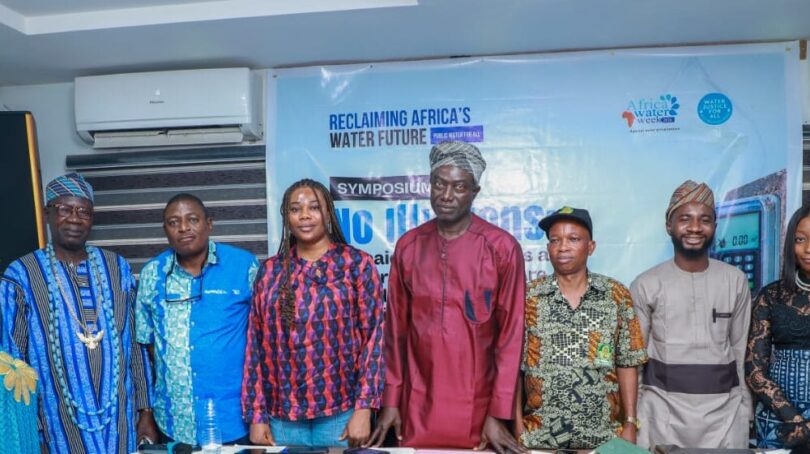
The event was themed “No Illusions: Prepaid Water Meters and Water Privatisation Are Failed Models for Lagos, Nigeria.”
Speakers included Akinbode Oluwafemi, CAPPA’s executive director; Zikora Ibeh, the organisation’s assistant executive director; Rufus Olusesan, national president of the Precision, Electrical and Related Equipment Senior Staff Association (PERESSA); Dagar Tolar of the Movement for Socialist Alternative; and Favour John, founder and executive director of the Sustainable Futures Development Initiative (SUFDI).
Mr Oluwafemi warned that private-sector participation did not guarantee better services and could put water beyond the reach of poorer households.
“For profiteers, control of water is becoming the new petroleum,” he said.
He argued that access to water for drinking, cooking, washing and basic hygiene should not depend solely on a household’s ability to pay.
He argued that access to water for drinking, cooking, washing and basic hygiene should not depend solely on a household’s ability to pay.
Mr Oluwafemi called on the Lagos State Government to publish the terms of its proposed water concessions, including the financial obligations, tariff arrangements and protections available to investors.
According to information presented by CAPPA, the Lagos Water Corporation (LWC) has announced a framework for standardised 20-year concessions, with cost-reflective tariffs subject to periodic reviews, foreign-exchange protections for investors and a five per cent royalty structure.
The proposed concessions cover seven water facilities in Lekki, Akilo, Victoria Island Annex, Magodo, Abesan, Alexander and Apapa.
Speaking at the event, Ms Ibeh said the corporation reported receiving 23 bids across four project lots in May but had not identified preferred bidders or published the full proposed agreements.
CAPPA said it had requested the identities of bidders, evaluation criteria, feasibility studies and award decisions in March 2026.
The group also questioned the state government’s April 2025 agreement with Belstar Capital and ENKA for water infrastructure rehabilitation and expansion. It raised concerns about the selection process, financing obligations and possible effects on tariffs.
Ms Ibeh cited a one-year memorandum of understanding signed in 2026 with China Harbour Engineering Company and Naston Engineering Nigeria Limited for a proposed water infrastructure programme within the Lekki Concession Area.
The planned works include transmission infrastructure beneath the Lagos Lagoon, distribution networks, metering and household connections.
The Lagos State Government had presented public-private partnerships as a way to attract investment, rehabilitate water infrastructure and expand access to reliable supply.
At a stakeholder engagement in August 2025, the Lagos Water Corporation said the initiative was intended to bring together public authorities, investors and development partners to improve service delivery.
Mr Tolar said the government should address the condition of existing water infrastructure rather than rely on private-sector participation to resolve the state’s water shortages.
He stated that Lagos had major waterworks and 48 mini and micro waterworks, but their combined output was inadequate to meet demand.
Citing figures he presented at the symposium, Mr Tolar put the combined production capacity of the facilities, including the Adiyan waterworks serving Lagos and Ogun states, at about 200 million gallons daily. He estimated that Lagos needed at least 500 million gallons a day.
The figures and operational rates he cited could not be independently established from the information provided at the event.
Mr Tolar called for a comprehensive “Water for All” plan that would include rehabilitating existing facilities, building additional waterworks and using modern technology to increase production.
He said the plan should account for future population growth. He also questioned how much successive administrations had invested in water infrastructure since Nigeria returned to civilian rule in 1999.
“No form or version of privatisation will fix the water problem in Lagos or Nigeria,” he said.
He cited electricity privatisation and private-sector participation in waste collection as examples of reforms he believed had failed to deliver the expected benefits.
Mr John said research into community water infrastructure in Lagos showed that residents often had to provide and maintain facilities that should serve the public.
Presenting findings from a research project on strengthening resilient public water services, he said many communities relied on water points donated by councillors, religious institutions and individuals because government facilities were unavailable or poorly maintained.
He explained that community development associations (CDAs) sometimes pooled money to buy water from tankers, pay electricity bills and repair pumps.
“In your community, for example, there’s no public water. There’s a situation whereby the CDA even organises to fund a water tanker sometimes,” he said.