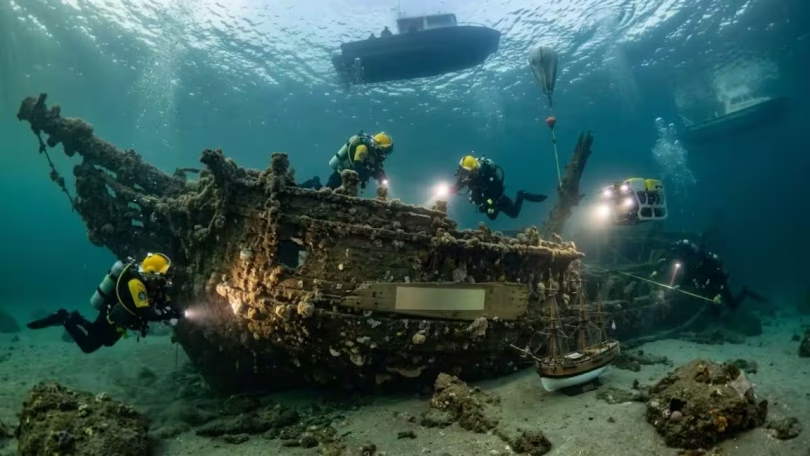
For more than 250 years, nobody knew exactly where Captain James Cook’s famous ship, HM Bark Endeavour, had ended its journey. The vessel is famous for carrying Cook on his historic Pacific voyage between 1768 and 1771. After returning to England, however, the ship quietly entered a new chapter of its life, serving as a transport vessel before being renamed Lord Sandwich. In 1778, during the American War of Independence, it was deliberately sunk in Newport Harbor, Rhode Island, as part of a defensive blockade. Now, after a 26-year archaeological project led by the Australian National Maritime Museum and its research partners’ final report has confirmed that shipwreck site RI 2394 is the remains of Lord Sandwich, formerly HM Bark Endeavour. The conclusion is based on years of historical research, underwater surveys and detailed archaeological evidence.
How researchers solved the mystery of HM Bark Endeavour
The Australian National Maritime Museum’s Locating HM Bark Endeavour final report brings together the results of more than 26 years of archival and archaeological research. The report concludes that shipwreck site RI 2394, in Newport Harbor, Rhode Island, is the remains of Lord Sandwich, the ship once known as HM Bark Endeavour.Researchers reached this conclusion using what they describe as a “preponderance of evidence” approach. Instead of relying on a single discovery, they compared many different pieces of historical and archaeological evidence. Together, these matched the known history and design of Endeavour.The report also explains what happened after the famous voyage ended. Once Endeavour returned to England in 1771, it was used as a naval transport before being sold to private owners. The ship was renamed Lord Sandwich and carried British troops during the American War of Independence. By 1778, it was in poor condition and was being used as a prison ship in Newport Harbor. When American and French forces attacked the British-held town, Lord Sandwich was one of 13 ships deliberately sunk to block the harbor entrance. The ship was never recovered and remained where it sank.
Archaeologists spent 26 years searching for HM Bark Endeavour
The search began after Australian historians Mike Connell and Des Liddy used historical records in 1998 to trace Endeavour’s final fate. Their work helped show that the famous ship had been scuttled in Newport Harbor in 1778.In 1999, the Australian National Maritime Museum began working with the Rhode Island Marine Archaeology Project (RIMAP) to locate the wreck. Between 1999 and 2004, research teams carried out seafloor surveys, underwater dives and scientific studies of timber, stone, coal and sediment from several 18th-century shipwrecks. None of the sites examined during those early expeditions matched the evidence needed to identify Lord Sandwich.The project restarted in 2015. A major breakthrough came in 2016, when new archival research by Dr Nigel Erskine narrowed the search to a smaller part of Newport Harbor, just north of Goat Island. This limited study area contained five of the thirteen transport ships sunk in 1778. Archaeologists investigated all five wrecks between 2017 and 2021.
Why researchers are confident RI 2394 is Captain Cook’s famous ship
Further excavation between 2019 and 2021 allowed archaeologists to examine RI 2394 in much greater detail. They uncovered important parts of the ship, including the keel, keelson, bilge pump well and bow structure.Researchers found that the size of many of the ship’s structural timbers closely matched measurements recorded when the Royal Navy surveyed HM Bark Endeavour in 1768.The site contained several other important clues. Archaeologists found a large stone ballast pile, exposed timber frames, four iron cannons and a lead scupper. They also identified an unusual joint connecting the stempost and keel, a feature that closely matched the ship’s known construction. Back in 1999, and again in 2019, the Australian National Maritime Museum and RIMAP agreed on a list of archaeological criteria that would need to be met before the wreck could be identified as Lord Sandwich. According to the final report, enough of those criteria have now been satisfied to positively identify RI 2394 as the remains of Lord Sandwich, formerly HM Bark Endeavour.The ship holds historical and cultural importance for Australia, Aotearoa New Zealand, England, the United States and many First Nations peoples across the Pacific.