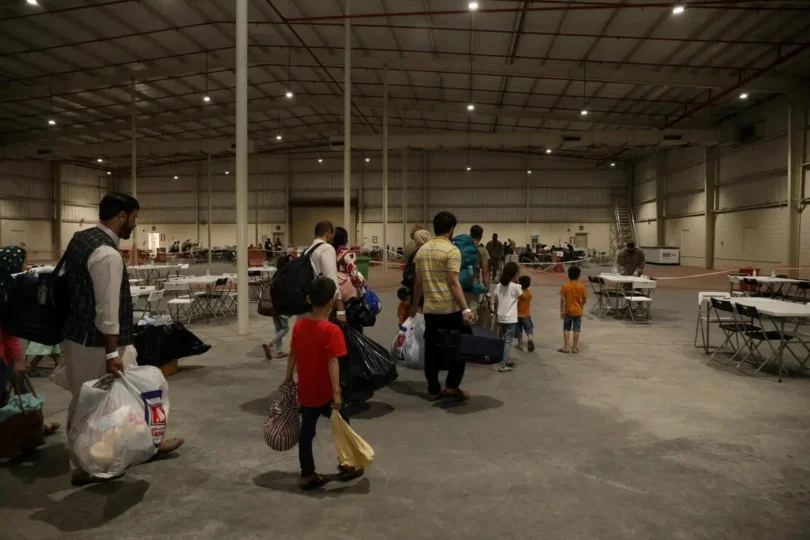
DOHA – Stuck for over a year behind a perimeter fence on a defunct American base on Doha’s edge, 1,100 former Afghan allies of US forces and their families have escaped Afghanistan with their lives only to find themselves trapped in uncertainty.
“We are all living in extreme anxiety, we feel that we are in limbo, not only me and my family, but other people here,” Mr Rasouly, a former interpreter for US forces in Afghanistan, and now a 19-month resident at Camp As Sayliyah (CAS) in Qatar, told AFP by phone.
Set in a hinterland of desert scrub and truck depots on the outskirts of the Qatari capital, CAS has served as a holding site for Afghans going through the base for processing in the hope of resettling in America since the 2021 US withdrawal from Afghanistan.
The Afghans on the base, who were evacuated for their ties to the US, fear reprisals by the Taliban authorities should they return.
But processing halted after US President Donald Trump paused refugee admissions in January 2025 and in November suspended all Afghan immigration cases.
“Returning to Afghanistan is not safe for us, and we do not have any clear alternative option,” said Mr Rasouly, 36.
Like other Afghans who spoke to AFP either by messaging app or over the phone from CAS, Mr Rasouly asked to be identified by a pseudonym for fear of endangering family still in Afghanistan or prejudicing resettlement cases in the US or elsewhere.
Now campaigners say Washington is preparing to force the 1,100 inhabitants of the camp to choose between returning to Afghanistan or resettling in the conflict-riven Democratic Republic of Congo.
AfghanEvac, a group supporting the Afghan allies, confirmed the proposal was under consideration by Mr Trump’s administration after it was first reported in US media.
In an open letter shared by the campaign group on April 22, the Afghan CAS residents rejected the proposal.
“We have been in enough war. We cannot take our children into another one. We also cannot return to Afghanistan. The Taliban will kill many of us for what we did for the United States,” the letter read.
Ms Shabnam, whose father worked with US and allied forces in western Afghanistan arrived at CAS in January 2025.
She said camp residents had received no official information about the DR Congo resettlement but the news had caused “uncertainty and stress”.
“Our concern is safety… We are asking for a better and safer country where we can rebuild our lives,” said Ms Shabnam, who with her now three-year-old son has never left the camp following their arrival in Qatar.
Mr Mahmoud, 38, who worked with US and international forces in Afghanistan and has lived on CAS with his family for over a year, told AFP “different rumours have circulated,” whether about resettlement or the camp’s closure.
“Rumours such as sending people to the Democratic Republic of the Congo… are being spread to increase psychological pressure,” he said.
The State Department has declined to confirm DR Congo as a destination but said relocating camp residents to a third country would offer safety and a chance to start a new life.
DR Congo officials had no comment when asked by AFP about reported plans to send the Afghans there.
In a statement responding to the US plans, Afghanistan’s foreign ministry said nationals abroad could return in “confidence and peace of mind”, insisting there was no safety threat.
The United Nations has reported that in Afghanistan between Nov 6 and Jan 25, there were 29 arbitrary arrests and detentions and six instances of torture and ill-treatment of former officials and former security forces members, including those who returned to Afghanistan.
When missiles streaked the skies and blasts reverberated across Doha in March and April, during Iranian attacks on Gulf neighbours, Tehran repeatedly targeted US bases, raising fears among Afghan residents at CAS although the base is no longer active.
Ms Shabnam described how inhabitants “witnessed interceptions in the sky and heard loud explosions” from the exposed camp.
“In one incident, debris nearly landed inside the camp and struck one of our neighbour’s rooms,” she said.
Living in cramped, windowless containers and only able to leave for serious medical emergencies, she said inhabitants “felt helpless” during the Iranian attacks.
“It reminded us of Afghanistan, the sounds of explosions, the fear of sudden attacks and the uncertainty,” she said.
“Many of us came here to escape conflict… it felt like we were reliving those same fears.”
The State Department confirmed in February that Washington had offered CAS inhabitants cash to return to Afghanistan, with roughly 150 individuals at the base taking the payments.
AfghanEvac and residents at the camp said authorities offer US$4,500 (S$5,739) per main applicant and US$1,200 per dependent to return.
Mr Rasouly, who moved from house to house in fear for his life in the three years before his evacuation, said “security is not something that can be negotiated” for money.
“If they pay me US$50,000 for me and my family, I cannot go to Afghanistan because my life is in danger,” he added. AFP