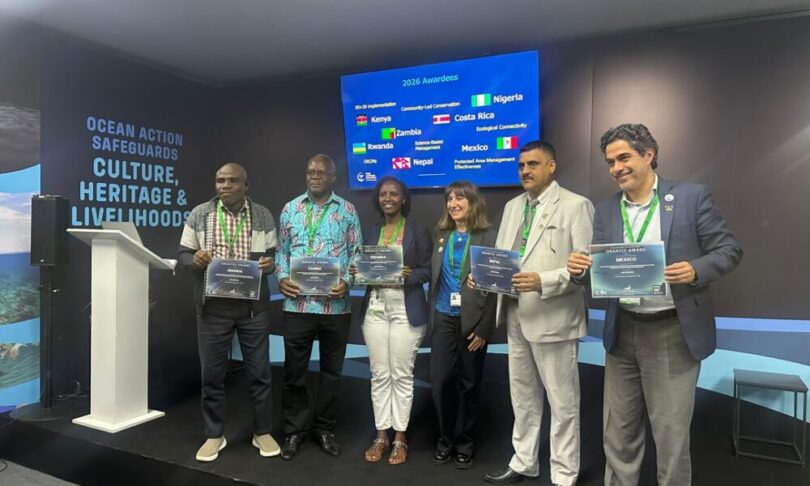
Nigeria and six other countries have won $50,000 seed grants each to accelerate biodiversity conservation efforts and advance their respective 30×30 targets under the High Ambition Coalition for Nature and People.
Nigeria and six other countries under the High Ambition Coalition (HAC) for Nature and People have won $50,000 seed grants each under the Rapid Deployment Mechanism (RDM) to execute projects aimed at accelerating progress towards their 30×30 conservation targets.
The beneficiary countries are Costa Rica, Mexico, Nigeria, Nepal, Zambia, Rwanda, and Kenya, each receiving a certificate confirming a $50,000 grant for its respective project.
Nigeria received the grant for its project proposal titled “Strengthening Nigeria’s 30×30 Progress through Ecological Connectivity, Terrestrial and Marine OECMs, and Protected Area Management Effectiveness”.
PREMIUM TIMES gathered that the project will be implemented by the Nigerian Conservation Foundation (NCF).
Costa Rica’s project, titled “From 30×30 Coverage to Effective Conservation: Developing an Acceptable Visitation Load Tool for Cocos Island National Park”, seeks to improve conservation management at the national park.
Mexico received the grant for its project, “Strengthening Mexico’s Marine 30×30 through Underwater Acoustic Baselines and Evidence-Based Protected Area Management”.
Nepal’s project, “Operationalising Nepal’s National OECM Guideline: Recognising New OECMs to Advance the 30×30 Target”, focuses on recognising other effective area-based conservation measures (OECMs) to advance its conservation target.
Zambia’s project is titled “Strengthening Zambia’s 30×30 Progress through the Busanga Swamps Wetland Inventory and Management Effectiveness Assessment”.
Rwanda’s project, “Advancing Rwanda’s 30×30 Commitments through Community-Based Terrestrial OECMs and Ecological Connectivity”, seeks to strengthen community-based conservation and ecological connectivity.
Kenya’s project, “Advancing Kenya’s Marine 30×30 through Community-Led OECMs, Indigenous and Local Knowledge, and Effective Marine Protected Area Management”, focuses on marine conservation.
Nigeria’s award was presented to Sikeade Egbuwalo, the country’s focal point to the Convention on Biological Diversity.
Representatives of the other beneficiary countries also took turns receiving their awards, except Kenya, whose representative was unavoidably absent.
In her remarks, Mrs Egbuwalo appreciated the HAC secretariat and the RDM for the recognition and support.
“This support will not only help us to achieve the 30×30 targets but also help us to address the issue of fragmented habitat, which has been a big issue in Nigeria,” she said.
The RDM is an initiative of the HAC for Nature and People designed to address funding gaps by providing small-scale financing to catalyse broader conservation impacts.
“By providing fast, flexible seed grants, the RDM bridges the gap between early-stage requirements and larger funding sources, helping countries accelerate actions to achieve their 30×30 goals,” the organisers said.
During the gala, some recipients of the 2025 RDM grants shared their experiences and highlighted the funding’s importance to biodiversity conservation efforts in their respective countries.
In his closing remarks, Labaran Ahmed, Nigeria’s Chief Scientific Officer at the Federal Department of Forestry and HAC for Nature and People Co-Chair, expressed the Nigerian government’s appreciation to the HAC secretariat for its deliberations.
“We look forward to seeing your projects move forward and contribute to your country’s effort to achieve the 30×30 targets,” he said.
In his reaction to the award, Director-General of the Nigerian Conservation Foundation (NCF), Joseph Onoja, said the award represents a significant milestone in Nigeria’s conservation journey and reinforces NCF’s leadership in advancing biodiversity conservation, ecological connectivity, and sustainable natural resource management.
“Working in collaboration with the Federal Ministry of Environment, NCF will provide scientific and technical support to the Federal Government of Nigeria in advancing the country’s commitment to the global 30×30 target of conserving at least 30% of land and sea by 2030,” he said.
Mr Onoja explained that the project will identify, map, and profile priority terrestrial and marine Other Effective Area-based Conservation Measures (OECMs); assess protected area management effectiveness; and develop a national Management Effectiveness Framework.
These interventions, he said, will generate critical evidence and recommendations to strengthen Nigeria’s protected and conserved area network, improve conservation governance, and support the implementation of Target 3 of the Kunming-Montreal Global Biodiversity Framework.
He said the award underscores the importance of strategic partnerships between government and conservation organisations in translating global biodiversity commitments into measurable national outcomes.
“NCF remains committed to working closely with the Federal Ministry of Environment, relevant government agencies, research institutions, conservation partners, and local communities to strengthen ecological connectivity, improve protected area management, and advance Nigeria’s 30×30 ambition,” he said.
Mr Onoja said the initiative represents an important investment in Nigeria’s ecological future, safeguarding biodiversity, strengthening ecosystem resilience, and ensuring that nature continues to support the wellbeing and livelihoods of present and future generations.